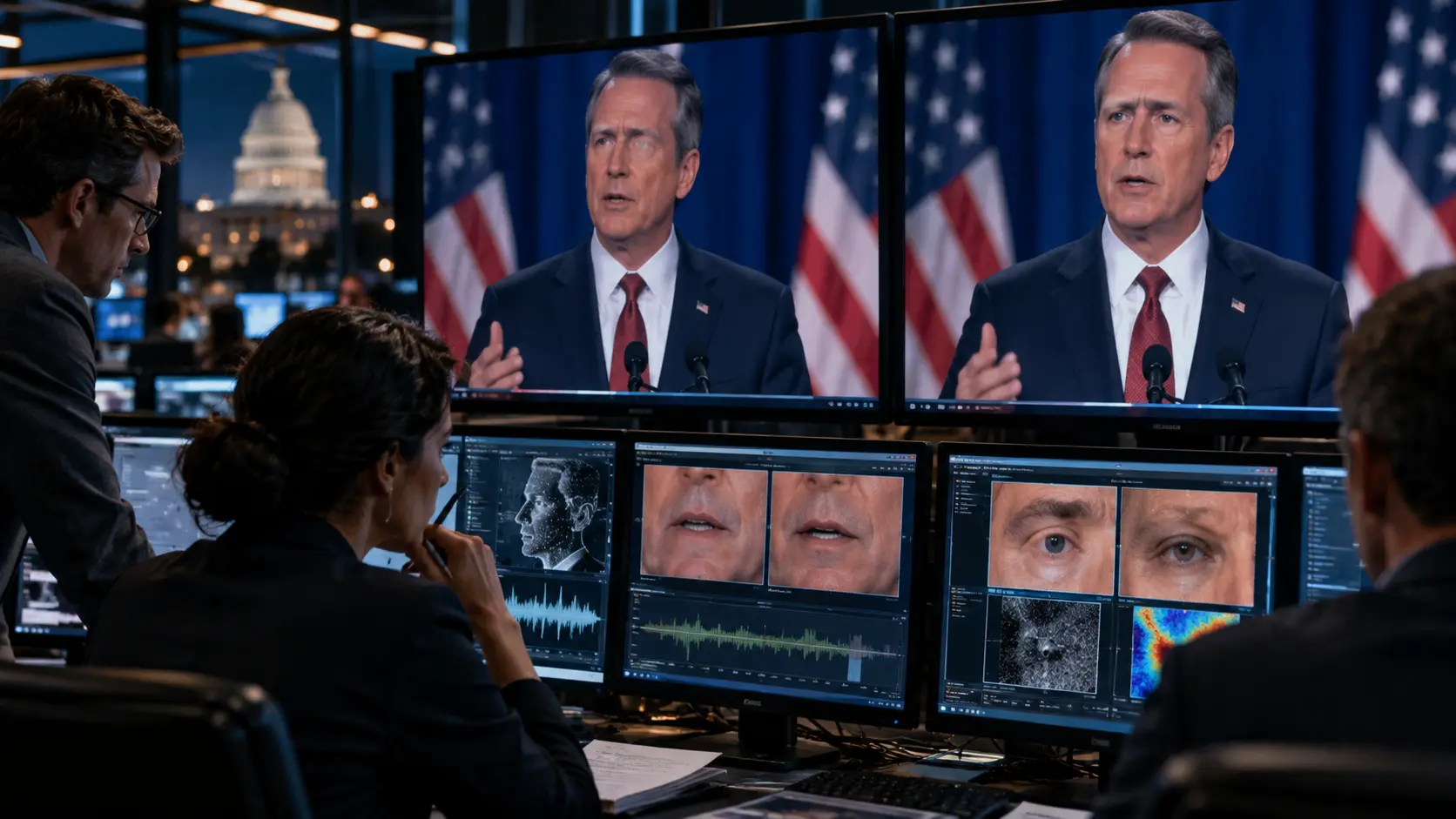
AI deepfakes in politics are synthetic or manipulated videos, images, and audio recordings that use artificial intelligence to make people appear to say or do things that never happened. The technology can imitate faces, voices, gestures, and speaking styles with increasing realism, making it possible to create convincing political content without the participation of the person being depicted. Deepfakes are part of a broader category of synthetic media, which includes legitimate applications in entertainment, education, accessibility, and creative production. In politics, however, the same tools can be used to fabricate statements, manufacture false evidence, damage reputations, and confuse voters about what is real.
Deepfakes are usually produced with machine-learning systems trained on examples of a person's appearance or voice. A system may analyze photographs, video footage, or audio recordings to identify patterns associated with facial movement, pronunciation, tone, and other characteristics. Generative models can then use those patterns to create new content that resembles the original person. Some systems replace one face with another, while others generate entirely synthetic images or imitate a voice from a relatively small sample. The technical methods vary, but the political effect can be similar: digital media can be created that appear to document an event that never occurred.
Manipulated political media existed long before artificial intelligence. Photographs have been altered, quotations have been fabricated, recordings have been selectively edited, and misleading material has been circulated throughout the history of mass communication. What AI changes is the speed, cost, scale, and accessibility of producing realistic synthetic content. Tasks that once required specialized visual-effects teams can increasingly be performed with widely available software and relatively modest technical knowledge.
Election campaigns are an obvious area of concern. A fabricated video could appear to show a candidate making an offensive statement, accepting a bribe, admitting to a crime, or announcing a policy that the candidate never supported. A synthetic audio recording could imitate a campaign official giving secret instructions or a public figure endorsing an opponent. Even if the falsehood is exposed later, the material may spread rapidly enough to influence discussion during a critical period.
Timing can make political deepfakes especially disruptive. False material released shortly before an election, debate, or major political event may leave journalists, campaigns, and election officials with little time to verify it. A correction issued after the public has already encountered the content may not reach everyone who saw the original claim. In highly polarized environments, some people may continue believing the fabrication even after reliable evidence contradicts it.
Deepfakes can also be used for propaganda outside formal election campaigns. Governments, political movements, influence operations, extremist groups, or private actors may create synthetic media to portray opponents as corrupt, incompetent, violent, or disloyal. Fabricated content can be designed to reinforce existing fears or prejudices because misinformation is often more persuasive when it fits beliefs that an audience already holds.
The ability to manufacture apparent evidence is particularly serious. Video and audio have traditionally carried strong persuasive force because people tend to regard recordings as more direct evidence than written claims. A document can be dismissed as forged, but seeing and hearing a public figure apparently speak can create an immediate sense of authenticity. Deepfakes weaken that assumption by making it possible to produce convincing audiovisual evidence without the underlying event.
This creates problems not only for voters but also for journalists, courts, investigators, and public institutions. A recording that once might have been treated as strong evidence may now require additional verification. Investigators may need to examine metadata, source files, recording history, technical inconsistencies, and independent evidence before determining whether content is authentic. The existence of synthetic media therefore increases the cost and complexity of establishing facts.
Reputational damage can occur even when a deepfake is quickly disproved. A fabricated video may generate headlines, social media discussion, and public suspicion before verification is complete. Political opponents may repeat the allegation, and fragments of the false story can continue circulating long after the original media have been debunked. The target is then forced to spend time denying an event that never occurred.
Deepfakes can be particularly harmful when they exploit socially sensitive issues. Fabricated recordings involving corruption, sexual misconduct, national security, racial or religious hostility, or political violence can generate intense emotional reactions. Content designed to provoke anger or fear may spread rapidly because users are more likely to share dramatic material before checking its origin.
However, the political threat posed by deepfakes should not be exaggerated into the idea that every convincing fake will automatically change an election. Voters do not passively accept everything they encounter. Political identity, source credibility, media literacy, prior beliefs, and competing information all affect how people interpret synthetic content. Many deepfakes are detected quickly, and poor-quality fabrications can fail to persuade anyone beyond audiences already inclined to believe them.
The broader danger may lie in uncertainty rather than direct persuasion. When people know that realistic media can be fabricated, they may become less confident in authentic recordings as well. This creates what is sometimes called the liar's dividend: a person confronted with genuine evidence can claim that the material was generated or altered by artificial intelligence. The mere existence of deepfake technology therefore provides a new defense against real evidence.
This problem can be politically powerful. Imagine that an authentic recording shows a politician making an embarrassing statement. Instead of disputing what was said, the politician might simply claim that the recording is synthetic. Supporters who already distrust the media or opposing institutions may accept that explanation. Deepfakes thus create two forms of risk at once: fake evidence can be presented as real, and real evidence can be dismissed as fake.
The second problem may eventually be as important as the first because democratic politics depends heavily on shared methods for establishing basic facts. Political disagreement is normal and unavoidable, but disagreement becomes more difficult to manage when citizens no longer trust photographs, recordings, documents, journalists, or public institutions. If every inconvenient piece of evidence can be dismissed as manipulated, accountability becomes harder to enforce.
Social media intensifies the problem because synthetic content can circulate faster than verification. A short manipulated video may be copied across numerous accounts and platforms within minutes. Users may encounter the media without its original source, making it difficult to know where it came from or who created it. Reposted clips may also lose contextual information that would otherwise help viewers assess authenticity.
Recommendation systems can contribute to distribution when dramatic content attracts substantial engagement. Platforms do not need to identify a deepfake as politically useful for it to spread. If users watch, comment on, or share the material, ranking systems may interpret that behavior as evidence of interest. A fabrication can therefore gain visibility through the same mechanisms that promote legitimate breaking news or popular entertainment.
Detection technology can help but is not a complete solution. Researchers and companies develop tools that look for signs of manipulation, including inconsistencies in images, audio patterns, metadata, or generation techniques. Yet detection is an ongoing technical contest. As synthetic media improve, indicators used by one detection system may become less reliable. A tool that performs well on known generation methods may struggle with new ones.
Authenticity systems offer another approach. Instead of trying only to detect fakes after they appear, media organizations and technology companies can attach information showing where legitimate content originated and how it was edited. Cryptographic signatures and content provenance systems can help establish a verifiable history for photographs, videos, and audio. These mechanisms cannot prove that every unsigned file is fake, but they can make authentic material easier to verify.
News organizations also play an important role. Rapid verification procedures can reduce the period during which fabricated political media circulate without challenge. Journalists can compare recordings with original sources, contact the people involved, inspect contextual evidence, and consult technical specialists when necessary. Clear reporting is particularly important because announcing that a video is “possibly fake” without sufficient evidence can itself create unnecessary doubt.
Political campaigns need similar procedures. Staff may need to monitor for impersonation, preserve authentic recordings, and respond quickly when manipulated media appear. Campaigns can also reduce confusion by publishing original versions of speeches and events through verified channels. Maintaining reliable archives makes it easier for journalists and citizens to compare questionable clips with authentic material.
Platforms face difficult moderation decisions because not every synthetic image or video is deceptive. Satire, parody, artistic expression, and obvious fictional content can use the same technology without attempting to mislead anyone. A humorous video placing a politician in an impossible situation is different from a fabricated recording presented as genuine evidence. Effective rules therefore need to consider context and intent rather than treating all AI-generated political media as identical.
Labeling can be useful when synthetic content is not inherently prohibited but viewers may misunderstand its origin. Clear notices indicating that media have been generated or substantially altered can help users evaluate what they are seeing. Labels, however, work only when platforms can reliably identify synthetic content and when viewers notice and understand the warning.
Laws addressing political deepfakes also face difficult trade-offs. Governments have legitimate reasons to prevent fraud, impersonation, voter deception, and malicious interference in elections. At the same time, political speech receives strong protection in many democratic systems, and broad restrictions on manipulated media could affect satire, criticism, or artistic expression. Regulations therefore work best when they focus narrowly on deceptive conduct, harmful impersonation, disclosure, and clearly defined electoral risks.
Education and media literacy remain important because technical protections will never identify every fabricated recording. Citizens can learn to check the source of surprising material, look for independent confirmation, examine whether reputable organizations have verified it, and remain cautious about emotionally provocative clips that appear immediately before important political events. Skepticism is useful when it encourages verification, but excessive skepticism can become equally harmful if it leads people to reject every form of evidence.
This balance is one of the central challenges created by AI deepfakes in politics. Democracies need citizens who are careful enough not to believe every convincing recording, but confident enough in reliable institutions and verification methods to accept authentic evidence. A political information system cannot function well if people are either completely credulous or permanently suspicious.
Deepfakes ultimately threaten democracy less because computers can create fake faces than because political systems depend on trust. Elections, journalism, courts, and public debate require some shared basis for determining whether events occurred and whether evidence is genuine. Synthetic media place additional pressure on that foundation by making fabrication easier while also making denial more plausible.
The most effective response combines technical verification, clear platform policies, responsible journalism, targeted regulation, rapid institutional communication, and public understanding of synthetic media. Artificial intelligence has weakened the old assumption that seeing or hearing something is sufficient proof that it happened. Democratic societies therefore need stronger methods for establishing authenticity without abandoning the possibility of trusting evidence altogether.
