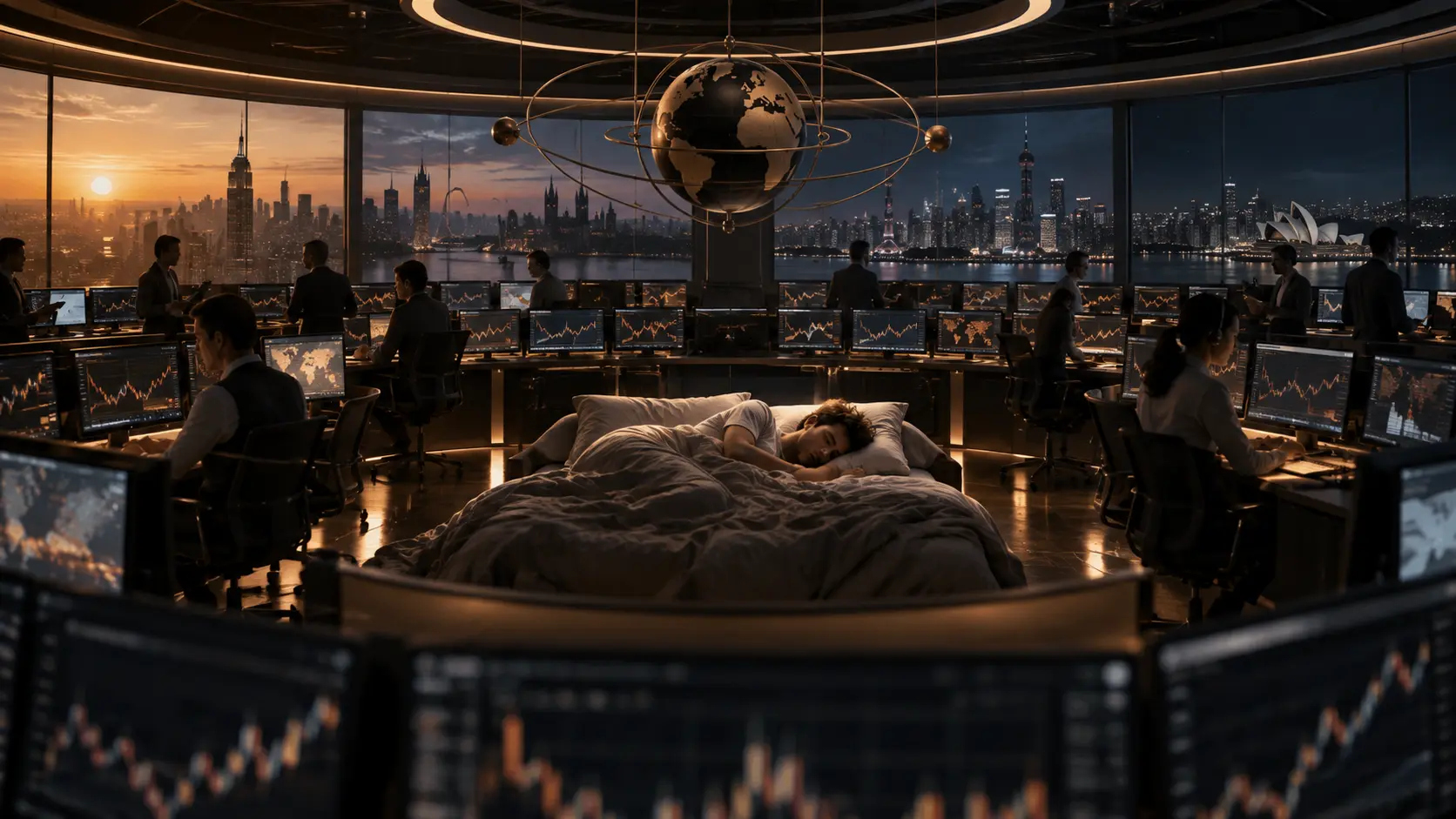
Crypto markets are often praised for being open continuously. Bitcoin and many other cryptoassets can be traded at any hour, on weekends, and during holidays. There is no universal closing bell that tells the market to stop until the next morning. That makes access unusually flexible, but it also creates a problem that technology cannot solve: markets may operate without sleep, but the people responsible for money, risk, security, and decision-making cannot.
In a traditional market with defined trading sessions, the closing bell creates a natural interruption. Prices may continue to matter indirectly after hours, and some assets have extended trading, but the primary session still establishes a rhythm. Traders know when the main market closes, organizations can organize staffing around that schedule, and many decisions can be postponed until the next session. Crypto removes much of that temporal structure. A position can move significantly while its owner is sleeping, having dinner, traveling, or spending a holiday away from a screen.
This does not mean investors should remain awake to monitor their portfolios. In fact, attempting to imitate a market that operates continuously can create its own risks. Human attention is limited, and sleep deprivation weakens judgment, concentration, and emotional control. A trader who checks prices throughout the night may technically be more informed about every movement while becoming less capable of making good decisions about them. Continuous access can therefore turn a technological advantage into a behavioral disadvantage.
The problem is especially visible during periods of high volatility. A cryptoasset may fall sharply at three in the morning in the investor's time zone. Leveraged positions can be liquidated automatically. Stop orders may execute. News can spread globally, and other participants can react immediately. By the time the investor wakes, the market may have moved through several stages of panic and recovery. There is no requirement that important events occur during convenient working hours.
For an unleveraged long-term holder, this may be uncomfortable without necessarily being operationally critical. If the investment strategy does not require reactions to short-term price changes, sleeping through an overnight movement may make little practical difference. For a leveraged trader, market maker, exchange, fund, or company managing large exposures, however, continuous markets create a much more serious operational challenge. Positions can reach risk limits whether employees are awake or not.
Automation becomes essential partly for this reason. Trading systems can monitor prices, execute predefined orders, reduce positions, rebalance portfolios, and issue alerts without requiring a person to watch every tick. Exchanges use automated liquidation engines, market makers continuously update quotations through algorithms, and professional risk systems monitor exposures around the clock. A continuously operating market gradually pushes important functions away from purely manual decision-making.
Automation does not eliminate human responsibility. It changes where that responsibility is exercised. Instead of making every decision when a market event occurs, participants increasingly need to decide in advance what should happen under different conditions. How much can a position lose? At what price should exposure be reduced? How much collateral should remain available? What happens if an exchange stops responding? Which employee is contacted if an automated system detects an abnormal event? The quality of preparation becomes as important as reaction speed.
This distinction is useful for individual investors as well. Someone who believes a position must be watched constantly may not actually have a monitoring problem; they may have a position-sizing or risk-management problem. If an ordinary overnight price movement would create an intolerable financial consequence, the exposure may require reconsideration. No amount of vigilance changes the fact that a person eventually needs to sleep.
Leverage makes this problem more severe because it converts price volatility into time-sensitive solvency risk. An investor who owns BTC outright can generally continue holding through a sudden decline if they choose. A leveraged trader may not have that option. If collateral becomes insufficient, the position can be liquidated automatically before the trader wakes. In a 24-hour market, there is no guarantee that a human will be available to add collateral or close the position manually before the system acts.
This is one reason continuous markets and leverage form a particularly demanding combination. A leveraged position can require attention at precisely the hours when attention is least available. Traders sometimes respond by setting alerts that wake them when prices reach particular levels, but a lifestyle built around repeated overnight interruptions is difficult to sustain. Professional organizations solve the problem through staffing, automation, and risk limits rather than expecting one individual to remain permanently alert.
Institutions face the same human constraint on a larger scale. A global crypto exchange cannot simply send everyone home and stop monitoring systems for the night. It needs technical teams, security personnel, risk controls, customer support procedures, and incident-response capabilities that reflect continuous operation. This often requires shifts, geographically distributed teams, automated monitoring, and formal escalation procedures.
The distinction between a 24-hour market and 24-hour infrastructure becomes important here. Trading may continue continuously, but many systems surrounding it do not. Banks have operational schedules. Some payment and settlement networks function differently on weekends and holidays. Legal and compliance teams may have reduced staffing outside business hours. Senior executives responsible for unusual decisions are not always immediately available. A crypto company must therefore operate inside two different clocks: the continuous clock of digital-asset markets and the more traditional calendar of the institutions around them.
This mismatch can become dangerous during a crisis. Imagine a large market movement on a Sunday. Crypto exchanges continue trading, but certain banking channels may be less accessible and some institutional counterparties may have reduced operations. A trading firm that needs additional capital on an exchange may discover that moving fiat money is harder than moving cryptoassets or stablecoins. The market remains open while parts of the financial infrastructure needed to respond are comparatively slow.
Liquidity can also change according to the human calendar even though the market never closes. Weekends, holidays, and certain hours may have fewer active traders or less market-making capacity. Automated systems continue operating, but the amount of capital available around current prices can decline. A market that is formally open can therefore become much more fragile when fewer participants are actively managing risk.
This produces an important paradox. Continuous trading removes the risk of waiting for Monday to transact, but it does not eliminate weekend risk. It changes its form. Instead of being unable to trade, participants may face a market that is open but thinner, more volatile, and connected to fewer fully operational financial institutions. Access is continuous; market quality is not.
Human psychology introduces another consequence. In a market with no closing bell, there is always something to check. A stock investor may know that the primary exchange is closed and that repeatedly refreshing the price at midnight serves little purpose. A crypto investor can always find an active chart. Every few seconds produce another price, another candle, another gain or loss. The market offers no external signal that it is time to stop paying attention.
Smartphones intensify this effect. The market is no longer merely open somewhere in the world; it is permanently accessible in a person's pocket. Notifications can announce sudden price movements, liquidation risks, exchange activity, or breaking news. What was once a specialized trading environment can follow someone into bed, meals, conversations, and holidays. The technological elimination of market hours can become an elimination of personal boundaries if the investor does not create their own.
Frequent monitoring can also distort perception of risk. Short-term price fluctuations become more psychologically prominent when observed continuously. A 5 percent decline seen only on a monthly statement is experienced differently from the same decline watched minute by minute as it develops. Constant observation can encourage investors to treat normal volatility as a sequence of emergencies requiring intervention.
This can lead to overtrading. Every market movement presents an apparent opportunity to respond: sell before the decline gets worse, buy before the rebound continues, move into another token, adjust a stop, increase leverage, reduce leverage, or chase an asset rising elsewhere. Because the market never closes, there is no natural end to this chain of possible decisions. Transaction costs, spreads, taxes, slippage, and poor timing can accumulate even when each individual action seems defensible at the moment.
Continuous markets can therefore reward the ability not to act. For a long-term investor, having a predefined thesis, position size, time horizon, and conditions for reconsidering the investment can be more useful than trying to respond to every overnight movement. If nothing fundamental has changed, a price fluctuation does not automatically require a decision merely because it can be observed in real time.
Professional traders have a different objective, but they also depend on limits. A trading firm may operate continuously while individual employees work bounded shifts. Responsibility is transferred between teams. Risk systems impose maximum exposures. Algorithms handle routine execution. Escalation procedures determine when human intervention is necessary. The institution operates 24 hours precisely because no individual is expected to do so.
Cybersecurity creates another continuous burden. Cryptoassets can be transferred at any hour, and blockchain transactions generally cannot be reversed merely because a company later discovers that an employee or attacker acted improperly. Exchanges and custodians therefore need monitoring systems capable of identifying unusual withdrawals, compromised credentials, or suspicious activity outside normal office hours. An incident discovered several hours late can have irreversible consequences.
Private individuals face a smaller version of the same problem. Self-custody allows someone to control cryptoassets without relying on a custodian, but control brings operational responsibility. Keys must be secured, backups must work, devices must remain protected, and procedures should exist for emergencies. Watching the market continuously does nothing to compensate for poor custody practices. In many cases, operational security matters more than reacting quickly to price movements.
Continuous trading also affects communication. Rumors, hacks, regulatory announcements, software vulnerabilities, exchange problems, and macroeconomic developments can begin influencing prices before a project team or company has issued a formal response. Participants in different time zones encounter information at different stages. By the time one region wakes, traders elsewhere may already have spent hours interpreting and pricing an event.
This creates pressure on organizations to communicate quickly, but speed can conflict with accuracy. A company facing a suspected security incident at midnight may need to investigate before making definitive claims, while the market is already reacting to incomplete information. Continuous price discovery does not grant continuous certainty. Markets can move rapidly while the facts remain unclear.
There is also no universal “overnight” in a global market. When an investor in Brazil goes to sleep, participants in Asia or Europe may be active. A movement that looks like an overnight event from one location may have occurred during ordinary working hours elsewhere. Crypto markets are therefore genuinely global not only geographically but temporally. There is always another group of participants entering a more active part of its day.
That global continuity can be beneficial. No single country's trading schedule determines when everyone else is allowed to respond. A person can transact when needed rather than waiting for a foreign exchange to open. Markets can incorporate information continuously, and participants in different regions can interact without submitting to one central trading session.
But continuous availability should not be confused with a requirement for continuous participation. The ability to trade at any moment is valuable precisely because a participant can choose when that ability matters. An investor who turns permanent availability into permanent attention gives up much of that advantage.
The more sensible response to an always-open market is therefore not to become an always-awake investor. It is to design exposure around human limitations. Position size, leverage, liquidity, custody, automated orders, alerts, diversification, and clear decision rules can all reduce dependence on immediate reaction. Institutions solve the same problem through shifts, redundancy, automation, and escalation systems.
Crypto never sleeping is a property of the market infrastructure, not an appropriate model for human behavior. Computers can process transactions continuously, exchanges can maintain order books throughout the night, and blockchains can operate through weekends and holidays. Human beings still need periods in which they are not monitoring risk minute by minute. A financial system that runs continuously therefore makes preparation more important, not constant vigilance. The market can remain open while the investor is unavailable; sound risk management begins by accepting that this will inevitably happen.
