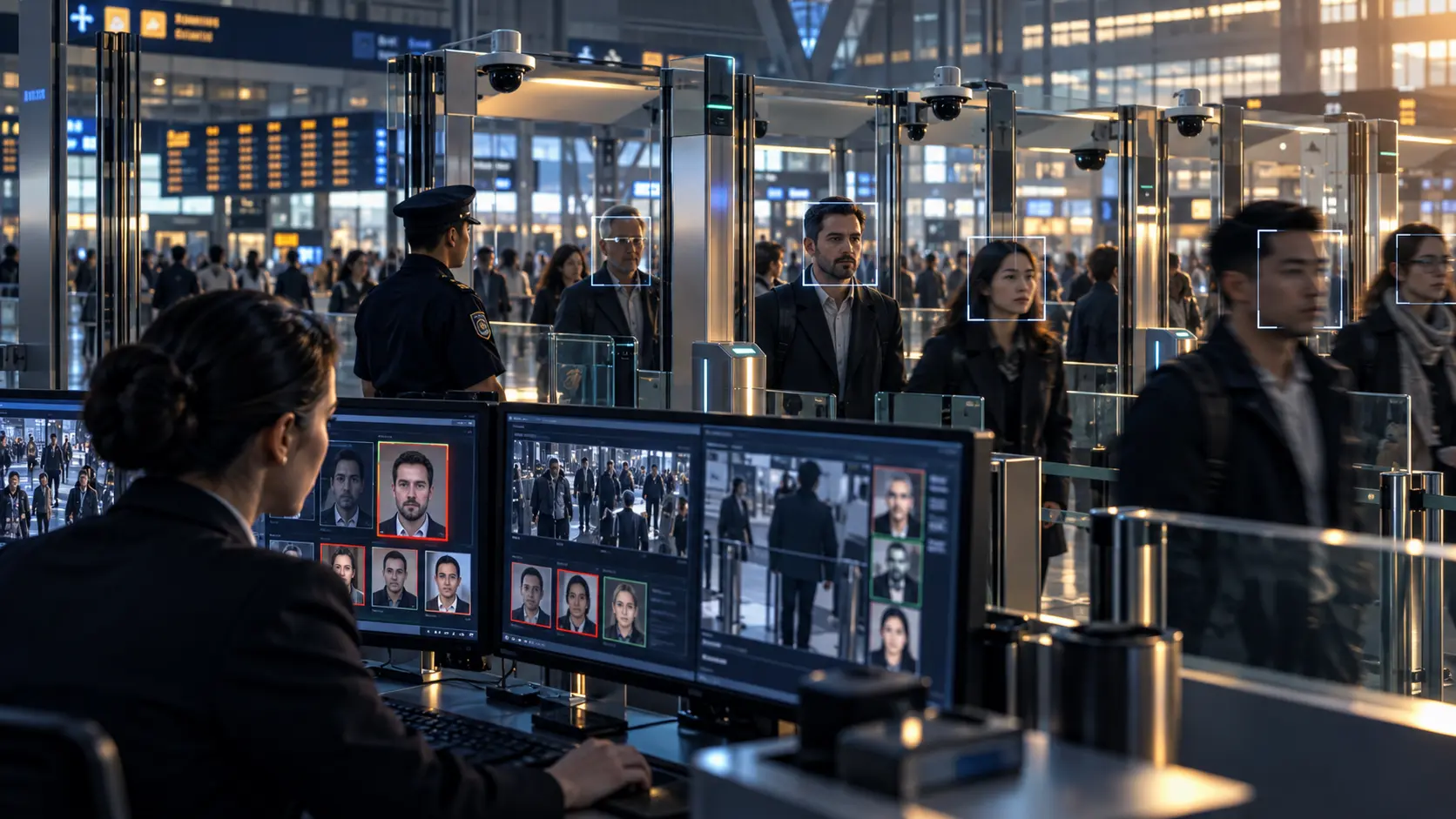
Facial recognition is a biometric technology that uses measurable features of the human face to verify or identify a person. Governments can use it for purposes ranging from confirming someone's identity when accessing a service to searching large image databases during investigations. The same technology can therefore support convenient authentication in one context and enable extensive surveillance in another. Understanding facial recognition government surveillance requires distinguishing these different uses, because the risks depend heavily on how the system is designed, where it is deployed, and what happens after a match is produced.
Biometric systems identify people through physical or behavioral characteristics. Common examples include fingerprints, facial features, iris patterns, voice characteristics, and, in some cases, the way a person moves. These traits differ from passwords or identity cards because they are connected to the body. A password can be changed after a security breach, but a face or fingerprint cannot easily be replaced. This makes biometric information useful for authentication while also making its protection especially important.
A facial recognition system normally begins by capturing an image. The source may be a photograph submitted during registration, an image stored in an identification database, or a frame taken from a video camera. Software first detects the presence of a face and then analyzes features and relationships within it. Modern systems generally convert this information into a mathematical representation, sometimes called a biometric template or facial embedding.
The template is not simply a conventional photograph. It is a numerical representation designed to capture features that help distinguish one face from another. The system can then compare the template with another facial template and calculate how similar they are. If the similarity exceeds a chosen threshold, the system may report a possible match.
This comparison can be performed in two fundamentally different ways. One-to-one verification asks whether a person is who they claim to be. A traveler might present a passport and then look into a camera. The system compares the live image with the photograph associated with that specific passport. A person unlocking a device with facial authentication is participating in a similar type of process.
One-to-many identification is more expansive. Instead of comparing a face with one known reference image, the system searches a database containing many people. Law-enforcement authorities, for example, might extract a face from security-camera footage and compare it with a collection of previously stored images. The system may then generate a list of possible candidates.
The distinction between verification and identification is important because the scale of the search changes the risks. In a one-to-one authentication process, the person normally knows that facial recognition is being used and actively participates in it. The system answers a relatively narrow question about a claimed identity. In one-to-many identification, people may be searched against a database without knowing that the comparison is taking place.
Governments can use facial recognition for civil identification. Biometric information may help prevent duplicate identity registrations, verify passport holders, or confirm that public records correspond to the correct person. In countries with large administrative systems, biometric tools can help distinguish people with similar names or incomplete documentation.
Authentication is another common application. A government portal might allow citizens to verify their identity remotely before accessing tax information, requesting a document, or managing public benefits. Facial verification can reduce the need for repeated in-person visits and may make services easier to access for people living far from government offices.
Biometrics can also be used at borders and airports. Automated systems may compare a traveler's face with the image contained in a passport or another official record. When the comparison works properly, it can accelerate identity checks and allow officials to focus attention on exceptional cases.
Law enforcement presents a more controversial use. Investigators may compare a photograph of an unknown suspect with existing image databases. Facial recognition can help generate investigative leads when conventional methods are slow or ineffective. However, a possible algorithmic match is not the same as proof that two images show the same person.
Facial recognition systems produce estimates based on similarity. They can make mistakes, and their performance depends on factors such as image quality, lighting, camera angle, facial expression, changes in appearance, database quality, and the specific model being used. A poor surveillance-camera image may be much harder to analyze accurately than a high-quality passport photograph.
False positives are especially important in government use. A false positive occurs when the system incorrectly indicates that two different people may be the same person. If an algorithmic match is treated as definitive evidence rather than an investigative clue, an innocent person can be questioned, detained, or subjected to additional scrutiny.
False negatives create a different problem. A system may fail to recognize a person who is actually present in its database. This can cause authentication failures, delays in accessing public services, or missed identification during investigations. Both types of error matter, although their consequences vary according to the context.
Accuracy can also differ across demographic groups depending on the system, training data, testing conditions, and deployment environment. A model that performs well overall may still produce higher error rates for certain populations. Average accuracy figures can therefore hide meaningful differences. Responsible evaluation requires testing performance across the groups and conditions in which the technology will actually be used.
The threshold selected for declaring a potential match also affects results. A stricter threshold can reduce false matches but may increase the number of genuine matches that are missed. A more permissive threshold may identify more possible candidates while also producing more incorrect matches. Setting this threshold is therefore not merely a technical exercise. It involves deciding which types of error are considered more acceptable.
These trade-offs become more serious as the scale of surveillance grows. A system used occasionally to verify a single person's identity creates a different risk from one that continuously scans thousands of people in public spaces. Even a low error rate can produce many false matches when millions of comparisons are performed.
Large-scale facial recognition can potentially transform ordinary cameras into identification systems. Traditional video surveillance records what happens in a location. Facial recognition can add the ability to ask who was there. When camera networks, facial databases, and automated analytics are connected, authorities may gain the capacity to track individuals across multiple places.
Such systems raise significant privacy concerns because people can be identified without actively presenting identification. A person walking through a street, transportation station, demonstration, or public building may be analyzed without directly interacting with the system. The possibility of persistent identification changes the nature of surveillance from observing anonymous activity to potentially recording identifiable movement.
This can affect political and social behavior. People may be less willing to attend protests, political meetings, religious events, or sensitive medical appointments if they believe their presence could be automatically recorded and linked to their identity. Even when no immediate punishment follows, the perception of constant monitoring can create a chilling effect on lawful activity.
Purpose limitation is therefore important. A biometric database created for one administrative function can become more intrusive if it is later made available for unrelated uses. Images collected for passports, driver's licenses, or identity cards may carry different privacy expectations from photographs gathered specifically for criminal investigations. Expanding access without clear legal limits can transform a narrow identification system into a much broader surveillance infrastructure.
Data security presents another major concern. Facial templates and biometric images are sensitive because they cannot easily be replaced. If a password database is compromised, users can create new passwords. If a biometric database is stolen, the underlying physical characteristic remains the same. Governments and contractors that hold biometric data therefore need particularly strong security controls.
Centralization can increase both administrative efficiency and risk. A unified biometric database may make verification easier across government agencies, but it can also become an unusually valuable target for attackers or misuse. Connecting multiple databases can reveal more information about individuals than any single system would contain on its own.
Private contractors often participate in biometric systems by supplying cameras, software, cloud infrastructure, or facial recognition models. This can complicate accountability. Governments need to understand how these systems perform, what data contractors can access, how long information is retained, and whether vendors can reuse data for other purposes.
Proprietary technology can create additional difficulties when authorities rely on systems whose internal operation cannot be fully inspected. Commercial confidentiality may be legitimate, but secrecy becomes more problematic when an algorithm contributes to decisions that can affect people's liberty or legal status. Public agencies need sufficient access to evaluate whether the technology works as claimed.
Contestability is especially important when facial recognition affects individuals directly. A person wrongly identified by a biometric system should have a realistic way to challenge the result. This requires more than an abstract right to complain. Institutions need procedures for reviewing source images, correcting database errors, examining how a match was produced, and considering other evidence.
Human review can reduce some risks, but only when it is genuinely independent. An officer who simply accepts the system's highest-ranked candidate is not providing meaningful oversight. Reviewers should understand that algorithmic similarity is probabilistic and should look for corroborating evidence before taking consequential action.
The risk also depends on whether the technology operates in a controlled or open environment. Facial authentication at a government service counter may use high-quality cameras, cooperative users, and known lighting conditions. Surveillance in a crowded street involves moving people, changing angles, poor lighting, partial obstruction, and lower-quality images. A system that performs well in the first environment may not achieve the same accuracy in the second.
Other biometric technologies raise related concerns. Fingerprint recognition has long been used in criminal investigations and identity systems. Iris scanning can provide highly distinctive biometric information. Voice recognition can help verify callers, while gait analysis attempts to distinguish people by movement patterns. Each technology has different strengths, limitations, and privacy implications.
Biometrics can make government services more secure and convenient when used carefully. They can reduce identity fraud, simplify access to digital services, and help individuals prove who they are without repeatedly presenting physical documents. These benefits are strongest when participation is clearly defined, the purpose is narrow, and alternatives are available for people who cannot use the technology reliably.
The risks increase when biometric identification becomes invisible, continuous, difficult to avoid, or connected to extensive databases. Large-scale monitoring can shift the balance of information between citizens and the state because authorities gain the ability to identify movement and association with little active participation from the person being watched.
Legal safeguards can limit these risks by defining which agencies may use facial recognition, for what purposes, under what level of authorization, and with which databases. Rules can also establish retention limits, auditing requirements, accuracy testing, disclosure obligations, and restrictions on real-time surveillance.
Independent oversight is valuable because agencies deploying surveillance technology may have strong incentives to emphasize its benefits. Courts, legislatures, data-protection authorities, inspectors, or other independent bodies can examine whether a system is necessary, proportionate, and performing as expected.
Transparency also matters, although operational details may sometimes need to remain confidential. Governments can often disclose which technologies they use, their purposes, general performance information, vendor relationships, retention policies, and oversight mechanisms without compromising legitimate investigations.
Facial recognition is therefore not one single practice. Using a face to unlock access to an individual public service is fundamentally different from continuously identifying people throughout a city. Both rely on related biometric techniques, but their implications for privacy and state power are not comparable.
The central issue in facial recognition government surveillance is not simply whether the technology can identify people. It is whether identification is necessary, accurate enough for the intended purpose, proportionate to the risk being addressed, and subject to meaningful accountability. Biometric systems can improve security and access to services, but their ability to connect physical identity with digital records also makes them unusually powerful. The broader and less visible their use becomes, the stronger the safeguards needed to prevent error, misuse, and excessive surveillance.
