Economics begins with a simple fact: people want many things, but the resources available to satisfy those wants are limited. Time, land, labor, raw materials, machinery, knowledge, and money can all be used in different ways, yet none exists in unlimited supply. A family cannot spend the same income twice. A worker cannot devote the same hour to two different jobs. A factory cannot use the same machine at the same moment to produce two different products. A government that spends more on one program may have fewer resources available for another. This condition is called scarcity, and it is the basic problem that makes economic choices necessary.
Scarcity does not mean that everything is rare or that people are always poor. It means that resources have competing uses. Even a wealthy society faces scarcity because its productive capacity, natural resources, skills, and time remain finite. If more engineers are assigned to build bridges, fewer may be available to design software or medical equipment. If land is used for housing, it cannot simultaneously be used for farming or conservation. Economic life therefore involves deciding how scarce resources should be allocated among different purposes.
Every choice involves giving something up. Economists call the value of the best alternative that is sacrificed the opportunity cost. Suppose a student spends an evening studying for an exam. The cost is not only any money spent on books or transportation. It also includes the most valuable alternative use of that time, such as working a paid shift, meeting friends, exercising, or resting. Similarly, when a company invests in a new factory, the opportunity cost includes what it could have done with the same funds instead, such as developing a different product, hiring more workers, or returning money to its owners.
Opportunity cost matters because the true cost of a decision is broader than its visible price. A public project may appear inexpensive if attention is focused only on the money paid for construction, but labor, land, equipment, and administrative effort used for that project cannot be used elsewhere at the same time. Economic reasoning therefore asks not only, “What does this cost?” but also, “What are we giving up by choosing it?” This does not mean that every decision should be reduced to money. Many alternatives involve time, health, safety, environmental quality, relationships, or other things that do not have simple market prices. The central idea is that choosing one path closes off others.
Because resources are scarce, individuals and organizations constantly compare benefits and costs. Most choices are not all-or-nothing decisions. They are decisions about whether to do a little more or a little less of something. A company may ask whether hiring one additional employee will add more value than the employee will cost. A consumer may decide whether the satisfaction from one more restaurant meal is worth its price. A city may consider whether an additional bus route produces enough public benefit to justify the required resources. Economists often describe this as thinking at the margin: comparing the additional benefit of a small change with its additional cost.
Choices are also shaped by incentives. An incentive is anything that changes the benefits or costs associated with an action and therefore makes that action more or less attractive. Prices are among the most familiar incentives. When the price of a product rises, consumers often have a reason to buy less of it, look for substitutes, or postpone a purchase. Producers, on the other hand, may have a stronger reason to increase production if the higher price makes supplying the product more profitable. When prices fall, the incentives can move in the opposite direction.
Money is only one source of incentives. Laws, taxes, subsidies, fines, workplace rules, social expectations, reputation, convenience, and personal values can all influence behavior. A fine for illegal parking raises the expected cost of parking in a prohibited place. A tax credit for home insulation lowers the effective cost of improving energy efficiency. A company promotion system may encourage employees to focus on the activities that are rewarded. People also respond to nonfinancial incentives, such as approval, status, professional pride, or the desire to avoid embarrassment.
Understanding incentives does not mean assuming that people are perfectly calculating machines. Human behavior is affected by habits, emotions, incomplete information, social relationships, cognitive limits, and uncertainty. People sometimes misunderstand incentives, overlook long-term consequences, or make inconsistent choices. Even so, changes in benefits and costs often influence behavior in predictable ways when many people face similar circumstances. This is one reason economic analysis pays close attention to how rules and institutions alter incentives, including unintended incentives that policymakers or organizations may not initially notice.
Individual choices become especially important when they interact with the choices of other people. An economy is not simply a collection of isolated decisions. Consumers depend on producers, producers depend on workers and suppliers, lenders depend on borrowers, and households depend on organizations that provide goods and services. Millions of separate decisions must somehow be coordinated. People need signals about what others want, what resources are available, what is becoming scarce, and where productive effort is most valuable.
Markets are one important way this coordination occurs. A market is not necessarily a physical place. It is any system in which buyers and sellers interact to exchange goods, services, labor, financial assets, or other resources. A neighborhood shop is part of a market, but so are online marketplaces, labor markets, housing markets, and international commodity markets. Through these interactions, prices can emerge as signals about relative scarcity and demand.
Consider what happens when demand for a product increases while supply initially remains unchanged. Buyers compete for the available quantity, putting upward pressure on the price. The higher price gives consumers an incentive to limit their purchases or seek alternatives. At the same time, it can encourage existing producers to expand output and attract new producers into the market. The price therefore does more than determine who pays what. It communicates information and influences behavior on both sides of the market.
The reverse can happen when demand falls. Sellers may reduce prices to attract customers. Lower prices discourage some production and may encourage consumers to buy more. Through repeated adjustments, market participants respond to changing conditions without requiring a single person to direct every transaction. No central coordinator needs to know exactly how many shoes, meals, computers, or haircuts every individual wants. Much of this information is reflected indirectly through purchases, sales, profits, losses, wages, and prices.
Supply and demand are useful concepts for describing this process. Demand represents how much buyers are willing and able to purchase at different prices, while supply represents how much sellers are willing and able to offer. Other things being equal, buyers generally want more of a product when its price is lower, whereas producers generally have stronger incentives to supply more when its price is higher. The interaction between these forces helps determine both prices and quantities exchanged.
Real markets are more complicated than simple diagrams suggest. Demand can change when incomes, preferences, population, expectations, or the prices of related products change. Supply can change because of technology, wages, energy costs, taxes, regulations, weather, access to credit, or disruptions to transportation and production. A sudden crop failure may reduce the supply of a food product. A technological improvement may allow factories to produce more at lower cost. A rise in household income may increase demand for some products while reducing demand for others. Prices and quantities adjust as these underlying conditions change.
Prices also influence how scarce resources are allocated among competing uses. If demand for a particular type of software grows rapidly, companies may offer higher salaries to programmers with the relevant skills. Students and workers may then have stronger incentives to acquire those skills, while firms may invest in training and technology. Over time, labor and capital can shift toward activities where customers appear willing to pay more. This is one way decentralized economic decisions can redirect resources without a central authority specifying every movement.
Profits and losses play a related role. A business earns a profit when its revenue exceeds its costs, including the expenses required to obtain labor, materials, equipment, and other inputs. Profit can signal that customers value a product more than the resources required to produce it, at least under the conditions reflected in market prices. This can encourage expansion and attract competitors. Losses can signal that resources might be more valuable elsewhere, leading businesses to reduce production, change their methods, or leave a market.
These signals are useful, but they are not perfect measures of social value. Market prices reflect what participants are willing and able to pay, not every effect that an economic activity has on society. A factory may sell a profitable product while also creating pollution that harms people who are not part of the transaction. A person who receives a vaccination may reduce the chance of infecting others, creating benefits beyond the person who paid for the treatment. Economists call effects on third parties externalities. When important costs or benefits fall outside the market transaction, private incentives and broader social interests can diverge.
Markets can also work poorly when competition is weak, information is seriously unequal, or important goods are difficult to provide through ordinary buying and selling. A dominant company may be able to raise prices or restrict output. Buyers may struggle to judge the quality of complicated financial or medical services. Some benefits, such as national defense or certain forms of public infrastructure, can be difficult to limit only to those who pay for them. These situations are often described as market failures because decentralized exchange does not automatically produce an efficient result.
Governments and other institutions can respond to such problems through laws, taxes, subsidies, public services, property rights, competition policy, environmental rules, consumer protections, and other arrangements. These interventions also involve trade-offs. A regulation designed to improve safety may increase production costs. A subsidy intended to encourage a beneficial activity may be expensive or poorly targeted. A tax may fund valuable services while also changing incentives to work, invest, consume, or produce. Economic analysis therefore examines government action using the same basic questions applied elsewhere: What resources are being used? What alternatives are being sacrificed? What incentives are created? Who gains, who bears the costs, and what unintended effects might appear?
Modern economies are consequently neither purely market systems nor purely government-directed systems. Most combine private ownership and voluntary exchange with public institutions that establish rules, provide services, redistribute income, regulate certain activities, and correct some market failures. The balance differs across countries and changes over time. The important distinction is not simply between “the market” and “the government,” because markets themselves depend on institutions. Contracts must be enforceable, property rights must be defined, money must be trusted, disputes must be resolved, and participants need some degree of legal and social stability.
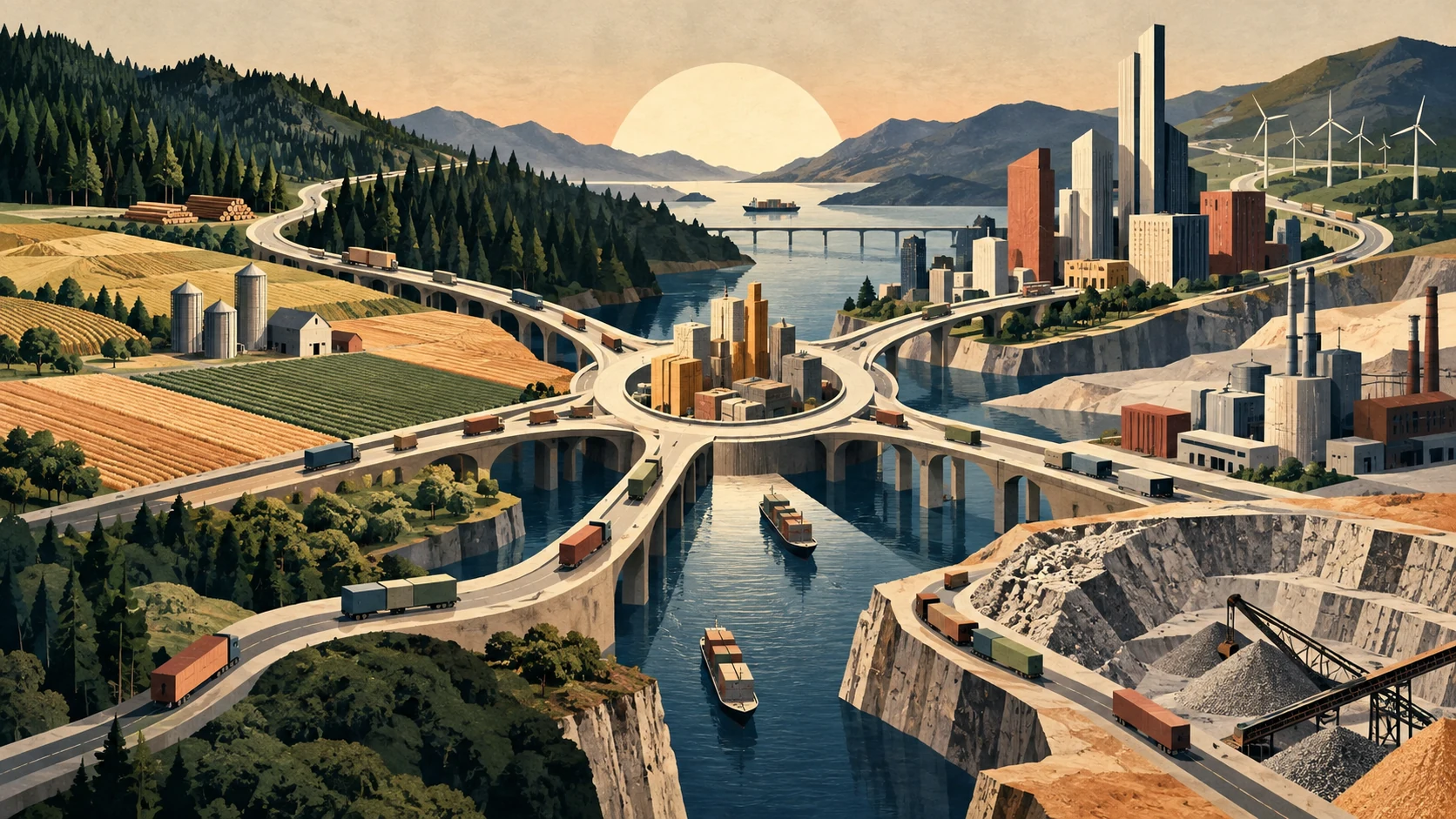
Economic coordination also extends beyond individual markets. The production of even an ordinary product may involve a long chain of specialization. A smartphone, for example, combines minerals extracted in one region, components manufactured in several countries, software developed by specialized teams, transportation networks, financial services, retail systems, and telecommunications infrastructure. No single participant may understand the entire production process. Specialization allows individuals and firms to concentrate on narrower tasks, develop expertise, use specialized equipment, and potentially produce more than they could if everyone tried to make everything independently.
Trade makes specialization more useful. People exchange because each side expects to gain from the transaction. Differences in skills, resources, technology, and opportunity costs can create opportunities for mutually beneficial exchange. An individual does not need to be the best at every activity to benefit from specializing. What matters is often comparative advantage: the ability to perform an activity at a lower opportunity cost than someone else. If one person is relatively better at repairing machines while another is relatively better at accounting, both may benefit when each concentrates more heavily on the activity that costs them less in terms of sacrificed alternatives and then they exchange services.
The same reasoning can apply to businesses, regions, and countries, although international trade involves additional complications such as transportation costs, political objectives, national security, adjustment pressures, and the distribution of gains and losses. Trade can increase the total range of goods and services available, yet particular workers, industries, or communities may face serious disruption when production shifts. Economic outcomes therefore need to be examined not only in terms of total gains but also in terms of how those gains and costs are distributed.
Distribution is a central part of economic life because markets determine not only what gets produced but also much of the income people receive. Workers earn wages, owners may receive profits, landlords receive rent, and lenders receive interest. These forms of income depend on many factors, including productivity, education, bargaining power, scarcity of particular skills, ownership of assets, institutions, discrimination, technology, and broader economic conditions. People enter markets with different resources and opportunities, so market outcomes can produce substantial differences in income and wealth.
Efficiency and fairness are related but distinct questions. An arrangement can use resources efficiently while producing a distribution that many people regard as unfair. Conversely, a policy intended to make outcomes more equal may affect incentives and therefore alter production, investment, or employment. Economics can help identify such trade-offs and estimate consequences, but it cannot determine by itself what a society should consider fair. Questions about justice, rights, obligations, and acceptable inequality also involve political and ethical judgments.
Time adds another layer to economic choices. Decisions made today can affect resources and opportunities far into the future. Saving allows income to be shifted toward future consumption. Investment directs resources toward assets such as factories, infrastructure, research, education, and technology that may increase future productive capacity. Borrowing does the opposite in one sense: it allows people, businesses, or governments to use future income to finance spending today. Interest rates influence these decisions by affecting the cost of borrowing and the reward for lending or saving.
Financial institutions help connect savers with borrowers and investors. Banks, bond markets, stock markets, pension funds, and other institutions move funds toward households, businesses, and governments that want to spend or invest. When this system works well, savings can finance productive projects that would otherwise be difficult to undertake. When it works poorly, excessive risk, weak lending standards, misinformation, or financial panic can disrupt the broader economy because credit and payment systems are deeply connected to everyday production and employment.
Money makes complex economic exchange easier. Without money, trade would often require barter, meaning that two people would need to possess exactly what the other wanted at the same time. Money provides a common means of payment, a way to compare values, and a method of storing purchasing power for future use. Its usefulness depends heavily on trust. People accept money because they expect others to accept it as well and because institutions support the monetary system.
The overall purchasing power of money can change. Inflation occurs when the general level of prices rises over time, reducing how much a unit of money can buy. Inflation can result from different combinations of forces, including strong overall demand, rising production costs, supply disruptions, changes in expectations, and monetary conditions. Moderate changes in prices are different from a rise in the price of one particular product. If coffee becomes more expensive because of a poor harvest, that is primarily a change in a relative price. Inflation refers to a broader increase across the economy.
Central banks influence monetary and financial conditions, often by adjusting interest rates and managing aspects of the money and banking system. Governments influence the economy through taxation, spending, borrowing, regulation, and public investment. These policies can affect employment, inflation, economic growth, and financial stability, although their effects are rarely instantaneous or perfectly predictable. Policymakers must make decisions under uncertainty while balancing objectives that can sometimes conflict. Measures that reduce inflation, for example, may temporarily weaken spending and employment, while policies designed to stimulate demand may become inflationary if the economy is already operating close to its productive limits.
At the level of the whole economy, economists often study production, employment, income, inflation, and economic growth. Total production depends on the number of workers, their skills, the amount and quality of capital, available natural resources, technology, infrastructure, institutions, and the efficiency with which these elements are combined. Sustained improvements in living standards depend heavily on productivity, meaning the amount of valuable output produced from a given amount of input. Better tools, education, organization, technology, and infrastructure can allow people to produce more without simply working more hours.
Economic growth can increase the resources available to households and governments, but it does not automatically resolve every economic problem. Growth can be unevenly distributed, may place pressure on natural systems, and can create disruption as technology and industries change. A richer economy still faces scarcity because new possibilities and expectations emerge alongside greater productive capacity. The question of how resources should be used does not disappear when a society becomes wealthier; the range of possible choices often expands.
Uncertainty is another permanent feature of the economy. Consumers do not know their future income with certainty. Businesses cannot perfectly predict demand. Investors do not know which technologies will succeed. Governments must make policies without knowing every future shock. People respond by saving, buying insurance, diversifying investments, signing contracts, holding inventories, and building financial reserves. Risk can be reduced or shared, but it cannot be eliminated entirely.
Expectations about the future can influence the present. If households become worried about job security, they may cut spending and save more. Businesses observing weaker sales may postpone investment or hiring. Those decisions can then reduce income for other people, reinforcing the slowdown. In the opposite direction, confidence about future demand can encourage investment, employment, and spending. Economic outcomes are therefore shaped not only by current resources and prices but also by beliefs about what will happen next.
This interaction between individual behavior and collective outcomes is one of the most important ideas in economics. What makes sense for one person does not always produce the same result when everyone behaves similarly. Saving more may improve the finances of an individual household, but if many households suddenly reduce spending at once, businesses may lose revenue and reduce production or employment. A company may benefit from using a common resource, yet if every company uses it without restraint, the resource may be depleted. Economists study these situations because the effects of a decision often depend on how other people respond.
Institutions help shape these interactions by establishing the rules within which choices occur. Property systems, courts, corporate structures, labor laws, financial regulations, cultural norms, professional standards, and political institutions all influence incentives and expectations. Two societies with similar natural resources can produce very different outcomes if their institutions differ in stability, accountability, trust, access to opportunity, or protection of contracts and property. Economic behavior therefore cannot be understood solely by studying prices and individual preferences; it also depends on the legal and social environment in which decisions are made.
Economics ultimately studies how people coordinate their lives under conditions of scarcity. Scarcity creates the need for choice, choice creates opportunity costs, incentives shape those choices, and institutions and markets help coordinate decisions among millions of people. Prices, wages, profits, losses, laws, and social rules all carry information and influence behavior, while specialization and exchange allow people to depend on one another in increasingly complex ways. The resulting system can generate extraordinary levels of cooperation and production without anyone controlling every detail, but it can also produce failures, inequalities, conflicts, and unintended consequences that require collective decisions about how the system should be organized.
Understanding how the economy works therefore does not require imagining it as a machine with a single control panel. It is better understood as an evolving network of choices and relationships. Households, workers, businesses, governments, financial institutions, and communities continually respond to changing information, opportunities, constraints, and incentives. Their decisions influence one another, and from those interactions emerge prices, jobs, production, income, investment, growth, and distribution. The basic economic problem never disappears: limited resources must be used among competing possibilities. What changes is how societies organize that choice, how effectively they coordinate it, and what consequences they are willing to accept in pursuing the outcomes they value.