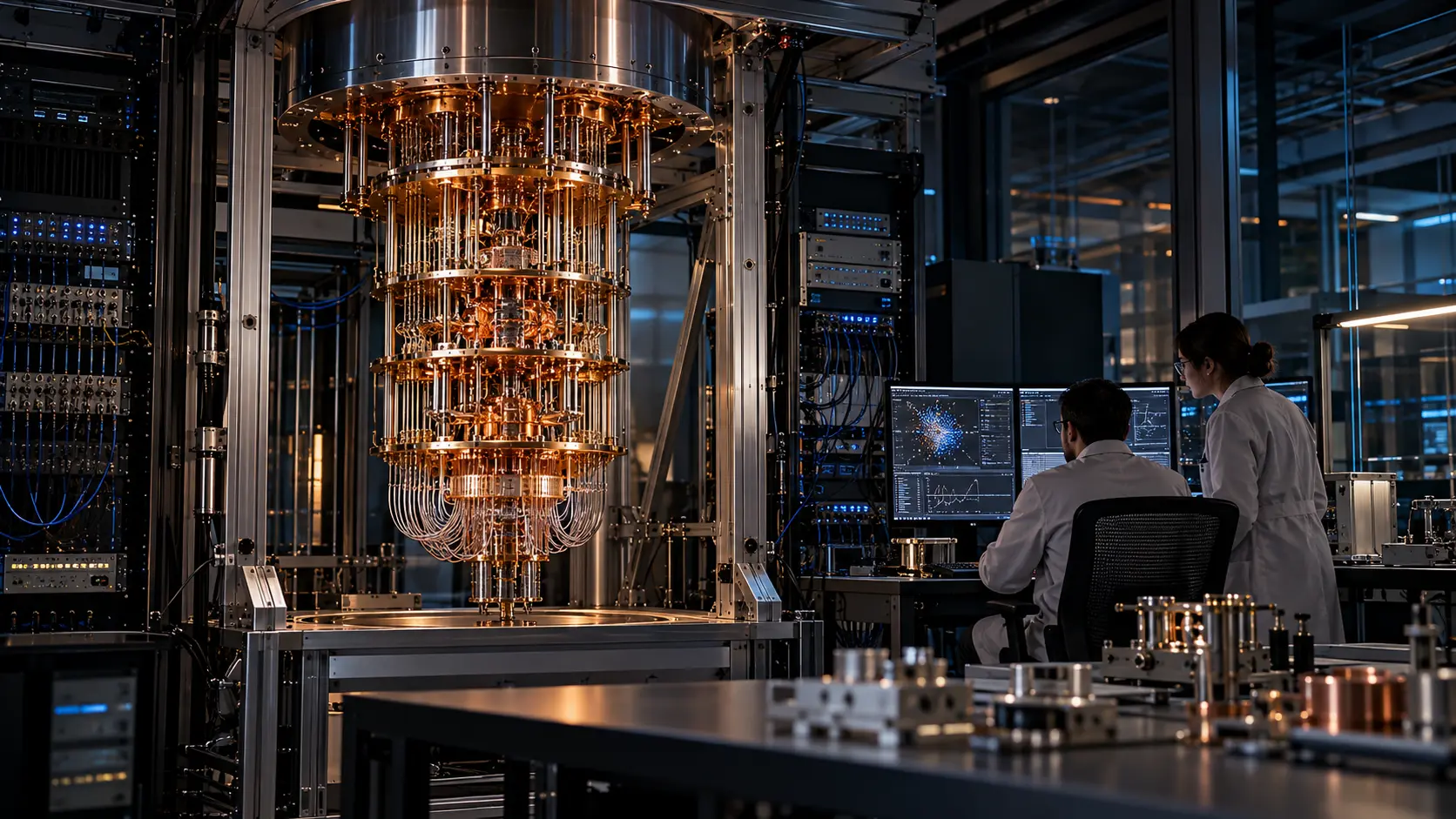
Quantum computing entered 2026 with an important change in emphasis. For years, progress was often described in terms of how many qubits a processor contained or whether a machine could outperform a classical computer on a carefully chosen laboratory task. Those achievements remain scientifically important, but they do not by themselves produce useful quantum computers. The central question is now whether quantum hardware can perform long, reliable calculations that solve valuable problems better, faster, or more economically than classical systems.
A quantum computer processes information using qubits rather than ordinary binary bits. While a classical bit is either 0 or 1, a qubit can exist in a quantum combination of these states, and multiple qubits can become entangled in ways that allow certain calculations to be organized very differently from classical computation. This does not mean that quantum computers are automatically faster at everything. Most everyday computing tasks gain little or nothing from quantum hardware. The strongest theoretical advantages appear in specific areas such as simulating quantum systems, some forms of cryptanalysis, and specialized mathematical procedures that could contribute to optimization, chemistry, materials science, and scientific modeling.
Building a useful machine is difficult because quantum information is extremely fragile. Qubits interact unintentionally with their surroundings, lose their quantum states, and accumulate errors during calculations. Gates, which are the operations performed on qubits, are also imperfect. A calculation involving a small number of operations may tolerate some errors, but a commercially important algorithm could require an enormous sequence of operations. Even a very small error rate becomes destructive when failures accumulate across a sufficiently long computation.
For this reason, the number of physical qubits on a processor is only one measure of progress. A processor with many noisy qubits can be less useful than a smaller system with much better control, connectivity, coherence, and gate accuracy. Useful quantum computing depends on the entire system: qubit quality, control electronics, calibration, error rates, software, fabrication consistency, measurement fidelity, cooling or environmental requirements, and the ability to operate the machine reliably for extended periods.
One of the most important advances in the field has therefore been the transition from focusing mainly on physical qubits to developing logical qubits. A logical qubit is created by encoding quantum information across multiple physical qubits so that errors can be detected and corrected. This process, known as quantum error correction, is essential for fault-tolerant quantum computing. A fault-tolerant machine should be able to continue performing calculations even when individual components occasionally make mistakes, provided those errors remain below manageable thresholds.
The crucial test is not simply whether researchers can demonstrate error correction once. The goal is to show that adding the resources required for error correction actually makes quantum information more reliable. As error-correcting codes become larger, the logical error rate should fall rather than rise. Researchers must then preserve that improvement while performing logical operations, connecting multiple logical qubits, and executing increasingly long algorithms. This progression is far more significant for practical quantum computing than announcing a record physical-qubit count.
Several hardware approaches are competing to reach that goal. Superconducting circuits, trapped ions, neutral atoms, photonic systems, semiconductor spin qubits, and other designs each offer different advantages and limitations. Superconducting processors can perform very fast operations and have benefited from advanced fabrication techniques, but they generally require extremely low temperatures and sophisticated control systems. Trapped-ion machines can achieve very accurate operations and flexible interactions between qubits, although their gates are typically slower. Neutral-atom systems offer potentially large arrays and flexible geometries, while photonic approaches could benefit from techniques related to optical communication and networking. Semiconductor-based qubits attract interest partly because they may eventually use manufacturing methods related to the conventional chip industry.
It remains uncertain which architecture, if any, will dominate. Quantum computing may ultimately resemble classical computing, where different types of hardware are used for different purposes. A machine designed for quantum simulation might not have the same optimal architecture as one intended for cryptographic algorithms or distributed quantum networking. The relevant question is therefore less about which company can build the largest processor and more about which systems can scale while maintaining low errors, reliable control, efficient error correction, and acceptable operating costs.
This distinction is particularly important when evaluating claims of quantum advantage. Researchers have already demonstrated experiments in which quantum processors performed specialized tasks that would be difficult to reproduce using particular classical methods. Such experiments can prove that a quantum device has reached an extraordinary level of control and computational complexity. They do not necessarily show that the machine has solved a useful commercial problem.
Many experimental demonstrations are intentionally designed to highlight the strengths of quantum hardware. Random circuit sampling, for example, can be scientifically valuable because it tests whether a quantum processor can generate results that are extremely difficult to simulate classically. Yet businesses generally do not need random circuit samples. A commercially meaningful demonstration must involve a problem whose answer has practical value and must be compared with the best classical methods available for solving the same problem.
That comparison is harder than it sounds because classical computing continues to improve. Better algorithms, specialized chips, graphics processors, large-scale parallel systems, and improved simulation techniques can narrow or eliminate an apparent quantum advantage. A convincing case for practical quantum computing therefore requires more than showing that a quantum algorithm works. Researchers must demonstrate that the complete quantum approach performs better than strong classical alternatives after accounting for preparation, error correction, data transfer, repeated measurements, and other computational overhead.
This is one reason the idea of useful quantum advantage has become more important than simple quantum supremacy. The strongest commercial milestone would be a quantum computer solving a relevant problem that cannot be solved as effectively by practical classical systems. Ideally, the advantage would be substantial rather than marginal and would remain meaningful when the full economic cost of operating the quantum machine is included.
Chemistry and materials science are often considered promising areas because quantum mechanics governs the behavior of molecules and materials. Conventional computers can approximate many chemical systems extremely well, but the computational difficulty can grow rapidly for certain strongly correlated quantum systems. A sufficiently powerful quantum computer could potentially model some of these systems more directly. Such capabilities might eventually assist research into catalysts, batteries, industrial materials, pharmaceuticals, or other molecular technologies. The challenge is that many of the most valuable calculations appear to require fault-tolerant hardware substantially beyond small experimental processors.
Optimization is another frequently discussed application, but the situation is more complicated. Logistics, manufacturing, finance, scheduling, and transportation all contain difficult optimization problems. Quantum algorithms may eventually improve some of them, but difficult does not automatically mean quantum computers will solve them better. Classical optimization has decades of highly developed methods behind it, and many practical problems contain structures that conventional algorithms exploit efficiently. Any claimed advantage must therefore be demonstrated against highly optimized classical techniques rather than against simplified benchmarks.
Artificial intelligence has also become closely associated with quantum computing in public discussion, yet evidence for large practical advantages remains limited. Quantum machine-learning algorithms can be mathematically interesting, but loading classical data into a quantum system, maintaining coherence, and extracting useful results can offset theoretical speedups. Quantum processors may eventually become useful for particular mathematical subroutines or scientific AI applications, but there is no reason to expect them simply to replace GPUs or conventional AI accelerators across mainstream machine learning.
Cryptography presents a different case because the long-term quantum threat is supported by strong theory. Shor's algorithm shows that a sufficiently large fault-tolerant quantum computer could factor large integers and solve related mathematical problems far more efficiently than known classical algorithms. This would threaten widely used public-key cryptographic systems. Present-day quantum computers are far from the scale and reliability required to break modern encryption in this way, but the potential future threat has already motivated the development and deployment of post-quantum cryptography. In this area, quantum computing can have practical consequences even before cryptographically relevant quantum computers actually exist.
The largest obstacle separating current machines from that level of capability is the cost of fault tolerance. A single reliable logical qubit may require many physical qubits, depending on hardware quality and the error-correcting code being used. A complex algorithm may then require large numbers of logical qubits and enormous numbers of logical operations. Consequently, a processor containing thousands or even millions of physical qubits would not necessarily correspond to the same number of usable computational qubits.
Scaling also creates engineering problems beyond error correction. Larger systems require more control channels, more precise calibration, better fabrication yields, faster decoding of error-correction information, and mechanisms for moving quantum information through the processor. Some architectures may need modular designs in which multiple quantum chips are connected together. Others may depend on optical links or quantum communication between separate processing units. Manufacturing thousands of high-quality qubits in a laboratory is different from manufacturing very large numbers of nearly identical qubits reliably and economically.
Quantum computers also require a substantial classical infrastructure. Classical processors control quantum operations, interpret measurements, calculate corrections, schedule tasks, and often perform parts of hybrid algorithms. Practical machines will therefore probably function as specialized accelerators rather than replacements for conventional computers. A user may submit a scientific or industrial calculation to an ordinary computing system, which decides which portions should be executed on CPUs, GPUs, or quantum processors.
For commercial adoption, reliability must extend beyond the qubits themselves. Organizations need predictable runtimes, stable software tools, security, technical support, reproducible results, and an economic reason to use the machine. Cloud access has already made experimental quantum processors available without requiring users to own specialized hardware, but access to hardware is not the same as commercial usefulness. A company will adopt quantum computing at scale only when the value produced by a quantum calculation justifies its cost and complexity.
Several milestones would provide much stronger evidence that practical quantum computers are approaching. Logical qubits must become increasingly reliable as error-correcting codes scale. Researchers must demonstrate logical gates and computations whose error rates remain low during long calculations. Systems must increase the number of logical qubits without losing the improvements gained from error correction. Hardware architectures must show credible paths toward manufacturing, controlling, and connecting much larger systems. Most importantly, quantum processors must begin solving useful problems with measurable advantages over the best classical alternatives.
Progress toward these milestones can occur gradually rather than through a single dramatic breakthrough. A small fault-tolerant machine could become scientifically valuable before a universal large-scale quantum computer exists. Early practical applications may involve narrow calculations inside larger classical workflows. Improvements in quantum simulation, error-corrected sensing, specialized scientific computation, or hybrid algorithms could create useful niches before quantum computing becomes a general commercial industry.
For that reason, the most accurate way to think about quantum computing in 2026 is neither that practical machines are already here nor that decades of research have produced only laboratory curiosities. The field has been moving from proof-of-principle processors toward the much harder engineering problem of reliable computation. Experimental demonstrations matter because they test the components required for that transition, but useful quantum computing demands a higher standard: fault-tolerant logical qubits, scalable architectures, algorithms with valuable applications, and demonstrated advantages over continually improving classical systems.
Practical quantum computing will have arrived not when a processor reaches a particular qubit count or wins an artificial benchmark, but when organizations can repeatedly give it important problems and receive results that justify using quantum hardware. Reaching that point requires progress across physics, engineering, computer science, manufacturing, and economics at the same time. The decisive developments of the coming years will therefore be measured less by spectacular demonstrations than by whether quantum computers can move from controlled experiments to dependable tools.
