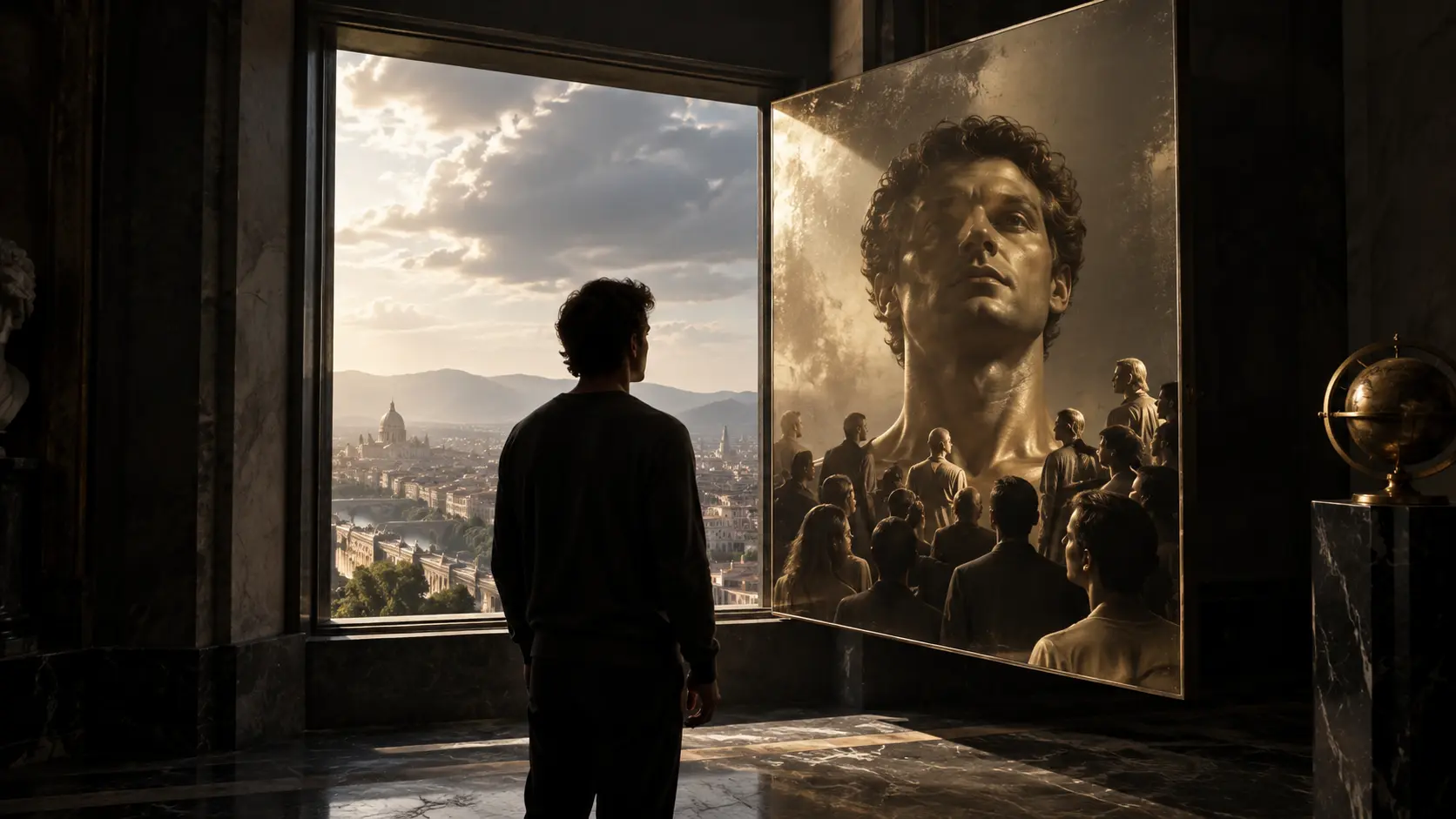
The most sophisticated idol of the modern age may not be a statue, a machine, or an external object of worship. It may be humanity itself. Not humanity in the sense of human dignity, which deserves protection, but humanity elevated into the highest source of meaning, judgment, value, and destiny. The old idols were often visible. They could be named, carved, guarded, and rejected. The modern idol is harder to recognize because it may look back at us from the mirror.
Idolatry, in the religious sense, is not merely the worship of objects. It is the act of giving ultimate status to something that is not ultimate. Wealth can become an idol, as can power, nation, ideology, success, sexuality, reason, or security. Anything finite can become absolute when it is treated as the final measure of truth and value. The distinctive danger of modern human self-sacralization is that it can absorb all these other forms at once. Humanity becomes the being that defines truth, decides morality, shapes nature, determines identity, and increasingly attempts to redesign its own future.
This does not mean that humanism, human rights, or scientific progress are forms of idolatry. Respect for human beings is not the same as worship of humanity. The distinction is essential. Human dignity protects people from being treated as objects. Human divinization treats the human being as the highest authority there is. The first places limits on power. The second can remove the very possibility of an authority beyond human power.
Religious traditions often hold these two ideas together: human beings possess extraordinary worth, yet they are not God. In the biblical tradition, humanity can be described as bearing the image of God while remaining created. The image has dignity precisely because it points beyond itself. This creates a tension that is difficult but important: the human person is neither worthless nor absolute.
Modern culture often struggles with the second half of that distinction. After centuries of resistance to oppressive political and religious authority, autonomy has become one of the strongest moral ideals. The individual should be free from coercion, able to make meaningful choices, and protected from domination. These are significant achievements. But autonomy can expand into sovereignty. The person moves from having the right to make choices to claiming the right to define the meaning and moral status of every choice.
At that point, freedom changes character. It is no longer simply the ability to act responsibly. It becomes the power of self-creation. The human being is imagined not as someone who receives a nature, a moral order, or a calling, but as someone whose highest task is to define themselves. Identity becomes authored. Meaning becomes constructed. Value becomes chosen. The self increasingly appears as its own creator.
This is where the religious structure of the change becomes visible. Traditional faith often places human beings under judgment. The believer may question, wrestle, interpret, and disagree, but the possibility remains that human desire is not the final standard. A self-sacralizing culture reverses the direction. God, tradition, morality, and even nature are brought before the tribunal of the human self and asked to justify themselves.
The language of dignity can then become the language of ultimacy. What begins with the legitimate claim that human beings must not be humiliated can move toward the stronger claim that nothing may contradict the individual's deepest self-understanding. Disagreement is increasingly interpreted as invalidation. Limits are experienced as oppression. Moral demands that do not originate from the self appear suspicious simply because they come from outside it.
The issue is not that every external authority is trustworthy. Religious, political, and social authorities can be abusive, and human beings have good reason to question them. The problem begins when criticism of false authority leads to the rejection of any authority that cannot be reduced to individual consent. Once that happens, the self becomes the final court of appeal.
This movement can also occur collectively. Humanity as a species may be imagined as the author of its own destiny. Scientific and technological power makes this vision increasingly plausible. Human beings can alter ecosystems, manipulate biological processes, design artificial systems, extend life, reshape communication, and influence their own bodies and minds in ways earlier generations could barely imagine. The growth of capability can easily become a growth of metaphysical confidence.
The ability to change reality, however, is not the same as the wisdom to determine what reality should become. Power answers the question “Can we?” It does not automatically answer “Should we?” The more powerful humanity becomes, the more dangerous it is to assume that capability itself confers moral authority.
This is why technological progress can acquire quasi-religious dimensions. The future becomes a horizon of salvation. Disease will be conquered, aging delayed, intelligence expanded, suffering reduced, and perhaps even mortality challenged. Technology begins to carry hopes that religions once placed in redemption, resurrection, liberation, or eternal life.
Again, the pursuit of medicine and human improvement is not inherently idolatrous. Preventing suffering is a legitimate good. The danger appears when humanity begins to see itself not merely as responsible for improving the conditions of life but as the final author of what life is for. The creator-creature distinction disappears, and human beings become the designers of their own meaning.
Artificial intelligence intensifies this temptation in a particularly symbolic way. AI is a product of human intelligence that can generate language, analyze information, simulate conversation, and increasingly participate in decisions. For some, it may appear to be the great rival that could one day replace humanity. Yet the deeper religious question may be different. AI can become not the idol itself but an instrument through which humanity worships its own powers.
A machine trained on human language, culture, knowledge, and imagination can function like an enormous reflective surface. People look into it and encounter an amplified form of human intellectual production. If such systems become objects of reverence, the reverence may ultimately be directed toward humanity's own capacity to create something that appears almost transcendent.
This is why the final idol may not be the machine. The machine may simply be the altar.
The human being remains at the center: the designer, the questioner, the one whose desires are increasingly anticipated and served. Digital systems learn preferences, adapt environments, personalize information, and reduce friction. The world becomes progressively organized around the user. What was once called providence can begin to resemble optimization: a reality that knows what the individual wants and responds accordingly.
This structure has spiritual consequences. Traditional religion often asks the believer to adapt to something beyond themselves. Digital culture trains the person to expect the environment to adapt to them. Music is personalized, news is personalized, entertainment is personalized, advertising is personalized, and increasingly advice and interpretation are personalized as well. It becomes natural to expect spirituality to function in the same way.
A personalized religion can still use the language of God while placing humanity at the center. God becomes the guarantor of human flourishing. Prayer becomes a tool for well-being. Salvation becomes self-realization. Grace becomes self-acceptance. Sin becomes whatever interferes with personal growth. The religious structure remains visible, but its final reference point is the human person.
This is a particularly refined form of idolatry because it does not require the denial of transcendence. God may remain in the vocabulary as long as God confirms the dignity, aspirations, and self-understanding of the individual. The decisive test is whether God retains the possibility of contradiction. Can God still say no? Can truth still be unwelcome? Can moral reality still place limits on desire? Can the person be told that self-expression is not always self-fulfillment?
If the answer is no, then the human being has become functionally absolute.
The same risk appears in moral progress. Modern societies have achieved important reforms by recognizing injustices that previous generations normalized. This has rightly increased confidence in moral criticism. But moral progress can be interpreted in two very different ways. One view says that human beings can learn to recognize truth more clearly. Another says that human beings create truth as they develop.
The distinction matters. If moral truth is discovered, humanity remains accountable to something beyond collective preference. If moral truth is simply produced by historical consensus, then today's humanity becomes the highest judge available. The danger is that every generation can mistake its own assumptions for final enlightenment.
A sacralized humanity is therefore not necessarily humble because it rejects old gods. It can become more absolute precisely because there is no longer any higher point from which it can be judged. The collective can condemn the past, define the present, and design the future while assuming that its own categories are self-validating.
The religious critique of idolatry has always challenged this confidence. Idols are dangerous not only because they are false but because they are made by human hands and then treated as authorities over their makers. Human beings project power outward and then bow before it. In the modern version, the movement may reverse: humanity no longer needs to project divinity onto an external object because it can increasingly attribute divine functions directly to itself.
Humanity creates, judges, names, transforms, predicts, controls, and designs. It seeks to overcome limits that once appeared permanent. It increasingly decides not only how to live but what counts as a life worth living. These powers can be used responsibly, but they can also encourage the belief that there is no meaningful boundary between human agency and ultimate authority.
The idea of human limitation becomes uncomfortable in such a culture. Dependence appears as weakness. Finitude appears as a technical problem. Submission appears as humiliation. Mystery appears as ignorance waiting to be solved. Death appears as the final enemy to be engineered away.
Religious traditions often interpret these same realities differently. Limitation can be part of creaturehood. Dependence can reveal relationship. Mystery can mark the boundary of human knowledge. Mortality can be tragic without being merely a technical defect. Such perspectives do not require passivity toward suffering, but they resist the assumption that every limit exists only to be conquered.
This resistance may become increasingly important as human power grows. A weak humanity needs hope. A powerful humanity also needs restraint.
The most dangerous idol is not necessarily one that makes human beings feel small. It may be one that tells them they have no meaningful limits. A culture that sees itself as increasingly capable of redesigning nature, identity, intelligence, and life itself may find it difficult to maintain the older religious intuition that power does not equal sovereignty.
The self-sacralization of humanity can also affect compassion. If human flourishing becomes the supreme good, society must decide what flourishing means. Those definitions will inevitably be shaped by institutions, technologies, and cultural authorities. A doctrine of unlimited human autonomy can therefore coexist with new systems of pressure that determine which choices are considered rational, healthy, progressive, or acceptable.
Human divinization does not abolish authority. It relocates it. Someone still defines what the human ideal should be.
This is why transcendence can serve as a limit on human power rather than merely as a limitation of human freedom. If the person possesses dignity because of a value that no state, market, algorithm, or majority created, then human dignity cannot be withdrawn by those powers. A belief in something higher than humanity can prevent any particular group of humans from claiming ultimate authority over the rest.
The theological distinction between human dignity and divinity therefore has political and ethical importance. To say that no human being is God is also to say that no ruler, institution, ideology, technology, or collective possesses absolute authority. Human limitation can protect human dignity.
The spiritual problem begins when humanity wants both the dignity of the image and the sovereignty of the original. It wants to be worthy without being dependent, creative without being created, free without being accountable, and powerful without being judged.
This temptation is old even when its technological forms are new. Religious traditions have repeatedly portrayed the desire to become like God as a fundamental human temptation. What changes in the modern era is the scale of the means available to pursue it. Scientific knowledge and technological power make aspirations toward mastery far more concrete than they once were.
The final idol may therefore be difficult to recognize because it will not necessarily stand against humanity. It will celebrate humanity. It will speak of dignity, freedom, creativity, intelligence, progress, and possibility. Many of these goods are real. The distortion occurs when they are removed from every higher measure and made absolute.
The idol will not need a face carved in stone because it will carry our own.
This is what makes human self-sacralization spiritually seductive. It does not ask people to degrade themselves before something obviously inferior. It tells them that nothing is higher. It transforms reverence into self-reverence and transcendence into the endless expansion of human possibility.
A mature defense of human dignity must therefore resist two opposite errors. One is the humiliation of the human person in the name of authority. The other is the deification of the human person in the name of freedom. Human beings can be precious without being ultimate, creative without being omnipotent, morally responsible without becoming the source of morality itself.
The last idol may not appear when humanity stops believing in God. It may appear when humanity preserves every sacred function for itself: creator, judge, redeemer, author of meaning, and master of destiny. At that point, the decisive religious shift has already occurred. The divine has not merely been removed from the throne. The human being has taken the seat.