Bitcoin mining is often described as the process of creating new bitcoins. That description captures one visible consequence of mining, but it misses most of what miners actually do. Mining is a coordination and security mechanism. It helps organize transactions into a shared history, applies proof of work to the process of adding new blocks, makes attempts to rewrite that history costly, and provides a way to distribute newly issued bitcoins according to the protocol’s rules. New coin creation is therefore one function of mining, not its entire purpose.
Bitcoin needs such a mechanism because it has no central institution responsible for maintaining its ledger. In a conventional payment system, a bank or payment company can decide which transactions are valid, place them in an authoritative order, and resolve conflicting attempts to spend the same funds. Bitcoin is designed to operate without giving any single participant that authority. Thousands of independent computers may receive transactions at different times, so the network needs a way to establish a common transaction history despite delays, disagreements, and potentially dishonest participants.
Miners contribute to this process by assembling valid transactions into candidate blocks. Before a transaction can be included, it must satisfy Bitcoin’s rules. Funds cannot be spent if they are unavailable, required authorization must be present, and the transaction must have a valid structure. Miners have practical reasons to choose valid transactions because a block that violates the rules will be rejected by nodes on the network. Mining therefore does not give miners unlimited authority over the ledger. They can propose blocks, but other participants independently verify whether those blocks are acceptable.
The difficult part is determining which proposed block gets added next. If adding blocks were free and effortless, many competing histories could be produced at almost no cost. An attacker could repeatedly create alternative versions of the ledger and attempt to replace transactions that had already been accepted. Bitcoin addresses this problem through proof of work. Miners repeatedly perform cryptographic computations while searching for a result that satisfies a target set by the protocol. Finding an acceptable result requires substantial computational effort, while checking that the result is valid is relatively easy.
Proof of work therefore turns the production of blocks into a costly competition. A miner cannot guarantee that it will find the next valid block simply by deciding to do so. Its chances depend largely on the amount of computational power it contributes relative to the rest of the mining network. Once a valid block is found and propagated, nodes can quickly verify its proof of work and all of its transactions. If it follows the rules, it can become part of the chain that participants build upon.
This process also helps organize Bitcoin’s history. Transactions do not arrive everywhere in exactly the same order, and conflicting transactions can sometimes circulate simultaneously. By grouping transactions into blocks and linking each block cryptographically to the one before it, Bitcoin creates an ordered chain of records. As miners continue adding proof of work on top of a block, reversing transactions in that block generally becomes more difficult because an attacker would need to construct an alternative history and catch up with the accumulated work of the competing chain.
Mining therefore gives Bitcoin a way to move from many individually observed transactions toward a shared record. This does not mean that miners determine truth by themselves. Full nodes verify the rules independently, and a miner cannot make an invalid transaction valid merely by spending enough electricity. Proof of work helps the network choose among competing valid histories; it does not override the protocol’s validation rules. A block that creates unauthorized coins or spends funds without satisfying the required conditions remains invalid regardless of how much computational work was used to produce it.
The creation of new bitcoins enters the system as an incentive attached to this process. When a miner produces a valid block, the protocol allows that block to contain a special transaction that claims a reward. Part of that reward consists of transaction fees paid by users, and part can consist of newly issued bitcoins known as the block subsidy. The subsidy is not an arbitrary amount chosen by the miner. Its maximum value is determined by Bitcoin’s issuance schedule and checked by other nodes.
This arrangement connects monetary issuance to network security. Instead of distributing new bitcoins through a central administrator, Bitcoin gives them to miners who successfully contribute proof of work to the chain. In the network’s early years, when transaction activity and fee revenue were relatively limited, newly issued coins provided a substantial economic incentive for miners to devote hardware and electricity to securing the system. The issuance mechanism therefore also helped bootstrap the security of a network that had no central organization funding it.
The distribution is competitive rather than equal. Miners repeatedly attempt to find valid blocks, and those with more computational power generally have a greater probability of succeeding over time. Individual outcomes remain uncertain, which is one reason miners often participate through mining pools that combine computational resources and distribute earnings according to agreed rules. Regardless of the organizational arrangement, however, the protocol rewards the production of valid proof of work rather than simply handing new coins to a predetermined authority.
This also explains why mining will still have a role as Bitcoin’s issuance declines. The block subsidy is reduced by half every 210,000 blocks and will eventually disappear under the current monetary rules. If mining existed only to create bitcoins, its purpose would vanish with the subsidy. But miners are also involved in ordering transactions and supplying proof of work to the blockchain. The long-term design expects transaction fees to become the main source of miner revenue as new issuance falls.
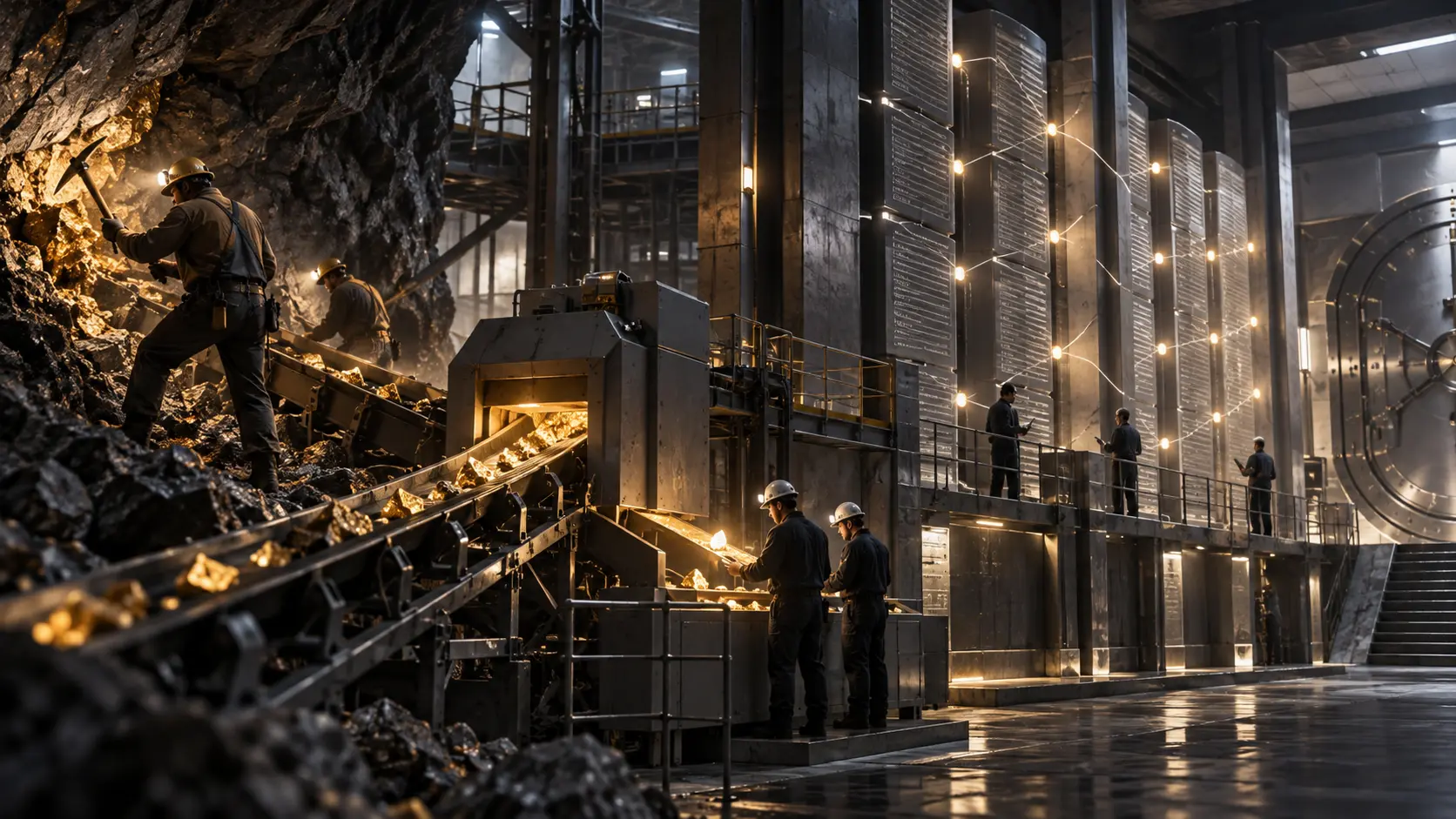
Mining is sometimes compared to digging gold out of the ground, largely because both processes involve costly effort and the introduction of new units into circulation. The analogy is useful only to a point. A gold miner physically extracts material that already exists in the earth. A Bitcoin miner participates in a protocol that permits new units to be issued as part of producing a valid block. The computational work is not searching for hidden bitcoins inside a computer. It is competing for the right to propose the next block and claim the reward allowed by the rules.
Nor is the electricity consumed by mining used to perform ordinary useful calculations that happen to produce bitcoins as a by-product. Its role is tied specifically to proof of work. The cost of computation makes participation in block production expensive and gives the history of the blockchain a measurable accumulated cost. That cost is part of what makes large-scale attempts to replace the accepted transaction history difficult.
It is also important not to confuse miners with the entire Bitcoin network. Miners specialize in producing blocks, but nodes decide for themselves whether those blocks follow Bitcoin’s rules. Users create and authorize transactions, nodes validate and relay information, developers produce software implementations, and economic participants decide which network and rule set they consider valuable. Bitcoin’s operation emerges from the interaction of these roles rather than from miners exercising complete control.
Understanding mining in this broader way resolves several common misconceptions at once. Miners do not simply manufacture coins, they do not have unrestricted power to rewrite balances, and proof of work is not merely a complicated lottery attached to issuance. Mining links transaction ordering, economic incentives, computational cost, and monetary distribution into one mechanism. The reward motivates participation; proof of work makes block production costly; blocks establish an ordered history; and independent validation prevents miners from changing the monetary and transaction rules at will.
New bitcoins are therefore best understood as compensation built into a larger security and coordination process. Mining provides a decentralized way to decide who may propose the next block while making that process costly enough to help protect the existing history. At the same time, it distributes new units according to a programmed issuance schedule. Calling mining simply “creating bitcoins” overlooks the architecture that makes those bitcoins meaningful in the first place.
