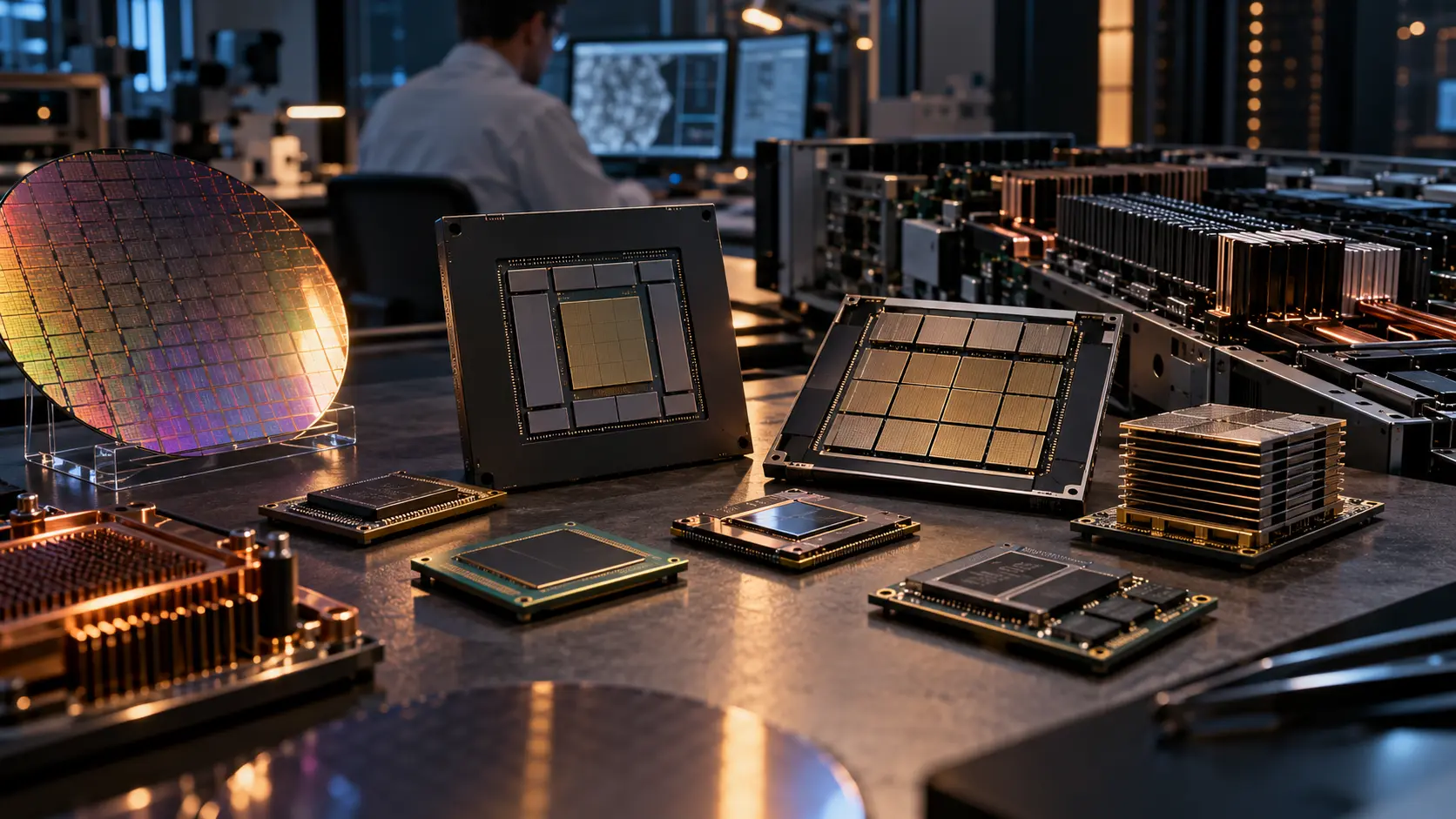
The rapid expansion of artificial intelligence is changing the way computers are designed. For years, GPUs became the dominant hardware for training and running large AI models because their highly parallel architecture is well suited to the matrix calculations used in neural networks. Nvidia benefited especially from this shift, building not only powerful processors but also a broad software ecosystem around them. Yet the growth of AI is now pushing the industry toward a wider range of AI chips, specialized accelerators, and heterogeneous computing systems designed to improve performance, reduce energy use, and control costs.
Traditional CPUs remain essential to modern computing, but they are not optimized for the enormous volume of parallel arithmetic required by deep learning. A CPU is designed to handle many different kinds of tasks with flexibility and strong single-threaded performance. AI workloads, by contrast, often involve repeating similar mathematical operations across very large datasets. GPUs proved effective because they contain many processing units that can perform these operations simultaneously, making them far more efficient than general-purpose processors for large-scale neural-network training.
The success of GPUs also revealed a broader principle: AI performance depends heavily on matching hardware to the structure of the workload. As models grew larger, companies began designing chips specifically for machine learning rather than adapting processors originally created for graphics. These dedicated accelerators may include specialized matrix units, tensor-processing blocks, low-precision arithmetic support, and dataflow architectures that reduce unnecessary movement of information between memory and compute units.
This has created a growing market for GPU alternatives. Major cloud providers, technology companies, startups, and semiconductor manufacturers are developing custom AI accelerators for training, inference, or both. The motivation is not simply to challenge Nvidia directly. Companies that operate large AI services can reduce dependence on external suppliers, optimize hardware for their own software, improve energy efficiency, and lower the cost of running massive workloads by designing processors around their specific requirements.
Training and inference also place different demands on hardware. Training a large model involves repeated forward and backward passes through a neural network, with huge volumes of data and frequent updates to model parameters. This requires high computational throughput, large memory capacity, and extremely fast communication between chips. Inference, which occurs when a trained model generates predictions or responses, can place greater emphasis on latency, power efficiency, and cost per request.
As AI services reach millions or billions of users, inference can become an enormous expense. A chip that is slightly slower than the most powerful GPU but significantly cheaper and more energy-efficient may be more attractive for certain workloads. This is one reason AI hardware is becoming more specialized. The best processor for training a frontier-scale model may not be the best processor for running that model in a search engine, smartphone, industrial robot, or edge device.
Memory is becoming just as important as raw processing power. Large AI models contain vast numbers of parameters that must be stored and moved rapidly during computation. If a processor can perform arithmetic faster than data can reach it, much of its theoretical performance is wasted. This is known as a memory bottleneck, and it has become one of the defining problems of modern AI hardware.
High-bandwidth memory helps address this limitation by providing faster access to large amounts of data, but it also adds cost and complexity. Chip designers are therefore looking at new ways to place memory closer to computation, reduce data movement, and organize workloads more efficiently. Some accelerators use architectures that keep frequently used information near processing units, while others rely on large on-chip caches or tightly integrated memory systems.
Communication between processors is another major challenge. Training very large AI models often requires hundreds or thousands of accelerators working together. These chips must exchange data constantly, so networking performance can become a limiting factor. Fast interconnects, advanced packaging, and efficient communication protocols are now central parts of AI system design rather than secondary considerations.
This is one reason the future of AI hardware is likely to be heterogeneous. Instead of relying on a single type of processor, computing systems can combine CPUs, GPUs, dedicated AI accelerators, networking chips, and other specialized components. Each part handles the workloads it performs best. A CPU may coordinate tasks and manage software, while an accelerator performs neural-network operations and specialized hardware manages communication or memory movement.
Heterogeneous computing is not entirely new, but AI is accelerating its adoption. The growing complexity of machine-learning workloads makes it increasingly difficult for one general-purpose architecture to deliver the best performance across every stage of the process. Specialized components can improve efficiency, but they also make system design more complicated because software must coordinate many different types of hardware.
Software ecosystems therefore remain a critical competitive advantage. A powerful chip is useful only if developers can program it efficiently, integrate it with machine-learning frameworks, monitor its performance, and deploy models without excessive engineering work. Nvidia's strength has come partly from its mature software environment, which makes its GPUs easier to use across a wide range of AI applications. Competitors must therefore offer not only capable hardware but also compilers, libraries, frameworks, debugging tools, and developer support.
Custom AI chips can gain an advantage when the organization building them controls both the hardware and the software. A cloud provider, for example, can design an accelerator around the workloads running in its own data centers and optimize its software stack accordingly. This vertical integration can reduce inefficiencies that arise when general-purpose hardware must support a much wider range of applications.
Energy consumption is also reshaping the competition. Large AI data centers require enormous amounts of electricity, and the power needed to operate and cool high-performance accelerators can become a major cost. Improving energy efficiency is therefore both an economic and engineering priority. Performance per watt is becoming nearly as important as raw performance, especially as organizations deploy larger models and run them continuously.
Energy efficiency matters even more outside data centers. Smartphones, laptops, vehicles, cameras, and industrial devices cannot provide the same power and cooling available in server facilities. These systems need compact AI accelerators capable of running models locally with limited energy. Dedicated neural-processing units have therefore become increasingly common in consumer and edge devices.
Running AI locally can also improve privacy and responsiveness. A device that processes speech, images, or personal data without sending everything to a remote server can reduce latency and limit the amount of sensitive information transmitted over the internet. Edge AI chips are therefore becoming important not only for performance but also for product design and data protection.
Cost is another reason companies are exploring GPU alternatives. High-end AI accelerators are expensive, and demand for them can exceed supply. Organizations building large AI systems may need thousands of chips, along with networking equipment, memory, cooling infrastructure, and power capacity. The total cost of training or operating a model can therefore become extremely high.
Custom silicon can reduce some of these expenses if it is designed for predictable, high-volume workloads. However, building a processor is itself expensive. Chip design requires specialized engineering, advanced manufacturing, software development, testing, and long-term support. For many companies, purchasing established GPUs remains more practical than creating proprietary hardware.
This means the market is unlikely to shift from one universal accelerator to another. Instead, AI computing is moving toward a layered ecosystem. Powerful GPUs may continue to dominate many large-scale training workloads, while custom accelerators handle cloud inference, specialized training, edge applications, or particular neural-network architectures. CPUs will remain essential for orchestration, data processing, and general-purpose tasks.
The design of AI models may also change in response to hardware constraints. Researchers increasingly consider memory use, communication requirements, sparsity, quantization, and numerical precision when building models. Lower-precision formats can reduce memory and computational costs while preserving acceptable accuracy, allowing hardware to process more operations with less energy. Specialized accelerators are often designed to take advantage of these techniques.
This creates a feedback loop between AI algorithms and chip architecture. New models influence hardware design, while new hardware enables different model structures. A processor optimized for sparse computation, for example, can encourage researchers to develop networks that use fewer active parameters at a time. Similarly, improvements in memory systems may make larger context windows or more complex models practical.
Advanced packaging is becoming another important part of this evolution. Instead of placing every function on a single monolithic chip, manufacturers can combine multiple smaller components, sometimes called chiplets, in one package. This allows designers to mix processing, memory, communication, and specialized functions while improving manufacturing flexibility. Such designs may become increasingly important as conventional transistor scaling becomes more difficult and expensive.
The future of AI hardware will therefore depend on more than which company produces the fastest processor. Competition is shifting toward complete systems that combine compute performance, memory bandwidth, networking, software, energy efficiency, manufacturing capacity, and cost. A chip that looks superior in one benchmark may be less attractive if it is difficult to program, expensive to operate, or unable to scale efficiently across large clusters.
This broader view also explains why Nvidia's position does not mean the market is closed to competitors. Its GPUs and software ecosystem established a powerful standard for modern AI computing, but the demand for artificial intelligence is becoming too diverse for a single architecture to optimize every workload. Cloud providers, semiconductor companies, and specialized startups all have incentives to target areas where custom designs can offer better economics or efficiency.
At the same time, replacing GPUs is harder than designing a fast chip. Developers care about reliability, software compatibility, deployment tools, model support, and access to hardware at scale. An alternative accelerator must solve these practical problems before organizations are willing to move major workloads away from established platforms.
The evolution of AI chips therefore represents a shift from general-purpose acceleration toward increasingly specialized computing. GPUs opened the door by showing that AI workloads could benefit enormously from parallel hardware. The next stage is bringing together different accelerators, memory technologies, interconnects, and software systems in architectures tailored to particular forms of artificial intelligence.
The future of AI hardware is likely to be defined less by a single winner than by specialization. Training the largest models, serving billions of inference requests, running AI on personal devices, and operating autonomous machines all create different requirements. As those workloads expand, efficiency, memory, energy consumption, and total computing cost will become as important as raw processing speed. The result will be a more diverse computing landscape in which GPUs remain central, but increasingly share the stage with a new generation of AI accelerators designed for specific tasks.
