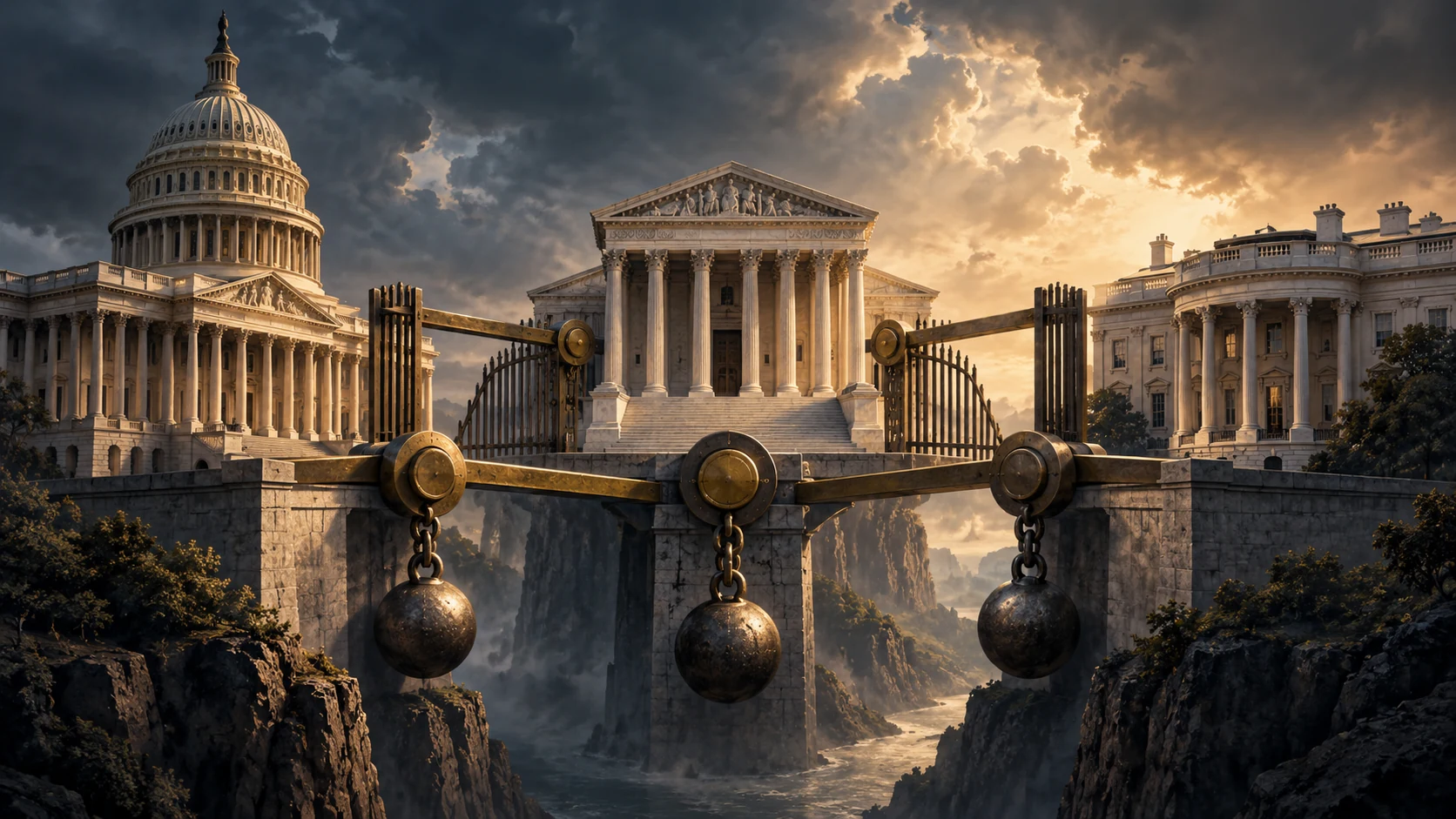
Checks and balances are arrangements designed to prevent political power from being concentrated entirely in one institution or office. Instead of allowing a single authority to make rules, enforce them, interpret them, control public money, and resolve disputes, political systems divide these functions among different institutions. The result is a structure in which powerful actors can limit one another and often need one another's cooperation to act.
The basic idea is simple: political power becomes more difficult to abuse when no single actor controls every stage of a decision. A legislature may pass laws, an executive may implement them, courts may review whether they are legal, and regional or local governments may possess separate responsibilities. Each institution has its own powers, but each also operates within limits created by the others.
Checks and balances are closely related to the separation of powers, but the two concepts are not identical. Separation of powers refers to dividing government functions among institutions. Checks and balances refer to the mechanisms that allow those institutions to restrain, review, or depend on one another. A system can formally separate institutions but provide weak checks if one branch can easily dominate the others.
Legislative approval is one common check. Executives may propose policies, but major laws often require approval from a parliament or congress. This forces the executive to negotiate with representatives who may have different priorities. In bicameral systems, legislation may need approval from two separate chambers, creating an additional veto point.
Executive vetoes provide a check in the opposite direction. A president may be able to reject legislation approved by the legislature. The legislature may then have a procedure for overriding the veto, usually requiring a higher threshold. Neither institution has complete control, so major disagreements must be resolved through negotiation or extraordinary majorities.
Judicial review creates another important restraint. Courts may examine whether laws or executive actions violate constitutional or legal rules. If a court invalidates a government action, political officials may be prevented from implementing it unless they change the policy, amend the law, or use whatever legal procedures remain available.
Courts therefore can possess substantial blocking power. Yet this illustrates an important distinction between negative and positive power. A court may be able to prevent the government from pursuing a particular policy without having the authority or administrative capacity to implement an alternative. It can say that an action is unlawful, but it may not be able to design and operate a complete replacement program.
The same distinction appears elsewhere. A legislative chamber may reject a budget but lack the authority to administer public programs itself. A local government may stop a development project through planning powers while lacking the resources to build a different project. An institution can therefore be extremely powerful as a veto player while remaining weak in its ability to produce a preferred outcome.
Control over public money is another major check. Legislatures often possess authority over taxation and spending. Executives may want to create programs or expand government activity, but they cannot always do so without appropriations. Budget rules force different institutions to cooperate because political ambitions depend on financial authorization.
Appointments can also involve shared authority. An executive may nominate judges, ministers, regulators, or other senior officials, while a legislature or separate body may need to confirm them. This prevents one institution from controlling appointments entirely and can encourage negotiation over candidates.
Oversight mechanisms provide further restraints. Legislative committees can investigate agencies, demand documents, question officials, and review implementation. Independent auditors can examine government spending. Inspectors general, ombuds institutions, anticorruption bodies, and ethics agencies can identify misconduct. These institutions do not necessarily make policy, but they can impose accountability on those who do.
Federalism and decentralization create checks by dividing authority territorially. National governments may control foreign affairs or monetary policy while regional governments manage education, policing, healthcare, or local infrastructure. Local governments can possess separate powers over planning, transportation, or public services.
This division creates multiple centers of political authority. A national government may need regional cooperation to implement policy. Regional governments may depend on national funding. Local authorities may be able to resist or modify national initiatives within their legal powers. The result is a network of dependence rather than a simple hierarchy.
Bureaucracies can also function as part of a checking system. Professional civil services may be legally required to follow established procedures even when political leaders want faster action. Regulatory agencies may have statutory independence. Public officials may refuse instructions that violate the law. Administrative rules can therefore limit how political authority is exercised.
Independent institutions can be particularly important in areas where short-term political incentives are dangerous. Central banks, electoral commissions, audit offices, statistical agencies, and regulators are sometimes given protected autonomy to reduce direct partisan control. The exact design varies, but the goal is usually to separate certain functions from immediate political pressure.
Checks and balances do not require every institution to have equal power. In most systems, some institutions are stronger than others. What matters is whether there are meaningful limits on unilateral action and whether institutions have enough independence to use the powers assigned to them.
Formal rules alone are not sufficient. A court may possess constitutional independence on paper but be unable to restrain the executive if judges can easily be removed or ignored. A legislature may have oversight powers but lack staff, information, or political willingness to use them. An audit institution may issue reports that no one enforces.
Political norms therefore matter. Institutions often depend on unwritten expectations about acceptable behavior. Officials may refrain from using every legal power available because doing so would damage cooperation or violate established conventions. When these norms weaken, formal rules may be tested more aggressively.
Checks and balances can protect liberty by making arbitrary decisions more difficult. If several institutions must approve a major action, one official cannot easily impose personal preferences on the entire political system. Review mechanisms create opportunities to identify legal violations, poor reasoning, or abuse.
These arrangements can also improve decision quality. Legislation reviewed by multiple chambers, committees, agencies, and courts may be examined from several perspectives. Errors can be corrected before they produce larger consequences. Opposition parties and independent institutions can force governments to explain and defend their choices.
However, checks and balances have costs. The same mechanisms that prevent abuse can also slow action. Multiple veto points can produce deadlock, especially when rival political parties control different institutions. Policies supported by large majorities may fail because approval is required from several bodies.
Responsibility can also become difficult to identify. When many institutions participate in a decision, each can blame the others for failure. Citizens may struggle to determine who should be held accountable. This is especially problematic when governments need to respond quickly to emergencies.
Political systems therefore face a fundamental trade-off. Concentrated power can act quickly but carries greater risks of abuse. Dispersed power provides safeguards but can reduce efficiency and clarity. There is no institutional design that eliminates this tension entirely.
Emergency powers illustrate the problem. During wars, disasters, or public health crises, governments may need to act rapidly. Executives are often granted temporary authority to bypass ordinary procedures. Yet emergency powers themselves require checks because temporary concentration of authority can become permanent or excessive. Legislatures, courts, expiration dates, and reporting requirements can help preserve oversight.
Checks and balances also influence political strategy. Leaders must anticipate whether courts will uphold a policy, whether legislatures will approve funding, whether regional governments will cooperate, and whether agencies can implement the decision. Political power therefore depends not only on what an actor wants to do but on which other institutions must participate.
This makes power deeply relational. A president may be powerful because the office can initiate policy, yet dependent on parliament for legislation. A legislature may control spending but depend on agencies for implementation. Courts may interpret the law but rely on executives to enforce judgments. Local governments may possess legal autonomy but depend on national transfers.
No institution needs to be weak for checks and balances to work. In fact, effective restraint often requires several strong institutions, each capable of defending its responsibilities. The purpose is not to eliminate political power but to divide it so that one actor's power encounters another actor's lawful capacity to resist.
The distinction between blocking and governing is especially important. An institution can have tremendous power to stop an action while having little ability to replace it. Political systems therefore contain different kinds of strength. Some actors initiate, some approve, some implement, some finance, and some review. Understanding who controls each stage reveals how checks and balances actually operate.
Checks and balances ultimately rest on the idea that political authority should be powerful enough to govern but limited enough to remain accountable. By distributing decision-making across legislatures, executives, courts, bureaucracies, and territorial governments, political systems create mutual dependence. That dependence can be frustrating, slow, and conflictual, but it is also one of the main mechanisms through which institutions prevent any single authority from controlling every stage of political life.
