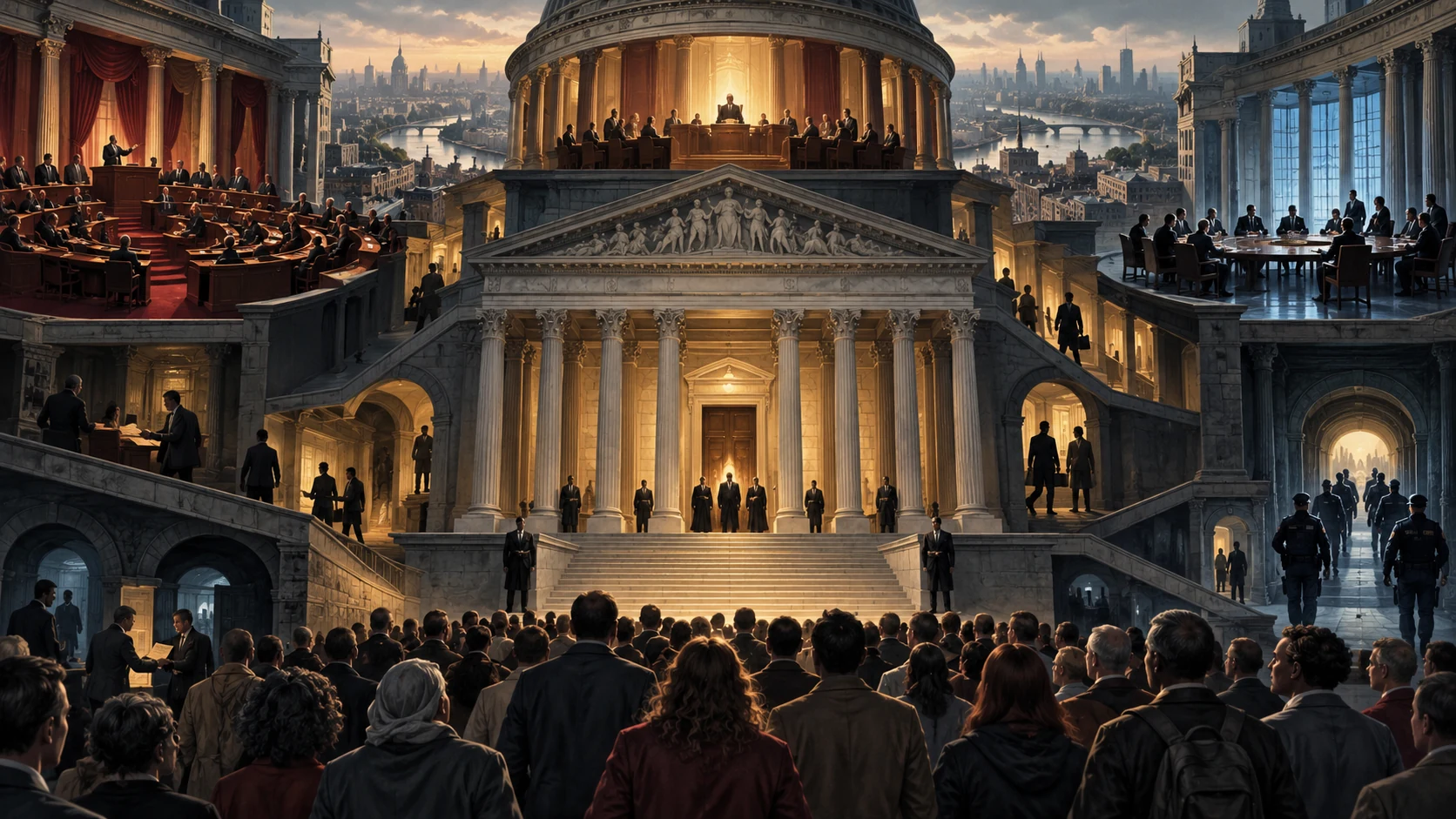
Political power is the ability to shape what other people, groups, or institutions can do. It is often associated with governments because governments make laws, collect taxes, regulate behavior, and enforce decisions. Yet political power is broader than official authority. It includes the capacity to make decisions, prevent decisions, influence others, control access to information, shape the choices available to decision-makers, and determine which issues receive attention. Understanding political power therefore requires looking not only at who formally governs, but also at who can affect outcomes and under what conditions.
The most obvious form of power is the ability to make binding decisions. A parliament can approve legislation, a president can issue certain executive orders, a city council can adopt local regulations, and a court can issue judgments that public institutions are expected to respect. These are visible exercises of power because they produce identifiable decisions. Someone proposes an action, an authorized institution decides, and the decision changes what others may or must do.
However, the ability to block a decision can be just as important as the ability to make one. A legislative chamber may prevent a bill from becoming law. A court may invalidate a government action. A regulatory agency may deny a permit required for a project. A political party may refuse to support a coalition agreement, preventing a government from forming. In each case, the actor may not be able to impose its preferred alternative, but it can prevent someone else from acting. This is sometimes called negative or veto power: the capacity to stop outcomes without necessarily having the capacity to create new ones.
Power also operates through influence rather than command. A minister may have the legal right to make a decision, but advisers, experts, party leaders, public officials, donors, unions, business organizations, social movements, or public opinion may strongly affect what that minister chooses. These actors may lack formal authority, yet their resources, knowledge, connections, reputation, or ability to mobilize supporters can give them substantial influence. Political power is therefore not always located where organizational charts suggest it should be.
Another important form of power involves shaping the alternatives from which others must choose. Decision-makers rarely face an unlimited range of possibilities. Advisers select proposals for consideration, bureaucracies prepare policy options, parties define campaign platforms, committees decide which bills will receive hearings, and institutions operate under legal and financial constraints. If an actor can determine which options reach the decision stage, that actor may influence the outcome even without casting the final vote.
This is why power is often exercised before an official decision occurs. Imagine a committee considering three possible policies. If a powerful actor succeeds in excluding a fourth option before the meeting begins, observers who focus only on the final vote may miss an important exercise of influence. The same applies when certain issues never reach the political agenda, when information is selectively distributed, or when some groups have regular access to officials while others struggle to be heard.
Political power is also relational. It does not exist in isolation, like an object that someone simply possesses. An actor is powerful in relation to other actors and usually within a particular area. A president may have extensive authority over foreign policy but need legislative approval for spending. A large corporation may influence economic policy but remain vulnerable to taxation, regulation, competition law, or judicial decisions. A court may be able to invalidate legislation but depend on executive agencies to enforce its rulings. Power therefore depends on the structure of relationships among institutions and on the resources each one controls.
This means that powerful actors are rarely completely free. Even governments with broad legal authority face constraints. They depend on tax revenue, administrative capacity, public cooperation, information, political support, and the performance of institutions they do not fully control. Businesses depend on employees, customers, infrastructure, credit, legal protections, and political stability. Political parties depend on voters, activists, candidates, donors, and coalition partners. Power creates opportunities, but it also operates within systems of dependence.
The distinction between formal and effective power is particularly important. A constitution may grant an institution significant authority, but that institution may lack the practical capacity to act. A government can pass an ambitious law yet fail to implement it because agencies lack staff, information, funding, or cooperation. Conversely, an actor with no formal right to decide may exercise considerable influence because others rely on its expertise or resources. Legal authority and practical power often overlap, but they are not identical.
Power also varies from one issue to another. A labor union may be influential in wage negotiations but have little effect on foreign policy. A technology company may possess enormous influence over digital infrastructure while having limited control over judicial appointments. A local government may be powerful in land-use decisions but dependent on the national government for funding. There is therefore no single hierarchy that explains every political outcome.
For this reason, asking simply "Who has the most power?" is often less useful than asking more specific questions. Who can make the decision? Who can block it? Who controls the relevant information? Who determines which alternatives are considered? Who can impose costs on others? Who depends on whom? These questions reveal the different ways power operates within political systems.
Political power is best understood as the capacity to shape the behavior, choices, and opportunities of others. Sometimes it appears openly in laws, commands, and votes. At other times it operates through vetoes, expertise, institutional rules, control of information, or influence over the political agenda. No actor possesses unlimited power because every institution depends on others and operates within constraints. Politics is therefore not simply a struggle over who gives orders; it is a complex system of relationships in which actors continuously shape what others are able, willing, or permitted to do.
Power vs. Authority: What Is the Difference and Why Does It Matter?
Power and authority are often treated as if they mean the same thing, but they describe different aspects of political life. Power is the practical ability to influence behavior, shape decisions, or produce consequences. Authority is the recognized right to make decisions, issue commands, or exercise control within a particular area. A person can therefore have power without authority, and another person can possess formal authority without having much effective power.
The distinction becomes clearer when we compare two simple situations. A government minister may have the legal authority to direct a department because the constitution or law assigns that responsibility to the office. Yet the minister may struggle to change policy if the governing coalition is divided, senior officials resist the plan, courts impose legal limits, or the budget is insufficient. The minister has authority, but the practical power to achieve the desired outcome is limited.
Now consider an influential adviser who holds no elected office and has no legal right to issue commands. If political leaders trust that person, depend on their expertise, and frequently follow their recommendations, the adviser may exercise substantial power. The adviser cannot legally order the government to act, but can still shape what the government does. This is power without formal authority.
Authority therefore depends on recognition. A person or institution possesses authority when others accept that it is entitled to make certain decisions. That acceptance may come from law, tradition, professional rules, organizational hierarchy, or widely shared social expectations. A judge has authority in a courtroom because the legal system recognizes the judge's role. A legislature has authority to enact laws because constitutional rules define its powers. A police officer has authority to enforce certain laws, but that authority is limited by legal procedures and jurisdiction.
Power does not require this kind of recognition. A person can influence others through money, information, social status, organizational control, fear, or personal relationships. A business organization may influence regulation because it controls investment and employment. A media owner may shape public debate. A senior party figure may determine which candidates receive support. None of these forms of influence necessarily involve a legal right to command.
Coercion illustrates the difference particularly well. If someone can force another person to comply by threatening harm, that person is exercising power. But coercion alone does not create authority. A criminal organization may be able to control a neighborhood through fear, yet its commands may not be considered legally or morally valid. Similarly, an occupying force can compel obedience without being widely accepted as a legitimate authority.
Authority can itself be effective or ineffective. An institution may formally possess the right to make decisions but lack the resources required to enforce them. A weak regulatory agency may legally supervise an industry while lacking enough inspectors to monitor compliance. A local government may have authority over certain services but depend heavily on national funding. In such cases, formal authority exists, but effective power is constrained.
Legitimacy strengthens authority because it increases voluntary compliance. When people believe that an institution has a rightful claim to rule, they are more likely to accept its decisions even when they disagree with particular outcomes. Citizens may obey court judgments, pay taxes, or follow administrative procedures because they recognize the institutions involved as legitimate. This reduces the need for constant coercion and makes authority easier to exercise.
Authority is also limited in scope. A judge may have enormous authority over a legal case but none over monetary policy. A university administrator may issue binding decisions within an institution but cannot impose criminal penalties. A parliament may enact laws but cannot necessarily decide individual court cases. Political systems divide authority among offices precisely because no single institution is expected to decide everything.
Informal power complicates this picture further. Political parties, unions, business associations, campaign organizations, religious institutions, professional networks, and activist groups often influence public decisions without having formal authority. Their power may come from their ability to mobilize voters, finance political activity, provide expertise, organize strikes, shape public opinion, or impose political costs on decision-makers.
The reverse problem also occurs: people may hold impressive titles but exercise little real influence. A ceremonial head of state can possess formal status while leaving most government decisions to ministers. A party leader may formally control an organization but lose practical influence if members stop following instructions. An agency director may have legal authority while depending heavily on technical staff who control essential information.
This is why political analysis must look at both authority and power. Constitutions, laws, and organizational structures tell us who is officially entitled to decide. They do not always tell us who can actually shape the result. To understand how politics works, it is necessary to examine formal rights alongside practical resources, relationships, incentives, and institutional dependencies.
The distinction also matters for political stability. Governments function more effectively when authority and power are reasonably aligned: institutions that are recognized as entitled to govern also possess enough practical capacity to carry out their decisions. When authority exists without power, the state may be unable to implement its rules. When power exists without recognized authority, influence may appear arbitrary, unaccountable, or illegitimate. Political order depends in large part on how societies manage the relationship between the right to decide and the capacity to make decisions matter.
