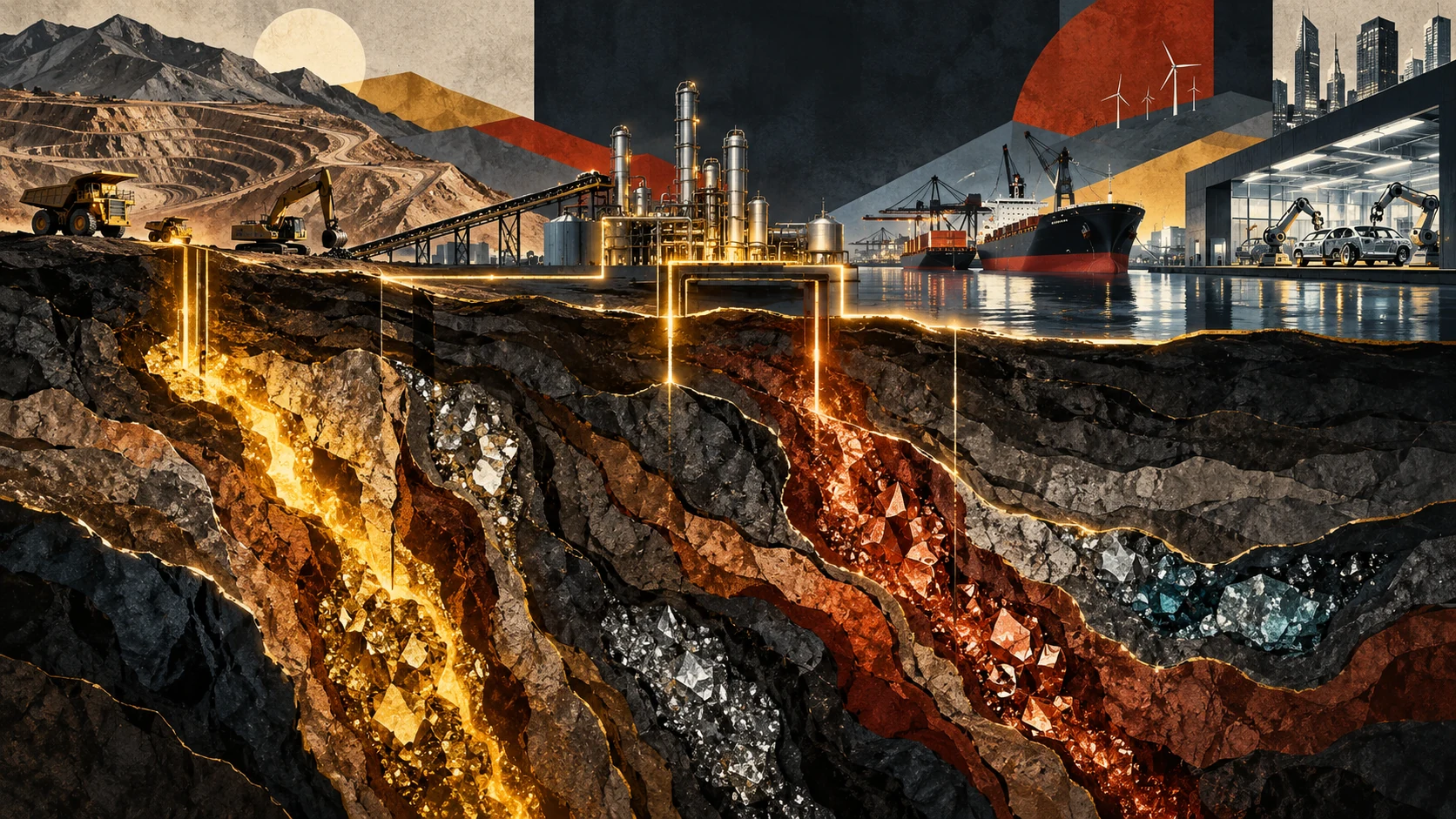
Digital technologies can make the modern economy appear increasingly weightless. Software, cloud computing, artificial intelligence, financial networks, and online services seem to depend more on information than on physical resources. Yet every digital system ultimately rests on a material foundation. Data centers require electricity, cooling systems, semiconductors, copper, steel, and concrete. Smartphones contain dozens of processed materials. Electric vehicles depend on batteries, motors, power electronics, and charging infrastructure. Renewable energy systems require large quantities of metals and specialized components. The growth of advanced technology has not eliminated dependence on natural resources; in many cases, it has made certain minerals more strategically important.
Critical minerals are materials considered economically or strategically important because they are difficult to replace and their supply may be vulnerable to disruption. The exact list differs between countries because industrial structures and security priorities vary, but commonly discussed examples include lithium, cobalt, nickel, graphite, copper, and rare earth elements. Some are essential for batteries, others for electrical wiring, magnets, semiconductors, defense systems, telecommunications, or energy infrastructure.
What makes a mineral critical is therefore not simply rarity. A material can be relatively abundant in the Earth's crust and still create strategic problems if economically viable deposits are concentrated in a few places, processing capacity is limited, production takes many years to expand, or substitutes perform poorly. Economic importance depends on the entire path from geological deposit to usable industrial input.
This distinction is fundamental because natural resources do not become economically useful merely by existing underground. A mineral deposit must be discovered, evaluated, financed, permitted, mined, processed, transported, refined to the required quality, and integrated into manufacturing systems. Each stage requires capital, technology, expertise, infrastructure, and often long-term commercial relationships. A country may possess enormous geological reserves yet capture only a limited share of the economic power associated with them.
Mining is the first major step, but even mining itself is more complicated than extracting rock from the ground. Commercial viability depends on ore quality, deposit depth, geography, energy costs, water availability, environmental conditions, labor, infrastructure, taxation, political stability, and the expected market price. Two countries may possess similar quantities of a resource while facing very different extraction costs.
Large mining projects also require significant capital before they generate revenue. Exploration can fail. Permitting can take years. Roads, ports, power supplies, or railways may need to be built. Commodity prices can change before production begins. Because of these risks, control over financing can be almost as important as control over the deposit itself.
A government may legally own subsurface resources while foreign or private companies provide the capital and technical knowledge needed to develop them. In that case, economic control is divided. The state may collect taxes, royalties, or equity returns, while investors may control production decisions, technology, marketing, or access to international customers. Legal ownership of the resource and effective control over its economic use are not necessarily identical.
Processing creates another layer of power. Raw ores are rarely useful to advanced industries in the form in which they are mined. They must be crushed, separated, concentrated, chemically treated, refined, and converted into materials meeting precise industrial specifications. In some supply chains, processing is more technically demanding and economically concentrated than extraction.
This means a country that mines a large share of a mineral may still depend on another country to refine it. The processed material may then be turned into battery components, magnets, electronic parts, or other intermediate products somewhere else. The final manufacturer can therefore depend on a chain involving several countries, each controlling a different stage.
Rare earth elements illustrate the problem particularly well. Their name can create the impression that the main difficulty is geological scarcity, but the more important challenge is often separation and processing. Rare earth deposits commonly contain several chemically similar elements mixed together. Producing high-purity materials requires specialized facilities, technical expertise, and careful waste management. A country may therefore possess deposits without possessing a competitive rare earth industry.
The same principle applies to battery materials. Lithium can be extracted from brines or hard-rock deposits, but raw lithium must be processed into chemical compounds suitable for battery manufacturing. Nickel used in advanced batteries must meet particular purity standards. Graphite may need extensive purification and shaping before it becomes battery-grade anode material. The strategically important asset is not merely the mine but the complete industrial capability surrounding it.
Manufacturing moves the chain one step further. A country can import refined materials and transform them into high-value components. Battery cells, electric motors, semiconductors, permanent magnets, cables, and power electronics may contain relatively modest amounts of raw material compared with their final market value. Technical knowledge, industrial scale, quality control, patents, and production experience can therefore capture more value than extraction alone.
This helps explain why resource-rich countries are not always the most economically powerful participants in resource markets. A country may export low-value raw material and import expensive finished products containing the same material. The difference lies in processing, manufacturing, technology, branding, logistics, and access to customers.
Economic power tends to increase when a country or company controls a stage that others cannot easily replace. If many producers can supply the same raw mineral, no individual miner has much leverage. If only a few refiners can produce the purity required by advanced manufacturers, processing becomes a more important source of power. If a specialized technology is protected by patents or difficult-to-reproduce expertise, control can shift further downstream.
Geographic concentration increases vulnerability. If most production of a critical input occurs in a small number of countries, political instability, conflict, natural disasters, export restrictions, labor disputes, or logistical problems can affect global supply. Buyers may be exposed even when their direct supplier is located elsewhere because that supplier itself depends on concentrated upstream production.
Concentration should therefore be measured across the entire supply chain rather than only at the mine. A mineral may be mined in several regions but refined mainly in one. Refining may be diversified while component manufacturing remains concentrated. A finished product may appear globally sourced even though a single upstream material represents a hidden bottleneck.
These bottlenecks create economic power because they reduce alternatives. A supplier controlling an essential stage can influence prices, contract terms, delivery schedules, and access. During shortages, buyers may be forced to compete for limited output. The strategically important question becomes not simply who possesses the largest resource base, but who can actually deliver usable material at the moment it is needed.
Time strengthens this power because mineral supply cannot usually expand quickly. Opening a new mine can require years of exploration, financing, permitting, construction, and infrastructure development. Processing facilities also take time to build and qualify. Manufacturers may need lengthy testing before accepting material from a new supplier. When a shortage appears, consumers cannot necessarily create alternatives within months.
This slow response makes critical mineral markets vulnerable to sudden shifts in demand. If a new technology rapidly increases the need for a particular material, existing production may struggle to keep pace. Prices can rise sharply, encouraging new investment, but the additional supply may arrive only much later.
High prices eventually produce adjustment. Manufacturers may redesign products to use less of the expensive material. Recycling may become more attractive. New deposits may be developed. Substitute technologies may gain market share. These responses limit the long-term power of any supplier, but they do not eliminate short-term vulnerability.
Substitution is one of the strongest constraints on resource power. A mineral is most strategically important when few alternatives can perform the same function at comparable cost. If manufacturers can easily replace one material with another, a supplier's ability to impose unfavorable conditions is limited. If substitution reduces performance substantially or requires redesigning entire production systems, dependence is stronger.
Technological change can therefore alter the strategic importance of minerals. A material that is essential to one generation of batteries may become less important if another chemistry becomes dominant. A specialized metal used in one manufacturing process may lose value when a different design emerges. Natural resources matter, but their economic significance is determined partly by technology.
The reverse can also happen. A mineral that once had a relatively minor market can become strategically important when a new technology creates large demand. The geology does not change, but the economic meaning of the resource does. Criticality is therefore dynamic rather than permanent.
Infrastructure determines whether mineral wealth can be converted into usable supply. Mines need electricity, water, roads, railways, ports, and communication networks. Bulk materials can be expensive to transport, making access to efficient logistics essential. A rich deposit in a remote region may be commercially unattractive if bringing the output to market requires enormous infrastructure investment.
Transport routes can themselves become strategic bottlenecks. Minerals may cross borders several times between extraction and final manufacturing. Ores can be shipped to processing centers, refined materials sent to component manufacturers, and components delivered to assembly plants. Ports, railways, shipping lanes, and border infrastructure therefore become part of resource security.
This creates dependence beyond the countries where minerals are found. A state may have no significant deposits yet occupy an important position through processing capacity, maritime infrastructure, industrial technology, or control of trade routes. Another may possess abundant resources but remain dependent on foreign companies to move and refine them.
Energy is particularly important because mining and processing can be highly energy-intensive. Electricity prices affect the economics of refining, smelting, and mineral conversion. Reliable power is also essential because interruptions can damage industrial operations or reduce output. Countries with competitive energy systems may therefore gain advantages in resource processing even when they do not possess the largest reserves.
Water availability and environmental management can be equally important. Mining can require large volumes of water and generate waste that must be handled safely. Processing can involve chemicals and create difficult environmental challenges. Communities may oppose projects if they believe the economic benefits are small relative to local environmental or social costs.
These conflicts can slow development and make supply less predictable. A deposit that appears enormous on a geological map may never become a mine if regulatory, environmental, financial, or political barriers cannot be resolved. Resource estimates must therefore be separated from economically recoverable supply.
The distinction between resources and reserves is useful here. A geological resource refers broadly to known concentrations of material that may have economic potential. A reserve is generally a more specific category referring to material that can be economically extracted under defined conditions using available technology and within relevant legal and operational constraints. Prices, technology, and regulation can change what qualifies as economically viable.
This is another reason headline claims about national mineral wealth can be misleading. Having a large resource base does not guarantee profitable production. Extraction may be too expensive. Infrastructure may be absent. Political risk may deter investment. The processing technology may belong to foreign firms. Buyers may already have long-term contracts elsewhere.
Commercial relationships matter because mineral markets often rely on long-term agreements. Manufacturers want reliable supplies with precise technical characteristics, while mining companies need confidence that customers will purchase enough output to justify large investments. These relationships can create durable networks that are difficult for new suppliers to enter.
Quality qualification can become a hidden barrier. A battery or semiconductor manufacturer cannot necessarily substitute a new source immediately simply because the chemical composition appears similar. Materials may need extensive testing to ensure consistency and safety. Production lines may be optimized for particular specifications. These technical requirements make switching slower than ordinary market models might suggest.
Intellectual property and specialized knowledge further complicate control. A country can possess ore while lacking the technology required for efficient extraction or refinement. Companies may control proprietary processing methods, geological data, specialized machinery, or manufacturing techniques. Economic power can therefore rest with the owner of knowledge rather than the owner of the ground.
Skilled labor is another constraint. Mining engineers, metallurgists, geologists, chemical engineers, process specialists, and highly trained technicians are needed throughout the chain. Developing this workforce takes time. A country seeking to move from raw material exports into refining or advanced manufacturing must build human capabilities as well as factories.
This makes industrial development around minerals difficult but potentially valuable. Instead of exporting raw material, a resource-rich country may try to capture more value by developing local processing, component production, or manufacturing. Success can create jobs, technological capabilities, and greater control over the supply chain.
However, moving downstream is not automatically profitable. Processing plants require scale, reliable energy, technical knowledge, environmental management, and access to customers. Governments that force local processing without these conditions can create inefficient industries that survive only through subsidies or trade restrictions. Resource policy works best when geological advantage is combined with realistic industrial capability.
National ownership policies can also produce mixed results. Governments may require state participation, local content, royalties, export restrictions, or domestic processing. Such policies can increase the national share of resource income, but excessive uncertainty or unstable rules may discourage investment. The balance depends on bargaining power: countries with highly desirable deposits and strong institutions can often demand better terms than countries competing for scarce capital.
Foreign investment is therefore neither inherently exploitative nor automatically beneficial. It can provide capital, technology, infrastructure, and access to global markets. It can also leave much of the value chain outside the producing country if contracts are poorly designed or local capacity remains weak. The central question is how risks, profits, knowledge, and decision rights are divided.
State-owned companies sometimes play a major role in resource sectors. They can help governments retain control over strategic assets and capture more revenue. They may also support long-term investments that private firms would avoid. But they can suffer from political interference, inefficiency, corruption, or weak financial discipline if governance is poor.
Private companies face different incentives. Competition and profit pressure can encourage efficiency and technological improvement, but companies may prioritize shareholder returns over national strategic goals. No ownership model automatically solves the problem of converting mineral resources into durable economic power. Institutional quality matters greatly.
Resource revenues can themselves become a source of vulnerability. Countries dependent heavily on mineral exports may experience large swings in government revenue and foreign exchange earnings when commodity prices change. Booms can encourage excessive spending, while downturns create fiscal crises. Exchange-rate appreciation during commodity booms can also make other export industries less competitive, a problem sometimes associated with the broader concept of the resource curse.
The resource curse is not an inevitable outcome of mineral abundance. Some resource-rich countries have built strong institutions, diversified economies, and long-term savings funds. Others have experienced corruption, conflict, weak industrial development, or excessive dependence on commodity exports. Natural wealth creates possibilities, but institutions determine how much of that potential becomes lasting economic strength.
Sovereign wealth funds can help convert temporary resource income into diversified financial assets. Instead of spending all revenue immediately, governments can save part of it for future generations or use it to stabilize budgets during downturns. This reduces dependence on volatile commodity prices and turns underground wealth into a broader portfolio of national assets.
Recycling can also reduce dependence on primary mining over time. Metals do not disappear after one use, and many can be recovered from vehicles, electronics, batteries, machinery, and infrastructure. As more material enters the economy, recycling can become an increasingly important source of supply.
However, recycling cannot immediately replace mining in rapidly growing industries. If total demand is expanding, there may not be enough old equipment available to recycle. Collection systems can be incomplete, recovery can be technically difficult, and some materials are dispersed in ways that make recycling expensive. Secondary supply improves resilience but usually complements rather than eliminates primary extraction.
Stockpiling is another strategy. Governments or companies can hold strategic reserves of critical materials to protect against temporary disruptions. Stockpiles can provide time to find new suppliers or adjust production, but they are expensive to maintain and cannot compensate indefinitely for a structural shortage.
Diversification is therefore central to mineral security. A buyer relying on several countries, processing centers, and transportation routes is less vulnerable than one dependent on a single supplier. Diversification can involve supporting new mines, developing alternative refining capacity, redesigning products, investing in recycling, or creating trade partnerships.
Yet diversification often costs more than relying on the cheapest existing supplier. Concentrated supply chains may emerge precisely because one country or company is highly efficient. Building redundant capacity elsewhere can therefore increase short-term costs. The economic debate is partly about how much society should pay for resilience.
This is similar to the trade-off between efficiency and redundancy in energy or finance. A system optimized entirely for low cost under normal conditions can become fragile during crises. Maintaining several suppliers, spare capacity, and inventories may look inefficient until disruption occurs. Security has an insurance value that market prices do not always capture fully.
Governments increasingly treat critical minerals as a strategic issue because supply interruptions can affect defense, communications, transportation, electricity, and advanced manufacturing simultaneously. Military systems depend on specialized metals, electronics, and magnets. Civilian infrastructure often uses the same materials. A severe shortage can therefore create national-security as well as commercial consequences.
Export restrictions demonstrate how resource control can become geopolitical leverage. A producing country may limit exports to protect domestic industry, raise prices, respond to political disputes, or preserve strategic resources. Buyers facing few alternatives may then need to change foreign policy, subsidize new supply, or redesign technologies.
But resource coercion has limits. Restricting exports can encourage customers to diversify more rapidly, develop substitutes, recycle materials, or invest in competing producers. A supplier may gain short-term leverage while damaging its long-term market position. Economic power is strongest when dependence can be maintained without causing others to escape it.
Importing countries also possess leverage. A producer may depend heavily on access to a large consumer market, advanced mining equipment, foreign financing, or specialized technology. If buyers can coordinate or shift demand, the producer's apparent resource advantage may weaken. Mineral relationships are often forms of mutual dependence rather than simple control by the resource owner.
This is why reserves alone are a poor measure of strategic power. A country may possess the world's largest known deposit yet remain dependent on foreign capital, machinery, expertise, refineries, shipping, and customers. Another country with few deposits may control advanced processing technology, large manufacturing capacity, and global commercial networks. The second country can sometimes exercise more economic influence over the mineral than the country where it is mined.
Control is therefore distributed across the supply chain. Geology determines where extraction is possible. Finance determines which projects are built. Technology determines whether material can be processed efficiently. Infrastructure determines whether it can reach market. Manufacturing determines where much of the value is created. Commercial networks determine who buys it. Political institutions determine how rights and revenues are allocated.
The digital economy does not escape this material structure. Semiconductor fabrication requires highly specialized materials, enormous amounts of electricity and water, and complex equipment. Cloud computing depends on data centers built from physical components and connected to power grids. Artificial intelligence requires computing hardware whose production relies on global mineral and manufacturing chains. Electric vehicles are software-intensive products, but they remain machines made from metals, chemicals, glass, plastics, and batteries.
Even information itself must be stored, transmitted, and processed through physical systems. Fiber-optic cables cross oceans. Satellites require specialized materials. Communication networks need towers, power electronics, backup systems, and data centers. The apparent immateriality of digital services rests on a vast industrial foundation.
This does not mean natural resources have become the only or even the primary source of economic power. Knowledge, institutions, capital, technology, and organizational capacity can be more important than geology. A country with few resources can become extremely wealthy by importing raw materials and transforming them into high-value products. Resource ownership is one form of advantage among many.
What critical minerals reveal is how these different forms of power interact. A mine without financing is inactive. Financing without technical expertise may be useless. Processing without reliable energy is uncompetitive. Manufacturing without access to inputs is vulnerable. Technology without physical materials cannot be produced at scale.
Economic power therefore belongs less to whoever simply possesses a resource than to whoever controls the chain required to make that resource economically useful. The strongest position comes from having several capabilities at once: access to deposits, efficient extraction, processing technology, infrastructure, skilled labor, financing, manufacturing, and diversified markets.
For resource-rich countries, the central challenge is converting geological wealth into durable economic capacity. That may involve capturing a fair share of resource revenues, developing infrastructure, building technical skills, encouraging downstream industries where economically viable, and using revenues to diversify the wider economy. Simply extracting and exporting raw material can generate income without necessarily creating lasting strategic power.
For importing countries, the challenge is reducing vulnerability without pursuing unrealistic self-sufficiency. Diversified suppliers, recycling, strategic reserves, substitute technologies, domestic processing, and international partnerships can all strengthen resilience. The objective is not to eliminate trade but to avoid dependence on a single point of failure.
Critical minerals matter because modern technology has changed the kinds of resources economies need, not because it has freed them from resources altogether. Digitalization, electrification, automation, and advanced manufacturing remain deeply physical processes. Behind every battery, data center, communications network, and renewable power system lies a chain of mines, refineries, factories, ports, energy systems, and specialized knowledge.
Natural resources still matter, but possession alone is not power. Economic control depends on who can extract the material, who can process it, who owns the technology, who finances the projects, who controls transportation, and who can deliver reliable supply to manufacturers. A country may sit above valuable deposits and still occupy a weak position in the value chain. Another may have few reserves yet dominate the stages that turn minerals into economically indispensable products.
The deeper lesson is that resource power is relational. A mineral becomes strategically powerful when others depend on it and cannot easily find alternatives. That dependence can arise from geology, but it can also arise from technology, infrastructure, processing capacity, or commercial concentration. In a supposedly digital economy, physical resources remain fundamental because information and technology still require matter. The critical question is no longer simply who has the minerals, but who controls the system that turns them into economic capability.
Technology as Economic Power: How Control of Innovation Creates Dependence
Technology is often described as a source of productivity, growth, and progress, but it is also a source of economic power. The organizations and countries that control important technologies can influence who is able to produce, compete, communicate, innovate, and participate in modern markets. This influence does not come only from inventing something new. It can arise from patents, software ecosystems, digital platforms, technical standards, infrastructure, proprietary data, and specialized knowledge that others cannot easily reproduce.
The central issue is dependence. A technology becomes economically powerful when many users, companies, or governments rely on it and switching to an alternative is difficult, expensive, or slow. In that situation, control over technology can become control over the conditions under which others operate. A firm that owns critical software may influence customers through pricing, licensing, compatibility, or access rules. A country that dominates an essential technology may shape the industrial options available to other countries. Economic power emerges not simply from ownership, but from the lack of practical substitutes.
Patents are one of the most direct ways innovation becomes a source of control. A patent gives its holder temporary legal rights over a protected invention, allowing the owner to prevent others from using the invention commercially without permission. This exclusivity is intended to encourage research and development by giving innovators an opportunity to recover their costs and earn returns.
At the same time, patents can create dependence when the protected technology is difficult to replace. A company that needs access to a patented manufacturing process, drug, component, or industrial design may have to accept licensing terms set by the patent holder. The economic significance of the patent depends on how important the technology is and whether substitutes exist. A patent on a minor feature may create little leverage. A patent covering a critical technology used across an entire industry can create much more.
Patent portfolios can strengthen this effect. Large technology companies may own thousands of patents covering different parts of complex products. Competitors entering the market may need to negotiate licenses for multiple technologies, increasing costs and legal risks. The barrier is not always a single invention but the accumulated web of rights surrounding an established technological system.
Software creates another form of economic power because it can become deeply embedded in organizations. A company may adopt an operating system, database, design platform, cloud service, or enterprise software package and then build years of processes around it. Employees are trained to use the system. Data are stored in proprietary formats. Other applications are connected to it. Internal workflows become dependent on its functions.
Once this happens, switching is no longer a simple matter of buying a competing product. Migration may require retraining staff, rewriting software, converting databases, changing equipment, rebuilding integrations, and accepting the risk of disruption. These are switching costs, and they can give the existing supplier significant bargaining power.
A software provider with high switching costs may be able to increase prices or alter licensing terms without losing customers immediately. Users may dislike the new conditions but conclude that migration would be even more expensive. Their dependence therefore gives the supplier power that cannot be explained by the original quality of the product alone.
This distinction is important because technological power often develops cumulatively. A company may initially win customers through genuine innovation and superior performance. As more users adopt its technology, complementary products are built around it, employees learn it, data accumulate within it, and business processes become connected to it. The original competitive advantage can gradually become structural dependence.
Digital platforms make this process even stronger through network effects. A network effect occurs when a service becomes more valuable as more people use it. A social network is useful because other people are already there. An online marketplace attracts sellers because it has buyers, while buyers come because it has sellers. A payment platform becomes more useful when many merchants and consumers accept it.
These effects can produce rapid concentration. A new platform may struggle even if its technology is good because users prefer the system where everyone else already participates. The established platform benefits from its accumulated network, and the network itself becomes a barrier to entry.
Once a platform becomes an important gateway, its economic role changes. It is no longer merely offering a product. It is organizing access between different groups. A marketplace connects sellers to buyers. An app store connects developers to users. A search engine connects advertisers to consumers. A cloud platform connects businesses to digital infrastructure.
Control over these gateways can create substantial power. The platform may set fees, technical requirements, ranking systems, advertising rules, access conditions, and standards for participation. Businesses can remain legally independent while becoming economically dependent on the platform that connects them to customers.
This dependence is particularly important when businesses have built their entire operations around one digital ecosystem. A seller relying on a single marketplace may be deeply affected by changes to commissions or search rankings. A developer dependent on one app distribution system may have to accept the platform's payment and review rules. A company that stores all its data with one cloud provider may face high costs if it decides to leave.
Infrastructure deepens technological dependence because digital activity requires physical and organizational systems beneath the visible software layer. Data centers, fiber-optic networks, semiconductor fabrication, undersea cables, satellites, cloud computing infrastructure, telecommunications networks, and electricity systems all support the digital economy.
Control over this infrastructure can become a strategic advantage. A company that provides essential cloud services may support thousands of other businesses. A country with advanced semiconductor manufacturing capacity may influence industries far beyond electronics. A telecommunications provider controlling important networks can shape access to digital services.
The greater the difficulty of reproducing this infrastructure, the more significant the power attached to it. Building a global cloud network, an advanced semiconductor plant, or a nationwide telecommunications system requires enormous amounts of capital, expertise, equipment, and time. The high cost of entry protects established providers from rapid competition.
Semiconductors offer a particularly clear example of technological interdependence. Modern economies rely on chips for vehicles, industrial machinery, computers, communications equipment, medical devices, defense systems, and countless consumer products. Yet the semiconductor supply chain is divided across highly specialized stages, including design, manufacturing equipment, fabrication, packaging, materials, and software tools.
No single country necessarily controls every stage. One may lead in chip design, another in fabrication, another in specialized manufacturing equipment, and others in materials or packaging. This creates a network of mutual dependence in which control over one critical stage can become a source of leverage.
A country that lacks access to advanced semiconductor technology may find it difficult to develop artificial intelligence, telecommunications equipment, modern weapons, or advanced manufacturing. Technology can therefore become a constraint on national development rather than merely a commercial input.
Export controls demonstrate how technological capability can become geopolitical power. Governments may restrict the sale of advanced equipment, software, or components to particular countries for security reasons. The effectiveness of such restrictions depends on whether the technology can be obtained elsewhere. If alternatives are scarce, control over the technology becomes a powerful policy instrument.
This reveals an important difference between natural resource power and technological power. A mineral deposit is limited by geology. Technology can theoretically be reproduced through learning and investment, but in practice advanced knowledge may take many years to develop. During that period, the holder of the technology can exercise considerable influence.
Specialized knowledge is one of the least visible forms of technological power. Complex systems depend on engineers, researchers, programmers, scientists, technicians, and experienced managers who know how to make them work reliably. Written documentation alone may not be enough to reproduce this capability.
Much valuable knowledge is tacit rather than fully codified. It exists in practical experience, accumulated routines, troubleshooting skills, supplier relationships, and production culture. Two companies can possess similar equipment and patents yet achieve very different results because one has decades of manufacturing experience.
This makes human capital strategically important. A country seeking to build an advanced industry cannot simply purchase machines and expect immediate success. It may need universities, research institutions, skilled workers, suppliers, testing facilities, and years of operational learning. Technological capacity is an ecosystem rather than a collection of isolated inventions.
Standards create another form of economic influence. Technical standards determine how products communicate, connect, and operate together. They define things such as communication protocols, file formats, charging systems, safety requirements, and network architecture.
Standards are valuable because compatibility makes technology easier to use. Consumers benefit when devices work together, businesses benefit when components are interchangeable, and manufacturers benefit from predictable technical requirements. But standards can also create power when one company or group controls essential elements of them.
A widely adopted standard can become difficult to replace because thousands of products and organizations are already built around it. New entrants may have to conform to the existing system rather than introduce an incompatible alternative. If the standard incorporates proprietary technology, its owners may collect licensing fees or influence future development.
This can produce path dependence, in which past technological choices shape future possibilities. A system may persist not because it is objectively the best option available today, but because the cost of changing everything built around it is too high. Once infrastructure, training, software, and investment are committed to a particular technology, the economy becomes partially locked into that path.
Lock-in does not mean change is impossible. New technologies can replace established systems when the benefits become large enough. But displacement may require a major technological improvement rather than a small one because the challenger must overcome the accumulated advantage of the incumbent system.
Data can reinforce this cumulative power. Digital companies often improve their services by analyzing user behavior, transactions, locations, searches, purchases, or interactions. More users generate more data, which can improve recommendations, advertising, fraud detection, logistics, and product design. Better services then attract more users.
This feedback loop can strengthen established companies. A new competitor may have a good product but lack the historical data needed to match the incumbent's performance. Data therefore function as an asset that can increase in value as the user base grows.
Control over data can also create informational asymmetry between platforms and the businesses that depend on them. A platform may observe market-wide trends that individual sellers cannot see. It can know which products are gaining demand, how consumers compare prices, and where purchasing behavior is changing. This knowledge can improve the platform's bargaining position and strategic decisions.
Artificial intelligence may intensify some of these dynamics because advanced systems depend on several concentrated inputs at once. Large amounts of computing power, sophisticated chips, specialized software, high-quality data, technical expertise, and substantial capital are often required. Organizations that control these resources can develop capabilities that smaller actors cannot easily reproduce.
Computing infrastructure itself can become a bottleneck. If advanced models require scarce processors and large data centers, access to computational capacity becomes a form of economic power. Companies with better access can experiment more, train larger systems, and deploy products faster.
The result can be cumulative advantage. Technological success generates revenue. Revenue finances research. Research produces better products. Better products attract more users and data. More users improve the company's ecosystem and strengthen its market position. The process can repeat until the gap between leaders and challengers becomes difficult to close.
Countries can experience similar cumulative effects. A nation with strong universities, venture capital, advanced manufacturers, large technology companies, skilled workers, and major research institutions can generate new industries more easily because each part supports the others. Successful companies train workers who later create new companies. Suppliers develop specialized capabilities. Investors learn how to evaluate technical ventures. Universities attract researchers.
This is why technology clusters often become geographically concentrated. Innovation depends partly on proximity to talent, capital, customers, suppliers, and knowledge networks. Once a cluster becomes established, it can attract still more resources, making it difficult for other regions to replicate.
Technological leadership can therefore affect national economic development. Countries that control advanced technologies can capture high-value activities, attract skilled workers, and influence global standards. Countries that depend entirely on imported technology may participate mainly in lower-value parts of supply chains.
Dependence does not mean imports are inherently harmful. International specialization allows countries to benefit from technologies they could not efficiently develop alone. Attempting to produce every technology domestically would be extremely expensive and often unrealistic. The problem arises when dependence is concentrated in areas that are essential and difficult to substitute.
A country dependent on foreign consumer electronics faces a different strategic problem from one dependent on foreign telecommunications infrastructure, advanced chips, military systems, or electricity-grid technology. Criticality depends on what would happen if access were suddenly restricted.
Diversification can reduce technological vulnerability. Governments and companies may use multiple suppliers, support open standards, maintain compatibility between systems, develop domestic expertise, or avoid placing all critical infrastructure with a single provider. These choices can increase costs in the short term but preserve alternatives.
Open standards can be particularly important because they reduce switching costs and make competition easier. When systems use common interfaces and portable formats, customers can change providers without rebuilding everything from the beginning. Interoperability therefore limits the amount of power any one company can gain from technological lock-in.
Data portability can have a similar effect. If users can move information easily from one service to another, competing platforms become more credible. If data are trapped in proprietary systems, customers become more dependent on the incumbent provider.
Competition policy can address some forms of technological power, especially when companies use control over one market to restrict competition in another. Regulators may examine acquisitions, platform rules, exclusivity agreements, interoperability, or the treatment of competitors that depend on a dominant company's infrastructure.
The challenge is that technological markets change quickly. Regulation that is too slow may allow dominance to become entrenched, while regulation that is too rigid may prevent innovation or lock existing technologies into place. Policymakers must distinguish between advantages earned through better products and practices that prevent challengers from competing.
Intellectual property creates a similar trade-off. Strong protection can encourage innovation by allowing creators to capture returns. Excessively broad or long-lasting control can restrict follow-on innovation and raise barriers for competitors. Weak protection can reduce incentives to invest in expensive research. The optimal balance varies across industries.
Pharmaceuticals illustrate the issue clearly. Developing new medicines can require large investments and substantial risk. Patents can provide the possibility of returns that justify those costs. But once a medicine becomes essential, exclusive control can also create pricing and access concerns. Innovation incentives and dependence exist simultaneously.
Software raises different questions because copying costs can be extremely low. A program may require years and large investments to develop but almost nothing to reproduce once created. Intellectual property and licensing therefore determine how the developer captures value. Control over updates, compatibility, and access can become more important than physical production costs.
Subscription models can strengthen continuing dependence because users no longer purchase a permanent copy but pay for ongoing access. This can improve maintenance and provide regular updates, but it also gives providers continued influence over pricing and functionality.
Cloud computing extends this model to infrastructure. Companies no longer need to own every server or data center. They can rent computing capacity as needed, reducing upfront costs and making advanced technology accessible to smaller businesses. This has created enormous efficiency and flexibility.
At the same time, dependence on cloud providers can become strategically significant. A company may rely on one provider for storage, databases, analytics, cybersecurity, and computing. Migrating away can become technically complex. The convenience that made adoption attractive can later create lock-in.
The same pattern appears throughout technological development: integration creates efficiency, while integration can also create dependence. A tightly connected ecosystem can make products easier to use but harder to leave. A shared standard can improve compatibility but strengthen the organizations controlling it. A platform can reduce transaction costs while gaining influence over participants.
This means economic power cannot be judged simply by asking whether technology benefits users. A technology can create enormous value and still generate significant dependency. The relevant question is whether users retain meaningful alternatives.
Technological dependence also affects bargaining between states. Countries may restrict access to advanced technology, condition licensing on political relationships, or use export controls as part of sanctions. Governments may respond by investing in domestic alternatives, building strategic reserves of equipment, or forming alliances around supply chains.
These efforts are often described as technological sovereignty or strategic autonomy. Complete independence is rarely realistic. Modern technologies are too complex and global supply chains too interconnected. The more practical goal is to avoid catastrophic dependence on any single external source.
This can involve maintaining domestic capacity in selected strategic sectors while continuing to trade extensively elsewhere. It can also involve alliances. A country does not need to produce everything itself if trusted partners can provide reliable access.
Reliability therefore matters as much as ownership. A foreign supplier that has provided stable access for decades may represent less practical risk than an inefficient domestic producer. Security is about the probability and consequences of interruption, not simply whether the supplier is foreign.
Technology transfer can reduce dependence, but successful transfer requires more than purchasing equipment. Countries need skills, institutions, research capacity, suppliers, and operational experience. Importing machines without developing the ability to maintain, improve, and reproduce them can create a new form of dependency.
Education and research policy therefore become part of economic power. Universities and technical institutes produce the people capable of understanding advanced systems. Public research can create foundational knowledge. Immigration policy can affect access to scientific and engineering talent. Technology policy is inseparable from human-capital policy.
Capital also matters because advanced innovation is expensive. Semiconductor plants, biotechnology laboratories, satellite networks, and large computing facilities require enormous investment. Financial systems capable of supporting high-risk, long-term projects therefore contribute to technological leadership.
Large domestic markets can provide another advantage. Companies serving millions of users can achieve scale quickly, gather data, and recover development costs across a broad customer base. Market size can therefore help transform innovation into durable economic power.
Government procurement can reinforce this process. States are major buyers of defense systems, healthcare technology, energy infrastructure, and digital services. Their purchasing decisions can help new technologies reach scale, establish standards, and support domestic industries.
Military technology has historically played an important role in this relationship because governments are willing to finance expensive research with uncertain commercial returns when national security is involved. Technologies initially developed for strategic purposes can later produce civilian applications, while commercial technologies increasingly shape defense capabilities.
The relationship between public institutions and private technology companies is therefore complex. Governments depend on private firms for innovation and infrastructure, while companies depend on governments for research funding, intellectual property protection, procurement, regulation, education systems, and legal stability. Technological power emerges from this broader ecosystem rather than from companies alone.
Economic influence can extend through development relationships as well. Countries that supply telecommunications systems, payment infrastructure, cloud services, or industrial technology to other countries may shape technical standards and long-term dependencies. Once major infrastructure is built around one technological ecosystem, changing suppliers can become difficult.
This does not necessarily imply political coercion. Long-term technological partnerships can benefit both sides. The strategic concern appears when dependence becomes so concentrated that the supplier can impose conditions the buyer cannot realistically refuse.
The power of technological control is therefore closely related to the ability to walk away. A customer that can switch software providers easily has leverage. A manufacturer with several semiconductor suppliers has alternatives. A country capable of replacing foreign infrastructure can resist pressure more effectively. The fewer substitutes available, the stronger the supplier's position becomes.
Time is especially important because technological capabilities cannot be recreated instantly. Developing a new chip fabrication process, retraining thousands of engineers, rebuilding a cloud architecture, or replacing a national telecommunications network can take years. A dependent buyer may know that alternatives are theoretically possible while still lacking any immediate option.
This gap between theoretical and practical alternatives is where much technological power exists. Control does not need to be permanent to be effective. If a supplier can impose costs for several years before competitors emerge, that temporary dependence can still shape major economic and political decisions.
Technological power is nevertheless unstable over the long term. Innovation can destroy old advantages. New standards can replace established ones. Open-source software can challenge proprietary systems. A new semiconductor architecture can reduce dependence on older designs. New firms can sometimes overcome network effects by offering a sufficiently better product.
This constant possibility of disruption distinguishes technological power from some forms of physical monopoly. The same innovation that creates dependence can eventually undermine it. Dominant firms must continue investing because their strongest defense is often technological progress itself.
Yet incumbents can sometimes use existing power to slow that process. They may acquire potential competitors, restrict interoperability, control distribution channels, or use intellectual property aggressively. When control over today's technology is used to prevent tomorrow's alternatives from emerging, technological leadership can become entrenched economic power.
The most important distinction is therefore between innovation and control. Innovation creates value by producing new capabilities. Control becomes power when access to those capabilities depends on one organization or a small number of organizations that cannot easily be replaced.
A healthy technological system benefits from invention while preserving enough competition and interoperability to prevent excessive dependence. Patents can reward research without becoming permanent barriers. Platforms can coordinate markets without making participants completely captive. Standards can create compatibility without preventing new entrants. Infrastructure can achieve scale while remaining accessible on reasonable terms.
At the international level, technological resilience depends on a similar balance. Countries benefit enormously from specialization and global exchange, but they also need alternatives in areas where interruption would threaten essential economic functions. Diversified supply chains, domestic expertise, research capacity, trusted partnerships, and compatible standards can reduce the risk that technological dependence becomes political vulnerability.
Technology is therefore a source of economic power because it shapes what others are capable of doing. A company controlling essential software can influence its customers. A platform controlling access to a market can influence businesses that depend on it. A country controlling critical manufacturing technology can affect the industrial development of others. A standard embedded across an entire industry can determine which products can participate.
The deepest form of technological power comes from accumulated dependence. Patents create legal exclusivity. Software creates switching costs. platforms create network effects. Infrastructure creates physical dependence. Standards create compatibility requirements. Data create informational advantages. Specialized knowledge creates capabilities that cannot be purchased instantly. When these forces reinforce one another, the result can be far more durable than a single invention.
Technology does not create power merely because it is advanced. It creates power when others need it and cannot easily replace it. The decisive economic question is therefore not simply who invents first, but who controls the systems, standards, knowledge, and infrastructure that others must use to keep participating. When those alternatives become scarce, innovation stops being only a source of productivity and becomes a source of dependence, bargaining power, and influence over the direction of economic development.
