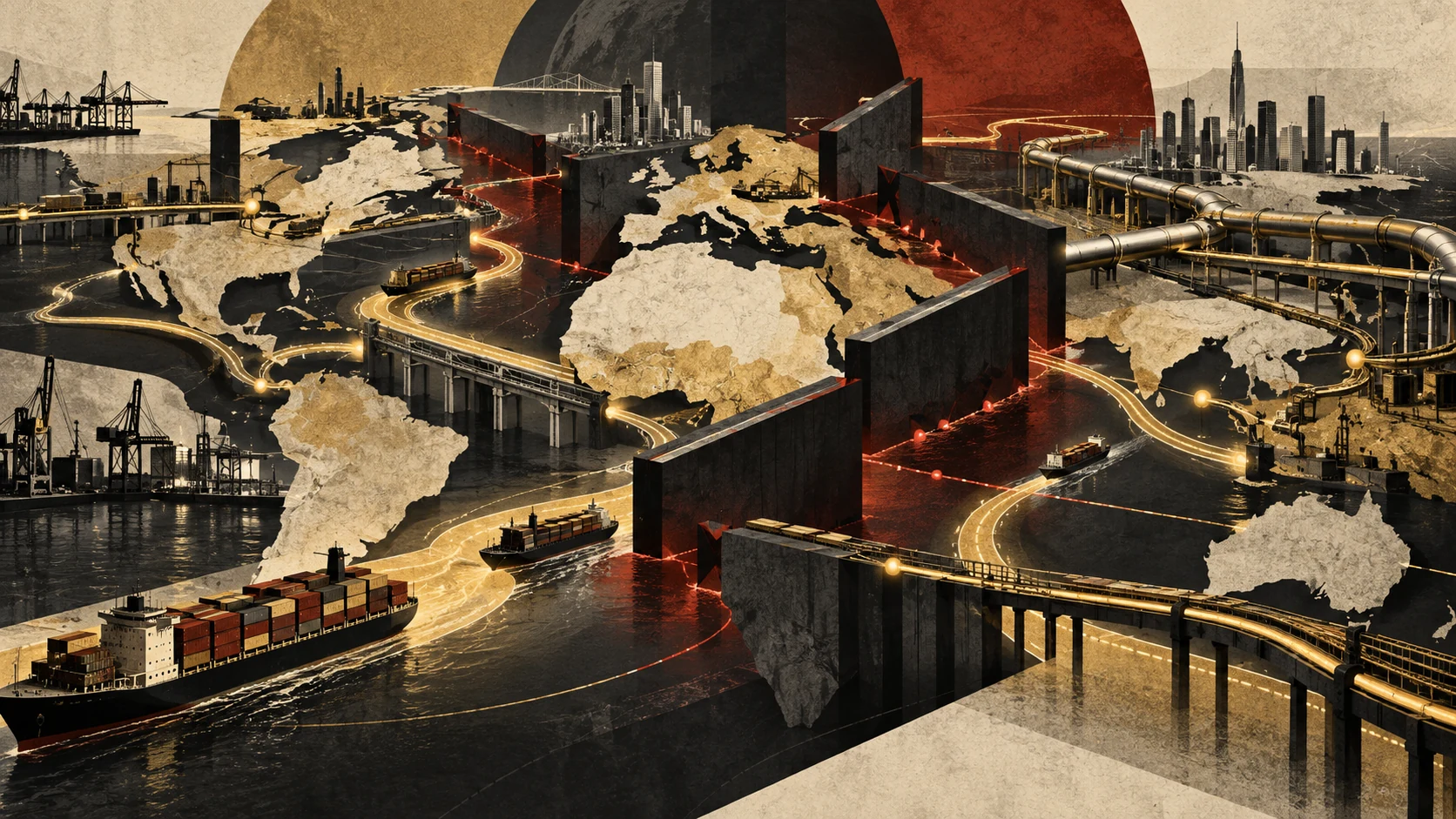
Economic sanctions are tools used by governments to pressure other states, organizations, companies, or individuals without relying directly on military force. They work by restricting access to something economically valuable: money, markets, technology, credit, transportation, investment, or international payment systems. Their effectiveness depends on existing relationships of dependence. A sanction has little influence if the targeted actor can easily obtain the same goods, financing, or services elsewhere. It becomes more powerful when the restricted resource is difficult to replace.
This makes sanctions fundamentally different from simple punishment. Their purpose is usually to change incentives by increasing the economic cost of particular behavior. A government may hope that restrictions on trade, finance, or technology will persuade another government to alter its policies. Sanctions can also be used to limit an adversary's military or industrial capabilities, signal political condemnation, isolate particular individuals or organizations, or make certain activities more difficult to finance.
The basic logic is one of economic leverage. If one country controls access to something another country needs, it possesses a potential source of bargaining power. The resource does not have to be a natural commodity. Access to a major consumer market, an important currency, advanced semiconductor equipment, international banking services, shipping insurance, or credit can all become instruments of pressure.
Financial sanctions are among the most powerful because modern economies depend on banks and payment networks to move money. International trade rarely consists of physical goods being exchanged directly. Importers must pay exporters, companies need banks to finance transactions, investors move capital across borders, and borrowers make payments on international debts. Restricting these financial channels can therefore affect many economic activities simultaneously.
One common financial measure is an asset freeze. If a sanctioned person, company, or institution holds assets within the jurisdiction imposing the sanctions, those assets may be blocked so they cannot be transferred or used normally. The owner may remain the legal holder, but access becomes restricted. This can affect bank accounts, securities, property, or other financial holdings depending on the rules involved.
Governments may also prohibit their own banks and companies from transacting with sanctioned entities. A targeted bank can then lose access to important counterparties, currencies, or sources of funding. Even if the institution continues operating domestically, its ability to participate in international finance may be severely reduced.
The power of such restrictions depends heavily on the structure of the global financial system. Some currencies and banking centers are used far beyond the borders of the countries that issue or host them. International transactions may pass through banks located in third countries or rely on institutions subject to particular legal jurisdictions. This gives some states greater capacity than others to impose financial restrictions with effects outside their own territory.
Access to major reserve and settlement currencies can be especially important. Businesses around the world hold and use widely accepted currencies because they are liquid, stable, and convenient for trade and finance. If access to transactions in one of these currencies becomes difficult, companies may face higher costs, fewer financing options, and greater difficulty settling international obligations.
International payment messaging and clearing systems also matter, although they should not be confused with money itself. Financial institutions need mechanisms for communicating payment instructions and settling transactions. Restrictions affecting these systems can make cross-border payments slower, more expensive, or impossible through ordinary channels.
This illustrates a central feature of financial power: control over infrastructure can matter as much as possession of wealth. A country may have substantial financial resources yet struggle to use them internationally if banks, clearing systems, insurers, or payment networks refuse to participate. Economic power therefore depends partly on access to institutions through which money can actually move.
Credit restrictions can deepen this pressure. Governments may prohibit lending to particular institutions, prevent the purchase of new debt, or limit access to capital markets. A company or government that normally refinances obligations by borrowing may then face higher interest rates, shorter maturities, or an inability to obtain new funds.
This matters because many organizations depend on continuous access to credit rather than operating entirely from accumulated cash. Banks refinance liabilities, corporations issue bonds, governments borrow to finance spending, and businesses use credit to fund inventories and investment. Cutting off financing can create pressure even when current operations remain profitable.
The effect is particularly strong when the target has significant foreign-currency debt. A borrower may earn most revenue in its domestic currency while owing lenders in another currency. If sanctions reduce access to foreign exchange, making debt payments can become much more difficult. Currency depreciation can intensify the burden because each unit of foreign debt becomes more expensive in local terms.
Trade sanctions operate through a different channel. Governments may prohibit the import or export of particular goods, impose tariffs, restrict shipping, or block commercial relationships with certain companies or industries. These measures can reduce revenue for exporters or create shortages and higher costs for importers.
Export restrictions are especially powerful when the sanctioning country controls goods or technologies that the target cannot easily replace. Advanced machinery, specialized industrial equipment, aerospace components, software, semiconductor technology, or certain scientific instruments may be difficult to reproduce quickly. Preventing access can slow production or technological development long after existing inventories are exhausted.
Import restrictions work in the opposite direction by denying the target access to customers. If a country depends heavily on exporting oil, metals, manufactured goods, or agricultural products to a particular market, losing that market can reduce foreign-exchange earnings and government revenue. The pressure is greater when alternative buyers are scarce or when redirecting trade requires major discounts or new infrastructure.
Markets themselves are therefore a source of economic power. A large economy can use access to its consumers as leverage because foreign producers value the ability to sell there. The larger and more profitable the market, the more costly exclusion may become.
Technology sanctions have become particularly important because modern production depends on complex and highly specialized supply chains. A country may possess factories and skilled workers yet rely on imported software, manufacturing equipment, precision components, or intellectual property. If access to those inputs is restricted, domestic production may eventually suffer.
Semiconductors illustrate this type of dependence. Advanced chips require specialized design tools, manufacturing equipment, materials, fabrication expertise, and intellectual property distributed across several countries and companies. Restrictions at one critical stage can affect an entire downstream industry. A government does not need to control every part of the supply chain if it controls something that cannot easily be replaced.
The same principle applies to aircraft maintenance, energy technology, telecommunications, medical equipment, and advanced industrial machinery. Complex products often contain components produced by a small number of specialized suppliers. Sanctions aimed at these bottlenecks can have effects disproportionate to the monetary value of the restricted item.
Technology restrictions may also be cumulative. A country can continue operating existing machinery for some time using spare parts and inventories. But over years, equipment wears out, software requires updates, and new generations of technology emerge. The gap between the targeted economy and technological leaders may gradually widen.
This makes some sanctions more effective as constraints than as immediate shocks. Their objective may be to reduce future industrial or military capacity rather than force an instant policy change. The relevant time horizon can therefore be measured in years rather than weeks.
Energy sanctions operate through another form of dependence. Oil, natural gas, coal, and electricity are essential inputs into modern economies. Restricting exports from an energy-producing country can reduce its income, but doing so can also raise prices for buyers. Sanctioning governments must therefore consider whether they can tolerate the consequences themselves.
This is one reason energy sanctions can be complicated. A major producer removed from the market can reduce global supply and push prices upward. The target may sell fewer units but receive a higher price for those it continues selling elsewhere. Sanctions can therefore produce unexpected results if the market response offsets part of the intended pressure.
Governments sometimes try to avoid this problem by designing restrictions that reduce the producer's revenue without eliminating all of its supply from world markets. Such arrangements are difficult because traders, insurers, shipping companies, banks, and buyers respond to changing incentives. The effectiveness of any policy depends on enforcement and on whether alternative commercial channels remain available.
Shipping is a crucial part of this system. International trade depends on vessels, ports, insurance, financing, certification, and logistical services. Restricting access to these networks can make trade significantly more expensive even when the goods themselves are not directly banned.
Insurance is particularly important because large commercial shipments create risks that few companies can afford to bear entirely themselves. If reputable insurers are unwilling or prohibited from covering a transaction, ports, lenders, and shipping companies may also become reluctant to participate. A relatively obscure financial service can therefore become a strategic bottleneck.
Sanctions often extend beyond the direct relationship between the sanctioning country and the target. This happens because third-party companies may fear losing access to important markets or financial systems if they continue doing business with sanctioned entities. The possibility of penalties can change behavior even where local law does not impose the same restrictions.
These indirect effects can greatly expand the reach of sanctions. A bank in one country may refuse a transaction involving a sanctioned customer because it wants to preserve access to another country's financial markets. A multinational company may leave a market because compliance risks outweigh the potential profits. Private firms often behave more cautiously than the law strictly requires because the consequences of making a mistake can be severe.
This phenomenon is sometimes described as overcompliance. Companies may stop transactions that are technically permitted simply because determining whether they are legal is expensive or risky. Banks can become particularly cautious because anti-money-laundering, sanctions, and compliance rules create significant legal exposure.
Overcompliance can produce humanitarian and commercial consequences beyond the intended target. A sanction may formally exempt food, medicine, or humanitarian transactions, yet banks may still refuse to process related payments. Shipping companies may avoid the destination. Suppliers may decide the market is not worth the legal complexity. The practical effect can therefore be broader than the written rule.
This is one reason sanctions can affect ordinary people even when they are aimed at governments or elites. Currency depreciation, inflation, shortages, reduced investment, unemployment, and weaker public finances can spread through the economy. The political leadership may retain access to scarce resources while households experience much of the adjustment.
Broad trade embargoes can create especially large civilian effects because they restrict many ordinary transactions at once. More targeted sanctions attempt to reduce these costs by focusing on specific individuals, companies, financial institutions, or technologies. Targeting can make sanctions more precise, but it does not eliminate indirect effects because economies are interconnected.
An industrial company placed under sanctions may employ thousands of workers and purchase from hundreds of suppliers. A bank restricted from international finance may also serve ordinary businesses. An export ban on technology can reduce production and employment in downstream industries. Economic pressure rarely remains perfectly confined to the intended decision-makers.
The political effects are also uncertain. Economic hardship does not automatically cause governments to change policy. Leaders may blame foreign countries for domestic problems, impose tighter controls, redirect resources toward favored groups, or accept economic damage rather than make political concessions. Nationalism can sometimes strengthen resistance instead of weakening it.
The effectiveness of sanctions therefore depends partly on the political structure of the target. Governments responsive to voters, businesses, or powerful domestic groups may face pressure when sanctions impose visible costs. More authoritarian systems may have greater ability to suppress opposition or shift the burden onto less influential populations.
Elite sanctions are designed around this problem. Instead of attempting to damage the entire economy, governments may freeze assets, restrict travel, or prohibit transactions involving politically connected individuals. The aim is to increase the personal cost to people believed to have influence over state decisions.
Whether this changes behavior depends on how political power actually operates. If targeted individuals have little ability to influence leadership, personal financial losses may have limited strategic effect. Sanctions work best when the pressure reaches actors capable of changing the decisions that prompted the sanctions.
Expectations also matter. If the target believes sanctions will remain in place regardless of its behavior, there is little incentive to make concessions. Effective coercion generally requires some understanding of what actions would lead to restrictions being reduced or removed. Otherwise, sanctions function mainly as containment or punishment rather than bargaining tools.
This distinction is important because sanctions can have several objectives simultaneously. A policy may seek to change behavior, reduce military capacity, demonstrate international opposition, deter other actors, or simply deny resources to a sanctioned organization. A sanction can fail at coercion while still succeeding at limiting access to technology or finance.
Measuring success therefore requires identifying the objective first. If the purpose is to force immediate political reversal, the standard is demanding. If the purpose is to slow technological development, increase the cost of aggression, or limit access to international capital, even partial restrictions may have meaningful effects.
Sanctions become more powerful when several countries coordinate them. A target can more easily replace a lost supplier or market when only one country imposes restrictions. If many major economies act together, the number of alternatives falls.
Coalitions are especially important in technology-intensive industries because no single country may control every necessary input. Coordinated export restrictions across several technological leaders can close substitution routes that unilateral controls would leave open.
International coordination is difficult, however, because participating countries bear different costs. One may depend heavily on the target's energy exports while another does not. A country with companies competing in the same markets as sanctioned firms may gain commercially, while another loses important business. Maintaining a coalition requires distributing costs in a politically sustainable way.
Countries outside the coalition can provide alternatives. They may purchase sanctioned commodities, supply restricted goods, provide financing, or serve as intermediaries. Trade can be redirected through third countries, although often at higher cost and with additional logistical complications.
This adaptation is one of the most important limitations of sanctions. Economic actors respond to restrictions rather than remaining passive. Companies find new suppliers. Governments develop alternative payment systems. Trade routes change. Domestic production expands. Goods are redesigned to use available components.
The longer sanctions remain in place, the stronger the incentive to build alternatives. A country repeatedly threatened with financial restrictions may reduce its dependence on the sanctioning country's currency. It may hold reserves in different assets, encourage trade in other currencies, or build new payment channels.
A country facing technology controls may invest heavily in domestic research, subsidize local manufacturers, recruit foreign expertise, or redesign products around components it can obtain. Initially inferior substitutes may improve with experience. Restrictions intended to create dependence can therefore encourage the target to reduce that dependence.
This does not mean sanctions necessarily defeat themselves. Building alternatives can be expensive, slow, and technologically difficult. A domestic substitute may cost much more or perform worse than the imported product. Alternative financial systems may have less liquidity and fewer participants. Trade rerouting can require discounts and additional transport costs. Adaptation reduces pressure but often does not eliminate it.
The distinction between substitution and efficiency is crucial. A country may successfully find another supplier yet pay more for the same input. It may route trade through intermediaries but lose part of the profit. It may develop domestic technology but devote large subsidies and scarce engineering talent to doing so. Sanctions can impose substantial costs even when they do not completely block economic activity.
The ability to absorb those costs becomes another source of bargaining power. A large, diversified economy may endure restrictions more easily than a small economy dependent on a narrow set of exports. A government with substantial foreign reserves may survive financial pressure longer than one already struggling with external debt.
Sanctioning countries also need endurance. Their companies may lose export markets, consumers may face higher prices, and governments may need to compensate affected industries. If the political cost becomes too high, the sanctioning coalition may weaken. As with other bargaining relationships, the side that can wait longer can gain an advantage.
Economic size is therefore not the only determinant of sanctions power. Dependence matters more. A smaller country controlling a highly specialized technology can sometimes exercise considerable leverage over a much larger economy. Conversely, a large economy may find sanctions ineffective against a target that has many alternative suppliers and markets.
Mutual dependence complicates the calculation. Two countries may trade heavily because the relationship benefits both. Sanctions impose costs on the target by disrupting that trade, but they also destroy value for the sender. The possibility of self-inflicted damage limits how aggressively interdependence can be weaponized.
Finance often appears especially powerful because dependence is asymmetric. Some financial systems, currencies, and capital markets are difficult to replace quickly, while the issuing economies may be less dependent on any particular foreign participant. This imbalance creates leverage.
But repeated use of financial sanctions can change incentives over time. Governments and firms may decide that excessive reliance on one financial system creates strategic risk. They may diversify reserves, build alternative settlement arrangements, or reduce exposure to institutions that could become inaccessible during political conflict.
This creates a tension at the heart of financial power. The more useful and trusted a financial network is, the more leverage its controller may possess. Yet the more frequently access is restricted for geopolitical purposes, the stronger the incentive for others to create alternatives. Using power can gradually encourage the behavior that weakens it.
The same pattern appears in technology. A country controlling a crucial manufacturing tool can restrict exports and impose severe short-term costs. But doing so tells the target that technological dependence is a strategic vulnerability. Massive investment in domestic alternatives may follow.
This is why sanctions can reshape the global economy beyond the immediate dispute. Supply chains may become more geographically divided. Companies may hold larger inventories, duplicate suppliers, or avoid technologies associated with geopolitical risk. Governments may subsidize domestic production of goods previously imported cheaply.
These changes can improve resilience but reduce efficiency. Global specialization lowers costs because different countries concentrate on activities in which they are productive. Fragmenting supply chains for strategic reasons can create redundancy and security while increasing prices and requiring greater investment.
Private companies often have to make these trade-offs before governments do. A business deciding where to build a factory may consider not only wages and transportation costs but also whether future sanctions could cut off access to components or markets. Geopolitical risk becomes part of ordinary investment planning.
Sanctions can therefore influence capital allocation even before any restriction is imposed. If companies expect relations between two countries to deteriorate, they may diversify production in advance. The possibility of sanctions becomes economically significant.
Financial markets react similarly. Investors may demand higher returns from countries considered vulnerable to restrictions. Banks may shorten lending terms. Companies may avoid long-term contracts with counterparties exposed to geopolitical risk. Expectations can raise financing costs before formal policy changes occur.
Sanctions also interact with exchange rates. If investors expect restrictions to reduce export earnings or make financial transactions difficult, they may sell the target country's currency. Depreciation increases the local price of imports and can contribute to inflation.
Central banks may respond by raising interest rates, using foreign reserves, imposing capital controls, or restricting access to foreign currency. These measures can stabilize the situation but also impose domestic economic costs. Higher interest rates can weaken investment, while capital controls reduce financial freedom.
Foreign-exchange reserves are therefore an important part of sanctions resilience. Governments hold reserve assets partly to pay for imports and stabilize their currencies during crises. If those reserves are held within financial systems controlled by sanctioning states, however, access may be restricted.
This reveals another difference between nominal ownership and effective control. A central bank may technically own foreign assets yet be unable to use them because institutions holding those assets are prohibited from processing transactions. Economic power depends not only on possessing wealth but also on being able to mobilize it.
Trade settlement has similar vulnerabilities. An exporter may successfully sell goods but struggle to receive payment if banks will not process the transaction. A buyer may have money but be unable to transfer it. Financial sanctions can therefore restrict trade without physically blocking the goods themselves.
Alternative payment arrangements can reduce this problem. Countries may use different currencies, bilateral clearing systems, barter-like arrangements, or banks with little exposure to sanctioning jurisdictions. These solutions are generally less efficient than established international networks because they may have lower liquidity, higher transaction costs, and fewer participants.
Cryptocurrencies are sometimes discussed as another possible alternative, but their practical usefulness for large-scale sanctions avoidance is constrained by price volatility, liquidity, regulatory oversight, and the visibility of many blockchain transactions. They can facilitate some transfers but do not automatically replace the broader banking, credit, and settlement infrastructure required by major economies.
Sanctions evasion can involve much more conventional methods. Companies can use intermediaries, obscure ownership structures, re-export goods through third countries, alter shipping documentation, or transfer products through several jurisdictions. Governments respond by monitoring trade patterns, imposing penalties, and expanding restrictions to entities that facilitate evasion.
This produces a continual adaptation process. Sanctions become more sophisticated; evasion becomes more sophisticated; regulators close loopholes; traders search for new ones. The economic outcome depends as much on enforcement capacity as on the formal rules.
Secondary sanctions can strengthen enforcement by threatening third parties with consequences if they continue certain transactions with the target. This can give restrictions global reach because international companies may choose access to a large financial market over business with the sanctioned entity.
Such measures are powerful precisely because they leverage existing economic dependence. A foreign bank may have no direct obligation to follow another country's policy under its own domestic law, yet it may comply because losing access to a major currency or banking system would be far more costly.
This also makes secondary sanctions controversial. Other governments may view them as an attempt to extend national law beyond national borders. Disagreements over their legitimacy can create diplomatic tensions even among countries that broadly share political objectives.
Humanitarian concerns create another challenge. Governments often design exemptions for food, medicine, disaster relief, or other essential goods. But exemptions are effective only if companies can use them in practice. Banks, insurers, and transport firms must understand the rules well enough to participate without fearing penalties.
Clear licensing procedures can reduce overcompliance. Governments may issue specific authorizations, publish guidance, or create protected payment channels for humanitarian transactions. The effectiveness of such measures depends on how simple and credible they are.
Sanctions can also produce distributional effects within the target economy. People with political connections may obtain privileged access to foreign currency or scarce imported goods. Wealthier households may protect themselves through foreign assets, while poorer households bear more of the inflation and unemployment.
Scarcity can create opportunities for intermediaries with access to alternative trade routes. Businesses capable of circumventing ordinary restrictions may earn large profits. Sanctions can therefore unintentionally strengthen black markets, politically connected traders, or organizations skilled at operating in opaque environments.
Government control over the economy may also increase. Authorities facing sanctions may impose capital controls, ration foreign currency, direct credit, restrict imports, or take greater control of strategic industries. Measures designed to pressure a government can therefore contribute to a more centralized domestic economic system.
On the other hand, sustained restrictions can weaken state capacity by reducing revenue, access to equipment, and economic growth. A government dependent on commodity exports may find it harder to finance public spending if sanctions reduce export earnings. Industrial restrictions can make infrastructure more difficult to maintain.
Which effect dominates depends on the structure of the economy and the government's ability to redistribute losses. There is no universal formula predicting when economic pressure will produce political change.
History shows that sanctions can have very different outcomes. Some help produce negotiations or concessions, particularly when objectives are limited and the target faces strong economic dependence. Others remain in place for years without achieving major political change. In still other cases, sanctions mainly function as containment by limiting resources available to a hostile government.
This variability is not evidence that economic pressure is meaningless. It reflects the fact that sanctions are instruments rather than automatic mechanisms. Their impact depends on the target's alternatives, the size of the coalition, the importance of the restricted resource, enforcement, political resilience, and the clarity of the demands.
A useful way to understand sanctions is to think of them as attempts to change the target's outside options. A country negotiating under normal conditions may have access to many markets, banks, suppliers, and technologies. Sanctions deliberately remove some of those alternatives. The target then has to decide whether resisting political demands is worth the higher economic cost.
The sanctioning side faces the same logic. If maintaining restrictions becomes too costly, it may compromise or abandon them. Sanctions are therefore forms of bargaining power in which both sides test the other's ability to endure.
Time can favor either side. Restrictions on advanced technology may become more damaging as machinery ages and inventories disappear. Financial pressure may accumulate as debts mature. In these cases, sanctions strengthen over time.
In other situations, time favors the target. New suppliers emerge, trade is redirected, domestic production develops, and businesses learn how to operate under restrictions. The initial shock fades as adaptation improves.
This makes the duration of sanctions strategically important. A policy effective for six months may become less effective after five years. Conversely, a restriction with limited immediate impact may gradually erode industrial capacity. Assessing sanctions requires understanding how both vulnerability and adaptation evolve.
The broader lesson is that sanctions reveal the architecture of economic power. Money is powerful because it moves through institutions. Trade is powerful because producers depend on markets and inputs. Technology is powerful because complex capabilities cannot be reproduced instantly. Credit is powerful because modern economies depend on future financing. International payment systems are powerful because ownership of money means little if payments cannot be settled.
These forms of power are usually invisible during normal economic exchange because access is taken for granted. Companies assume payments will clear, suppliers will deliver, software will remain available, and banks will provide financing. Sanctions make those dependencies visible by deliberately interrupting them.
They also reveal that interdependence can serve two very different functions. Under stable political conditions, interdependence creates efficiency, specialization, and mutual benefit. Under conflict, the same connections can become sources of leverage. The pipeline that enables cheap energy imports can become a vulnerability. The financial network that makes trade efficient can become a channel of pressure. The technology supply chain that lowers costs can become a strategic bottleneck.
For this reason, governments increasingly think not only about efficiency but also about resilience. They diversify suppliers, hold strategic reserves, develop domestic capabilities, maintain alternative payment arrangements, and identify industries considered too important to depend on a single external source.
These policies do not eliminate sanctions power. Complete economic independence is unrealistic for most countries, and trying to produce everything domestically would impose enormous costs. But diversification changes bargaining relationships by increasing alternatives.
That is ultimately what determines the strength of economic sanctions. A restriction is powerful when the target cannot easily walk away from the relationship being restricted. Financial sanctions matter when alternative currencies and banks are inadequate. Technology controls matter when substitute equipment cannot be produced. Trade restrictions matter when replacement markets or suppliers are scarce.
Sanctions therefore operate by exploiting the same principle that governs bargaining power throughout the economy: dependence weakens the side with fewer alternatives. The sanctioning country uses control over markets, finance, technology, or infrastructure to make refusal more expensive.
Yet using that power changes the system itself. Targets search for alternatives, allies reconsider their vulnerabilities, companies redesign supply chains, and governments invest in domestic capabilities. Economic coercion can therefore produce both immediate pressure and long-term adaptation.
The result is a continual tension between leverage and substitution. The more indispensable a financial network, market, or technology is, the more powerful restrictions on access become. But the more frequently that access is used as a political weapon, the greater the incentive for others to reduce their dependence on it.
Economic sanctions are therefore best understood not simply as bans or penalties, but as the strategic use of existing economic relationships. They convert access to money, trade, technology, credit, and international infrastructure into bargaining power. Their success depends on how indispensable those connections are, how much economic pain each side can tolerate, and how quickly alternatives can be built. They demonstrate a basic truth about economic power: control matters most when others depend on what is being controlled and cannot easily replace it.
