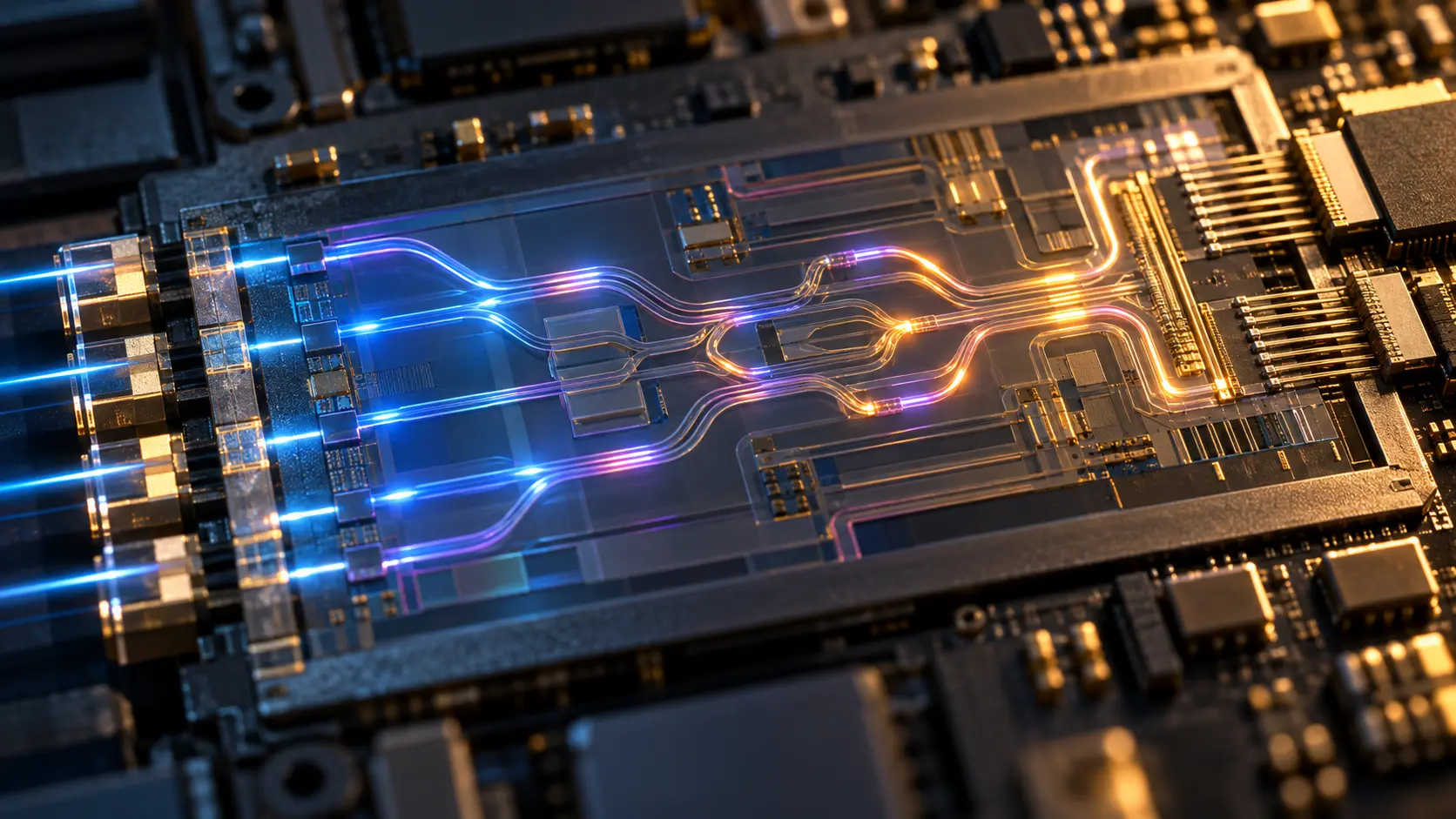
Photonic computing uses light rather than electrical current to transmit information and, in some designs, to perform calculations. The idea is especially attractive for artificial intelligence because modern AI systems move and process enormous amounts of data, and that movement consumes substantial energy. Light can travel quickly, carry many signals at once, and move through optical components with potentially lower energy costs than traditional electrical interconnects. For these reasons, photonic computing is being explored as a way to improve AI accelerators, data-center communication, and high-performance computing.
Conventional processors rely on electrons moving through transistors and metal interconnects. This approach has supported decades of computing progress, but it increasingly faces limits related to heat, resistance, and data movement. In large AI systems, the cost of moving information between processors and memory can be as important as the cost of performing the calculations themselves. Electrical signals lose energy as heat, and communication between many high-performance chips requires increasingly complex interconnects.
Photonic systems approach the problem differently. Information can be encoded into properties of light such as intensity, phase, wavelength, or polarization. Optical signals can then travel through waveguides, fibers, and other photonic components. Multiple wavelengths can also share the same communication channel, allowing large amounts of data to move simultaneously through a technique known as wavelength-division multiplexing.
This ability to transmit many data streams in parallel is one of the main reasons optical technology is already important in telecommunications and data centers. Fiber-optic networks move vast amounts of information over long distances with low signal loss. The challenge is extending similar advantages deeper into computing systems, where chips must exchange data across much shorter distances and where optical components must be tightly integrated with conventional electronics.
Photonic computing goes beyond communication when light is used to perform mathematical operations. Certain optical components can naturally manipulate signals in ways that correspond to operations used in linear algebra. This is particularly relevant to artificial intelligence because neural networks depend heavily on matrix multiplication and related calculations.
In some photonic AI chips, information is represented as optical signals that pass through networks of interferometers, modulators, or other photonic devices. The way light waves combine can implement mathematical transformations very efficiently. Because these operations can occur through the physical propagation and interference of light, they may require less energy than repeatedly performing the same calculations with digital electronic circuits.
This does not mean that light automatically makes every computation faster. Photonic systems are best suited to particular kinds of operations, especially highly parallel linear algebra and communication. General-purpose logic, memory management, branching, and many control tasks remain more practical with electronic processors. The most realistic future for photonic computing is therefore likely to involve hybrid systems combining optical and electronic components.
Artificial intelligence is a strong candidate for this hybrid approach because many neural-network workloads contain large amounts of repetitive numerical computation. Matrix operations used in training and inference can consume enormous computational resources. A photonic accelerator could potentially perform some of these operations with high throughput while a conventional CPU, GPU, or control processor handles the rest of the workload.
One potential advantage is parallelism. Different wavelengths of light can carry independent values through the same optical structure, allowing several calculations to occur simultaneously. Optical devices can also process signals at very high frequencies. In principle, this could provide substantial throughput for workloads that can be mapped efficiently onto photonic hardware.
Energy efficiency may be even more important than raw speed. Large AI data centers consume significant electricity not only for computation but also for moving data and cooling equipment. If optical systems can reduce the energy required for communication and selected mathematical operations, they could help control the growing power demands of artificial intelligence.
Optical interconnects are therefore among the most promising near-term applications. Instead of replacing entire processors with photonic computers, engineers can use light to connect electronic chips more efficiently. High-performance AI systems often contain many accelerators that must exchange information constantly. As electrical links become a bottleneck, optical connections can provide more bandwidth over longer distances with lower losses.
This is already pushing the semiconductor industry toward closer integration between electronics and photonics. Rather than converting signals between electrical and optical form only at the edge of a server or data center, future systems may place optical components much closer to processors. Co-packaged optics, for example, aims to integrate optical communication components within the same package or near the computing chips they serve.
Reducing the distance between electrical processing and optical communication can improve efficiency because repeated electrical transmission over long traces becomes increasingly costly at very high data rates. However, integrating optical components with advanced electronic chips introduces difficult manufacturing and packaging problems. Photonic devices often have different material requirements and fabrication processes from standard digital logic.
Silicon photonics attempts to address part of this challenge by manufacturing optical components using processes related to those already used in semiconductor production. Silicon can form waveguides and other useful photonic structures, allowing some optical functionality to be integrated with conventional chip technology. Even so, important components such as lasers may require additional materials or separate devices.
Lasers themselves are a major practical issue. Photonic systems need a reliable source of light, and generating that light consumes energy. A photonic accelerator may perform certain internal operations very efficiently, but the full system must also include lasers, modulators, detectors, control electronics, and data converters. The total energy and cost of all these components determine whether the design is truly better than an electronic alternative.
Another challenge is precision. Digital electronic processors can represent numbers with well-defined bit widths and perform arithmetic with predictable accuracy. Optical systems are affected by noise, manufacturing variations, temperature changes, imperfect components, and fluctuations in light sources. These effects can reduce numerical precision.
Some AI workloads can tolerate limited precision, which makes photonic computing more attractive. Neural networks often run successfully using reduced-precision arithmetic, especially during inference. However, training complex models may require more numerical stability, and some scientific or financial applications demand much higher accuracy. Photonic systems must therefore balance speed and efficiency against the precision required by the workload.
Analog photonic computing introduces another complication. Many optical calculations are naturally analog rather than digital, meaning values are represented continuously rather than as exact binary numbers. Analog computation can be extremely efficient, but errors and noise accumulate differently than in digital systems. Calibration becomes essential, and the system may need electronic correction mechanisms to maintain reliable results.
Data conversion can also reduce the advantages of photonic accelerators. If information begins in digital electronic memory, it must often be converted into an optical form before being processed and then converted back afterward. High-speed digital-to-analog and analog-to-digital converters can consume substantial power. If too much conversion is required, the energy saved by optical computation may be lost elsewhere in the system.
Memory presents an additional limitation. Photonic systems are good at moving and transforming information, but storing large amounts of data optically is more difficult. Modern AI models depend on enormous parameter sets that must be accessed constantly. Electronic memory technologies remain much more mature for this purpose, which is another reason hybrid architectures are likely to dominate.
A practical photonic AI system may therefore use electronic memory, digital control processors, and conventional logic alongside optical matrix engines and optical interconnects. The challenge is designing the system so that data spends enough time in the photonic domain to justify the cost of conversion and integration. If information constantly moves back and forth between electrical and optical components, much of the potential advantage disappears.
Manufacturing consistency is also critical. Photonic circuits depend on extremely precise physical dimensions because small variations can change how light propagates through a device. Temperature can also alter optical behavior. Large commercial systems may contain thousands or millions of photonic components, so maintaining uniform performance across a chip is a significant engineering problem.
Calibration can compensate for some variations, but calibration itself adds complexity. A processor may need sensors and control circuits that continuously adjust optical components as conditions change. This increases power consumption and makes the design more difficult to manufacture and operate reliably.
Software is another major barrier to widespread adoption. Most AI frameworks are designed around CPUs and GPUs. New photonic accelerators need compilers, programming models, libraries, and tools that allow developers to map neural-network operations efficiently onto optical hardware. A fast accelerator has limited value if using it requires extensive custom engineering.
This is a familiar challenge in specialized computing. Hardware performance alone rarely determines commercial success. Developers also need stable software, debugging tools, model compatibility, deployment support, and predictable behavior across different workloads. Photonic AI chips must compete not only with electronic hardware but also with highly mature software ecosystems.
The economics of semiconductor production will also influence adoption. Photonic devices may offer impressive laboratory results, but commercial systems must be manufacturable at high yield and competitive cost. Packaging, lasers, optical alignment, testing, and integration can all increase expenses. The technology must therefore provide enough performance or energy savings to justify those additional costs.
For this reason, optical interconnects may become widespread before fully photonic processors do. Communication is a problem where light already has clear advantages, and the demand for bandwidth between AI accelerators continues to grow rapidly. Replacing electrical links with optical ones can improve system performance without requiring an entirely new computing architecture.
Photonic computation itself may initially appear in more specialized roles. Certain matrix operations, inference workloads, scientific calculations, or signal-processing tasks may benefit from optical acceleration. Over time, improvements in integration, precision, control, and manufacturing could expand the range of applications.
It is therefore misleading to ask whether light will simply replace electricity in future computers. Electronic circuits remain exceptionally good at logic, memory, control, and general-purpose processing. Photonic systems offer different strengths, particularly in high-bandwidth communication and highly parallel mathematical operations. The likely future is not an all-optical computer but a system that uses photons where they provide a real advantage and electrons where conventional electronics remain superior.
The significance of photonic computing lies in this shift toward heterogeneous hardware. As AI models become larger and the energy cost of moving data continues to rise, computing systems must become more specialized. GPUs, dedicated AI accelerators, advanced memory, chiplets, and optical technologies can all contribute different capabilities within the same machine.
Photonic AI chips will become practical only if they can deliver clear benefits at the system level. High theoretical throughput is not enough. They must also achieve adequate precision, integrate with memory and electronic processors, operate reliably, support mainstream software, and be manufactured economically at scale.
Light is therefore unlikely to replace electricity throughout computing, but it may become increasingly important inside future AI systems. Its strongest role could be in moving enormous amounts of data and accelerating selected calculations that match the natural behavior of optical hardware. If engineers can solve the remaining integration, precision, and manufacturing challenges, photonic computing could become an important part of the next generation of AI infrastructure rather than a complete substitute for electronic chips.
