The religious future shaped by artificial intelligence may be richer in explanation than any previous age. Sacred texts can be summarized instantly, doctrines compared across centuries, theological disagreements clarified, rituals contextualized, and difficult concepts translated into accessible language. A person with no formal religious education can ask about prayer, salvation, sin, suffering, revelation, death, or morality and receive an organized response within seconds. In that sense, AI can make religion more available, more intelligible, and more personalized than ever before.
Yet greater access to religious information does not necessarily produce deeper religious life. A person can know more about faith while participating less in it. They can understand the meaning of ritual without practicing it, compare traditions without belonging to one, discuss prayer without praying, analyze community without being accountable to one, and explore morality without accepting any discipline that resists personal preference. The danger is not ignorance, but a new kind of spiritual sophistication detached from formation.
This distinction is important because religion has never consisted only of ideas. Doctrines matter, but they traditionally exist inside communities, practices, memories, obligations, and habits. A teaching about forgiveness becomes different when someone must actually forgive. A doctrine of generosity becomes concrete when money or time must be given away. A belief about mortality acquires another weight at a funeral. A teaching about patience means more when a person remains faithful through years of uncertainty.
Artificial intelligence excels at the level of explanation. It can make complex religious material easier to navigate. But explanation naturally favors what can be expressed in language. The more religion is mediated through conversational systems, the easier it becomes to think of faith as content: something to be searched, organized, summarized, interpreted, and personalized.
What does not fit this model can gradually seem secondary. The body, repetition, silence, waiting, shared ritual, inconvenience, physical presence, inherited obligation, and long-term discipline are less compatible with instant interaction. They cannot be compressed into a better answer because their meaning comes partly from duration and practice.
This creates the possibility of a future religion that is highly informed but thinly inhabited. Believers may possess unprecedented access to theological knowledge while becoming less connected to stable communities. They may receive personalized spiritual reflections every day while rarely participating in common worship. They may know multiple interpretations of a sacred text while lacking the habits through which a tradition once formed character.
Personalization intensifies the tension. Traditional religious communities usually expose people to teachings they did not select. The same sermon, prayer, ritual, or scripture is encountered by individuals with different temperaments and needs. Some parts comfort, others confront, and some remain difficult. A shared tradition has a degree of independence from the person receiving it.
AI can reduce that independence. The same religious question can be answered differently according to the user's language, emotional state, moral assumptions, and previous concerns. One person may receive an emphasis on mercy, another on discipline, another on healing, another on autonomy. This can make spiritual guidance more sensitive, but it can also make faith increasingly reflective of the individual.
The distinction between adaptation and formation then becomes central. Adaptation asks how religious teaching can be made more suitable for the person. Formation asks how the person might be changed by religious teaching and practice. A mature tradition may need both, but if adaptation dominates, the believer is rarely required to encounter something that cannot be customized.
A religion that continually adjusts to the user's preferences may become easier to consume and harder to inhabit seriously. Difficult doctrines can be rephrased until they become acceptable. Uncomfortable moral demands can be placed in softer contexts. Traditions can be combined. Theological tensions can be smoothed. The result may be spiritually attractive because it produces less resistance.
But resistance has often been part of religious formation. Fasting resists appetite. Prayer resists distraction. Community resists isolation. Forgiveness resists resentment. Humility resists vanity. Ritual resists the demand for novelty. Obedience, when responsibly understood, resists the assumption that personal desire is always sovereign. If every form of resistance is treated as unnecessary friction, religion can lose its capacity to reshape desire.
Community is especially vulnerable in a personalized religious environment. Digital systems allow people to explore faith privately, which can be valuable for those who fear judgment or lack access to trustworthy communities. Yet privacy can also become isolation. A person may gradually build a complete spiritual worldview without ever having to explain it to anyone who knows them.
This matters because real communities provide forms of correction that private systems cannot fully reproduce. Other people remember patterns. They notice contradictions. They place demands on time and attention. They require compromise. They can challenge self-serving interpretations. They can also fail badly, but their existence makes religion more than a dialogue between the individual and an adaptive interface.
A personalized system can create something closer to a spiritual environment built around one person. The user chooses when to enter, what to ask, what to ignore, and when to leave. If an answer is uncomfortable, another can be requested. If a tradition seems restrictive, alternative interpretations can be generated. This gives the believer extraordinary control.
Religious life has traditionally included experiences in which control is limited. One does not choose every member of a congregation. One does not rewrite every inherited prayer. One cannot guarantee that prayer will produce consolation. One cannot accelerate grief or force moral transformation. Spiritual formation often occurs within realities that refuse to adapt immediately.
The speed of AI may therefore change not only access to religion but expectations about religion. A person accustomed to instant answers may find mystery increasingly frustrating. Silence may feel like failure. Waiting may seem unnecessary. Theological uncertainty may appear to be a problem that simply requires better prompting.
Yet some religious questions do not become easier because more answers are available. Suffering remains suffering after every theory has been explained. Death remains final to human experience even after every doctrine of the afterlife has been compared. Forgiveness still requires something from the person after its psychology and theology have been analyzed. Religious knowledge cannot eliminate the conditions that gave rise to religion in the first place.
This is why a future religion can be more explained while becoming less capable of forming people. Formation requires time. Character is not generated through instant comprehension. Patience develops by waiting, generosity by giving, courage by acting under fear, humility by accepting limitation, fidelity by remaining through difficulty. These qualities cannot be downloaded as information.
Artificial intelligence may help people understand what such virtues mean. It may suggest practices or illuminate traditions of moral formation. But the decisive work still occurs outside the explanation. A person must act, fail, repeat, and change over time.
Embodied ritual preserves this difference. A ritual can be explained in a paragraph, but its formative power may depend on being repeated over years. The same words spoken at different stages of life acquire different meanings. A prayer heard as a child may sound different after bereavement. A fasting practice experienced in youth may mean something else in old age. The ritual accumulates memory through the body.
Instant spirituality can struggle with this because it tends to privilege novelty and relevance. The system can always generate something new, more precise, more personal, or more emotionally appropriate. Yet some religious depth comes from returning to what is not new.
The same prayer is said again. The same story is heard again. The same sacred time returns. The repetition creates continuity with people who came before and with earlier versions of oneself. Religion becomes a form of memory rather than only a source of present insight.
A future religious life dominated by AI may therefore become historically shallow even while being informationally vast. The user can access centuries of theology while experiencing tradition mainly as a searchable archive. The past becomes material to consult rather than an inheritance to inhabit.
This does not mean inherited religion should be accepted uncritically. Traditions can preserve injustice, error, and abuse. AI can help expose historical complexity and make alternative voices easier to find. That may be one of its most valuable religious contributions. But critical access to tradition is different from having no durable relationship with tradition at all.
Rootedness requires more than knowing history. It means belonging to a story one did not create and accepting some responsibility for how it is carried forward. It involves receiving as well as selecting.
Authority also changes in an AI-mediated religious world. Traditional authority is visible and therefore vulnerable to criticism. Clergy, teachers, institutions, and communities can be named, questioned, and held accountable, at least in principle. AI often appears less authoritative precisely because it has no face or office.
Yet its influence can be extensive. The system decides what sources to synthesize, which distinctions to emphasize, and what tone to use. If it becomes the primary interpreter through which believers understand doctrine, its authority may be greater than it appears. The difference is that the authority is embedded in mediation rather than announced through office.
This raises a difficult question for religious communities. They cannot preserve depth merely by defending institutions as they exist. If people prefer AI because communities are inaccessible, leaders are untrustworthy, questions are punished, or difficult experiences are met with clichés, then digital mediation is filling a real absence.
The response must therefore involve renewal as much as resistance. Communities that want to remain formative will need to become places where intellectual seriousness, moral accountability, human presence, and compassion coexist. They will need to make room for difficult questions without turning every doubt into disloyalty. They will need to distinguish responsible authority from control.
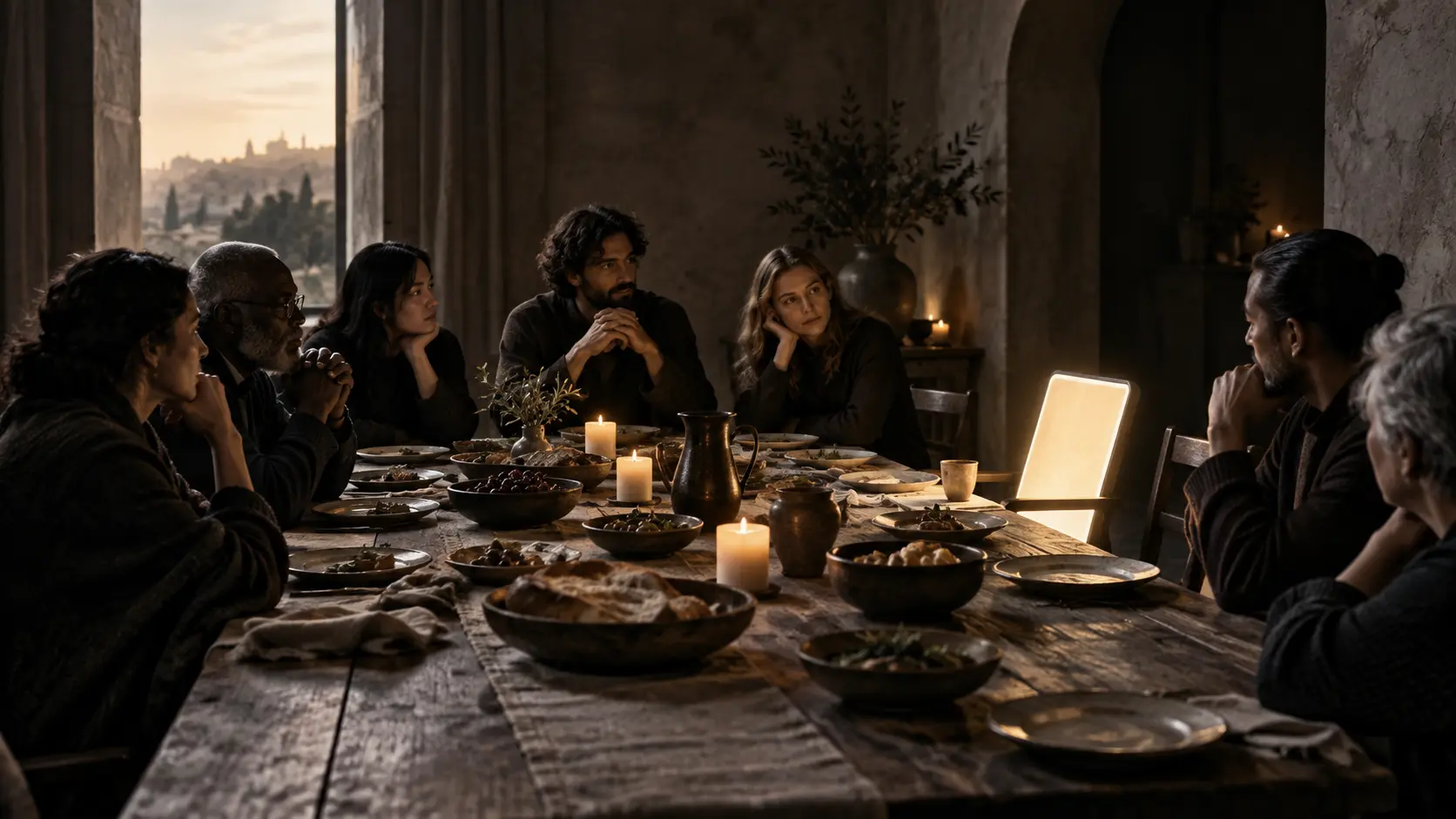
Their advantage will not be speed. AI will almost always answer faster. Their value will lie in what cannot be accelerated: presence through illness, shared mourning, long memory, reconciliation after conflict, communal celebration, physical service, and the slow formation of trust.
The human body will remain central to this distinction. No matter how advanced digital systems become, people will continue to inhabit bodies that need rest, food, touch, care, and eventually burial. Religion has historically accompanied these realities through rituals of birth, adulthood, marriage, illness, death, and grief.
A spirituality that lives primarily on screens risks becoming detached from these bodily thresholds. It may speak beautifully about mortality without standing beside a grave. It may generate language about compassion without washing wounds, preparing food, or sitting silently with the suffering. Information can guide these actions, but it cannot replace them.
The same applies to memory. AI can store enormous amounts of religious knowledge, but religious memory is not simply stored data. It is a community remembering together. It is a story told by grandparents, a song repeated in mourning, a prayer associated with a particular place, a festival returning year after year. Its meaning comes partly from who remembers and with whom.
A religion after AI may therefore face a paradox. It could become easier than ever to learn what a tradition believes while becoming harder to experience why those beliefs mattered enough for generations to organize their lives around them.
This does not make technological mediation inherently destructive. AI can strengthen religious life when it remains a servant of practices and communities larger than itself. It can help believers study texts before gathering with others, prepare questions for teachers, understand historical controversies, compare interpretations responsibly, or recover neglected parts of their tradition.
The decisive issue is whether digital explanation leads back into embodied religious life or becomes a substitute for it.
If a person learns about prayer and then prays, information has served practice. If they learn about community and then enter relationships of responsibility, explanation has supported belonging. If they study forgiveness and then attempt reconciliation or establish appropriate boundaries, knowledge has moved into life.
If, however, religious engagement increasingly ends at the screen, a different pattern develops. The person continually learns, reflects, compares, and personalizes without being required to practice anything durable. Spirituality becomes intellectually rich and existentially light.
This may be the central risk of religion after AI: not that faith disappears, but that it becomes increasingly frictionless. It can remain emotionally meaningful, culturally diverse, intellectually sophisticated, and continuously available while becoming less capable of demanding the kinds of sustained commitments through which religions once formed people.
The future could therefore contain more religious language rather than less. People may talk constantly about purpose, spirituality, healing, transcendence, values, and God. They may have access to more theological material than entire libraries once contained. Yet abundance of language can coexist with scarcity of practice.
The measure of religious vitality will not be how much spiritual content people consume. It will be what kind of people and communities that content helps produce.
A faith capable of surviving the age of AI without being reduced to information will need to preserve what cannot be generated instantly: embodied habits, common rituals, durable commitments, accountable relationships, shared memory, and the willingness to remain with realities that cannot be personalized away.
Artificial intelligence may make religion easier to understand. That is a real opportunity. But understanding is not the final purpose of faith. Religious traditions generally seek some form of transformation, fidelity, liberation, holiness, wisdom, reconciliation, or communion. Whatever language a tradition uses, it asks that belief become life.
The most important question for religion after AI may therefore be surprisingly old. Not how much do we know, nor how quickly can it be explained, but what are we becoming through what we believe? A religion that cannot answer that question in bodies, communities, habits, and lives may be more accessible than ever and still be losing the very thing that made it religion.