The strongest resistance to the algorithmic reshaping of faith may not come from better arguments alone. It may come from forms of religious life that cannot be reduced to personalized content: living communities, embodied rituals, shared memory, physical presence, disciplined practice, and responsible authority. These elements slow religion down. They place the believer inside relationships and traditions that are not instantly adjustable. In an age of spiritual answers tailored to individual preference, this resistance may become one of the most important ways faith preserves its depth.
Digital spirituality is powerful partly because it is immediate. A person can ask a question and receive an answer within seconds. The response can be adapted to mood, temperament, vocabulary, moral outlook, and level of knowledge. Difficult doctrines can be rephrased. Conflicts can be softened. Alternative interpretations can be generated until one feels acceptable. The result is a spiritual environment with very little friction.
Traditional religious life often contains the opposite experience. The believer enters practices that existed before them. They hear words they did not write, observe rituals they did not design, belong to communities they did not fully choose, and encounter teachings that may resist personal preference. This resistance can be frustrating, but it can also be formative. It reminds the individual that faith is not simply another service organized around the user.
Tradition plays a central role because it creates continuity across generations. A religious tradition carries texts, interpretations, prayers, disputes, practices, moral judgments, and memories that have survived long before the present believer appeared. To receive a tradition is to accept that one does not begin from zero. There are inherited questions, inherited answers, and inherited mistakes. The individual becomes part of a conversation older than their own preferences.
This does not mean tradition should be treated as infallible merely because it is old. Traditions can preserve distortions, prejudices, and harmful practices. They need criticism, interpretation, and sometimes reform. But even reform depends on memory. Without some continuity, there is nothing to reform, only constant reinvention.
Algorithmic culture tends toward the present. It responds to the question being asked now, in the language that works now, according to the preferences that matter now. Tradition introduces another dimension: what previous generations believed, suffered, learned, and transmitted. It creates friction between present assumptions and inherited wisdom.
Shared memory strengthens this effect. Religion is not sustained only by doctrines but by stories remembered together. Communities recall deliverance, persecution, revelation, migration, sacrifice, martyrdom, reform, failure, and hope. These memories are repeated through festivals, sermons, songs, sacred texts, anniversaries, and family practices. They teach people that faith belongs to a history larger than the current moment.
A personalized digital spirituality can weaken this memory because it tends to organize experience around the individual. The most relevant story becomes the one that speaks directly to the user's current need. Historical depth can be reduced to useful fragments. A prayer, symbol, or doctrine is extracted from its setting and applied to the present.
Shared memory resists this fragmentation. It forces believers to encounter parts of the tradition that do not seem immediately useful. A community remembers not only comforting stories but difficult ones. It preserves defeats as well as victories, judgment as well as mercy, failure as well as faithfulness. Memory creates a thicker religious world than personalized relevance alone can provide.
The body does something similar. Digital religion can become intensely verbal and mental. The user reads, listens, asks, compares, and reflects. Embodied ritual introduces a different form of knowledge. The believer stands, kneels, bows, fasts, eats, sings, walks, touches, waits, keeps silence, gives, and gathers.
These actions matter because faith is not experienced only as thought. A person who fasts learns something about desire that cannot be reduced to a definition. Someone who participates in a funeral experiences mortality differently from someone reading an explanation of death. A community that eats together, sings together, or mourns together creates bonds that information alone cannot produce.
Embodied practice also limits personalization. A ritual does not usually change according to every participant's mood. The same prayer may be spoken by people who feel joy, boredom, doubt, grief, or certainty. The practice remains stable while individual emotional states change. This stability can be spiritually significant because it prevents faith from becoming completely dependent on immediate feeling.
Someone may not feel like praying but pray anyway. They may not feel spiritually inspired but attend worship. They may not feel generous but give. Such actions do not prove sincerity, but they create a form of discipline in which belief is not entirely governed by mood.
Instant spirituality tends to privilege relevance and emotional fit. Embodied discipline can teach the opposite lesson: some practices matter precisely because they are not always immediately satisfying.
Human presence adds another layer of resistance. A machine can simulate attention, but it does not stand physically beside someone who is grieving. It does not notice the person's condition in the same way a longtime friend, pastor, rabbi, imam, elder, or fellow believer might. It does not share meals, attend funerals, visit the sick, or participate in the consequences of its advice.
Presence creates accountability because people cannot be infinitely customized. A real community remembers what someone said last year. It notices patterns. It may challenge self-deception. It may also disappoint, misunderstand, and fail. Human community is difficult precisely because other people possess their own wills.
That difficulty can be spiritually important. A personalized system is designed to respond to the user. A community requires the user to respond to others. The difference is profound.
Religious traditions often treat love as something practiced toward actual people, including inconvenient ones. Patience becomes meaningful because someone is difficult. Forgiveness becomes necessary because someone caused harm. Generosity costs something because resources are limited. Hospitality disrupts routine because another person's needs enter one's life.
A digital spiritual environment can explain all these virtues without creating the relationships in which they are tested. Community converts religious language into social reality.
This is also why religious authority cannot be reduced to information. Responsible authority involves more than knowing doctrines. It includes accountability, character, limits, and obligations toward the people being guided. A religious leader may be answerable to a community, a tradition, colleagues, institutional rules, sacred texts, or established forms of oversight.
Such authority can certainly be abused. History provides many examples of manipulation, coercion, secrecy, and spiritual domination. Defending responsible authority therefore requires defending accountability, not unquestioning submission. The answer to abusive authority is not necessarily the disappearance of authority altogether.
When formal authority disappears, informal authority often takes its place. Influencers, algorithms, recommendation systems, charismatic personalities, and conversational AI can become powerful precisely because their authority is less visible. A person may distrust a priest because the priest's institution is obvious while trusting a machine whose interpretive assumptions remain hidden.
Responsible authority has the advantage of being locatable. It can be questioned. Its tradition can be identified. Its claims can be compared with established teaching. A system that presents itself as neutral may exercise influence without making its framework equally visible.
This is why religious communities will need forms of authority that are both trustworthy and transparent. If people turn to AI because human leaders are inaccessible, judgmental, or poorly informed, simply condemning digital spiritual guidance will not solve the problem. Communities will need to offer forms of presence worth returning to.
This means creating spaces where difficult questions can be asked without humiliation. It means taking confidentiality seriously. It means admitting uncertainty when certainty is not available. It means knowing the difference between spiritual counsel and professional psychological or medical care. It means making authority responsible rather than merely powerful.
A living tradition is also able to distinguish between development and constant adaptation. Faith must be interpreted in new contexts. Ancient language sometimes needs explanation. New knowledge raises questions that older generations did not face. But adaptation becomes dangerous when every inherited belief is adjusted until it fits current preference.
Community provides a place where such changes can be debated publicly rather than absorbed privately through endless personalized conversations. Interpretation becomes shared and contestable. Others can ask whether a new reading is faithful, useful, distorted, or incomplete.
This public dimension matters. One of the distinctive features of AI-mediated spirituality is its privacy. A person can gradually reshape their theology without anyone else seeing the process. They may still belong formally to a religious tradition while privately developing a very different set of beliefs.
Communal life makes belief more visible. This does not mean policing every thought. It means that faith is expressed through shared language, worship, moral commitments, and practices that create some common world. Without that common world, religion can become an association of individuals who use the same labels while inhabiting entirely different spiritual systems.
Ritual helps maintain that common world because it gives shared belief a form that exceeds personal interpretation. Repeated actions create continuity even when individuals understand them imperfectly. A ritual can hold meanings that a single generation has not exhausted.
This is one reason ancient prayers can remain valuable. They prevent every person from having to invent spiritual language from scratch. They place the believer inside words shaped by another time and another community. Sometimes those words fit perfectly. Sometimes they resist. Both experiences can be formative.
Artificially generated prayers can also be useful, especially when someone struggles to find words. But a spirituality composed entirely of custom-generated language risks becoming too perfectly fitted to the user. Inherited prayer can challenge because it contains priorities the individual did not choose.
Shared discipline performs a similar function. Religious calendars, fasting periods, common worship times, and communal obligations create rhythms that are not based entirely on convenience. They tell the believer that time itself can be structured around something other than personal productivity or mood.
This matters in digital culture because algorithms tend to compete for attention. Religious discipline can interrupt that competition. Silence, Sabbath, prayer, fasting, and gathered worship can become practices of refusing constant responsiveness.
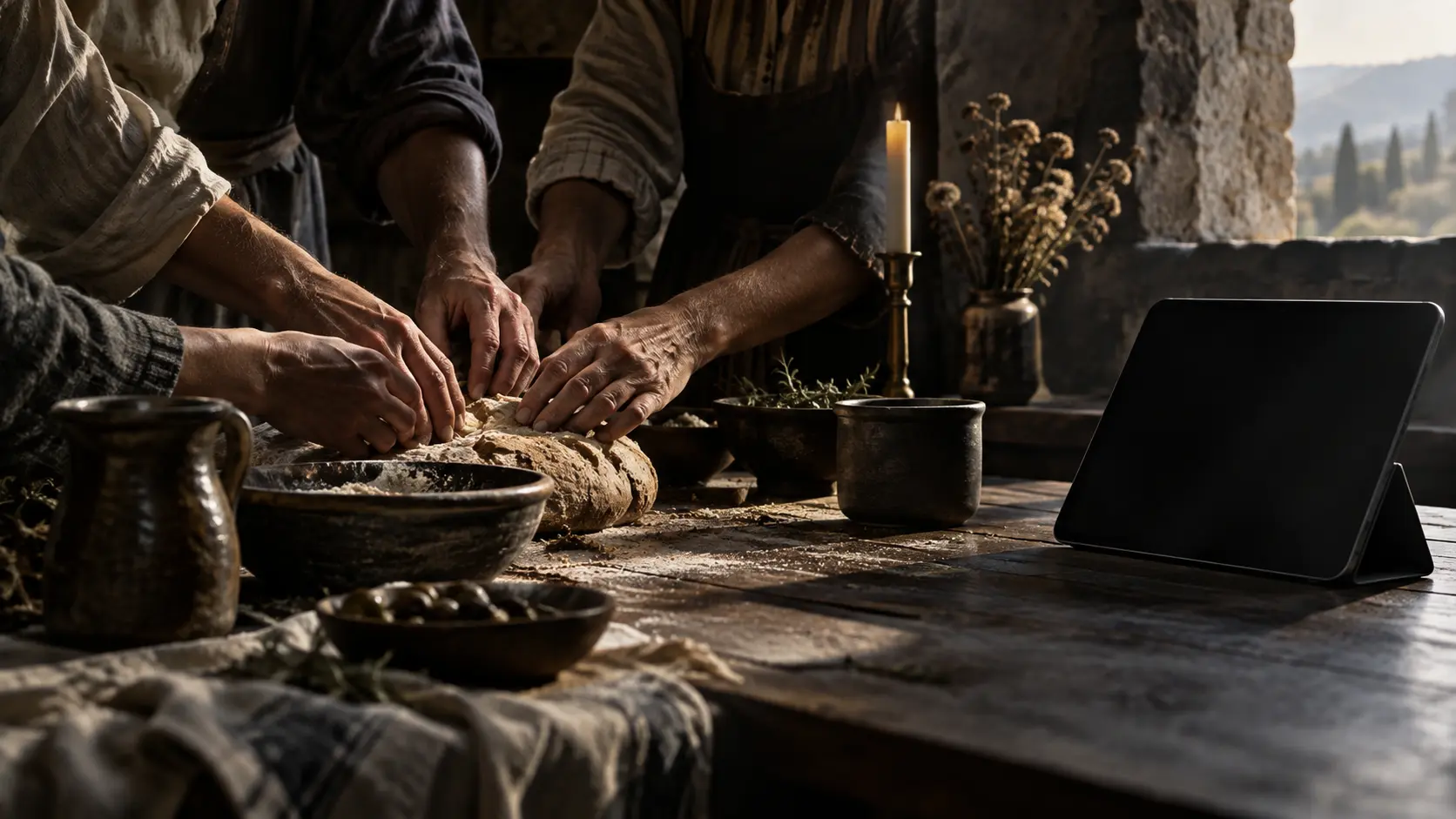
The resistance is not primarily anti-technological. Religious communities do not need to reject digital tools in order to preserve embodied faith. Technology can help with education, accessibility, translation, communication, and study. AI can clarify difficult texts, organize information, and support preparation for deeper human conversation.
The question is what remains central. If the interface becomes the place where faith is primarily interpreted, personalized, and emotionally processed, community may become secondary. If technology remains subordinate to embodied practice, it can function as a tool rather than a replacement environment.
This distinction depends on habits. A believer who uses AI to prepare questions for a study group is using technology differently from someone who gradually replaces all human religious conversation with AI. Someone who uses an app to remember a prayer time is not doing the same thing as someone whose entire spiritual life exists inside the app.
The difference is not between digital and nondigital religion. It is between mediation and substitution.
Memory, embodiment, community, and authority are especially important because they introduce forms of resistance that personalized systems tend to remove. They preserve otherness. The tradition has a past the individual did not create. The community contains people the individual did not select. The body has limits the individual cannot simply reprogram. Responsible authority can offer correction the individual may not request.
This resistance can become oppressive when misused. Tradition can fossilize. Community can conform. Authority can dominate. Discipline can become coercive. The answer is not to romanticize these structures but to reform them while recognizing what they provide.
A completely frictionless spirituality has problems of its own. If every element adapts immediately to the user's preferences, faith may lose the capacity to form desire rather than merely satisfy it. Religion becomes responsive but not demanding, comforting but not transformative.
The body is perhaps the strongest reminder of this limit. Human beings remain finite, vulnerable, dependent, and mortal regardless of how personalized their digital environments become. Bodies become tired, sick, hungry, old, and eventually die. Embodied religion keeps spiritual life connected to these realities.
A community gathered around illness or death encounters something that no interface can optimize away. People sit together. They wait. They touch. They cry. They bury the dead. They remember. Religious meaning is carried through presence as much as through explanation.
This is why resistance to algorithmic reprogramming of faith will depend less on producing better religious content than on sustaining thicker forms of religious life. Content can always be summarized, compared, reformulated, and personalized. A living tradition is harder to compress because it exists in bodies, relationships, places, memories, habits, and obligations.
The future religious community that wants to preserve its integrity will therefore need more than correct doctrine. It will need practices that make doctrine inhabitable. It will need leaders whose authority is accountable, communities capable of honest disagreement, rituals that engage the body, and forms of memory that connect believers to lives beyond their own.
Artificial intelligence can explain why these things matter. It can help people learn their history, understand their rituals, and examine their beliefs. But it cannot replace the social and embodied world in which those beliefs become a form of life.
The strongest protection against a completely personalized faith may therefore be surprisingly ordinary: gathering with others, repeating inherited prayers, sharing meals, keeping rituals, serving people who cannot be customized, remembering the dead, submitting private interpretation to public conversation, and allowing a tradition to remain something more than whatever feels most relevant in the moment.
Instant spirituality offers speed, privacy, and adaptation. Tradition, community, and the body offer continuity, presence, resistance, and memory. The future of faith may depend on whether believers still recognize the value of what cannot be instantly rewritten.