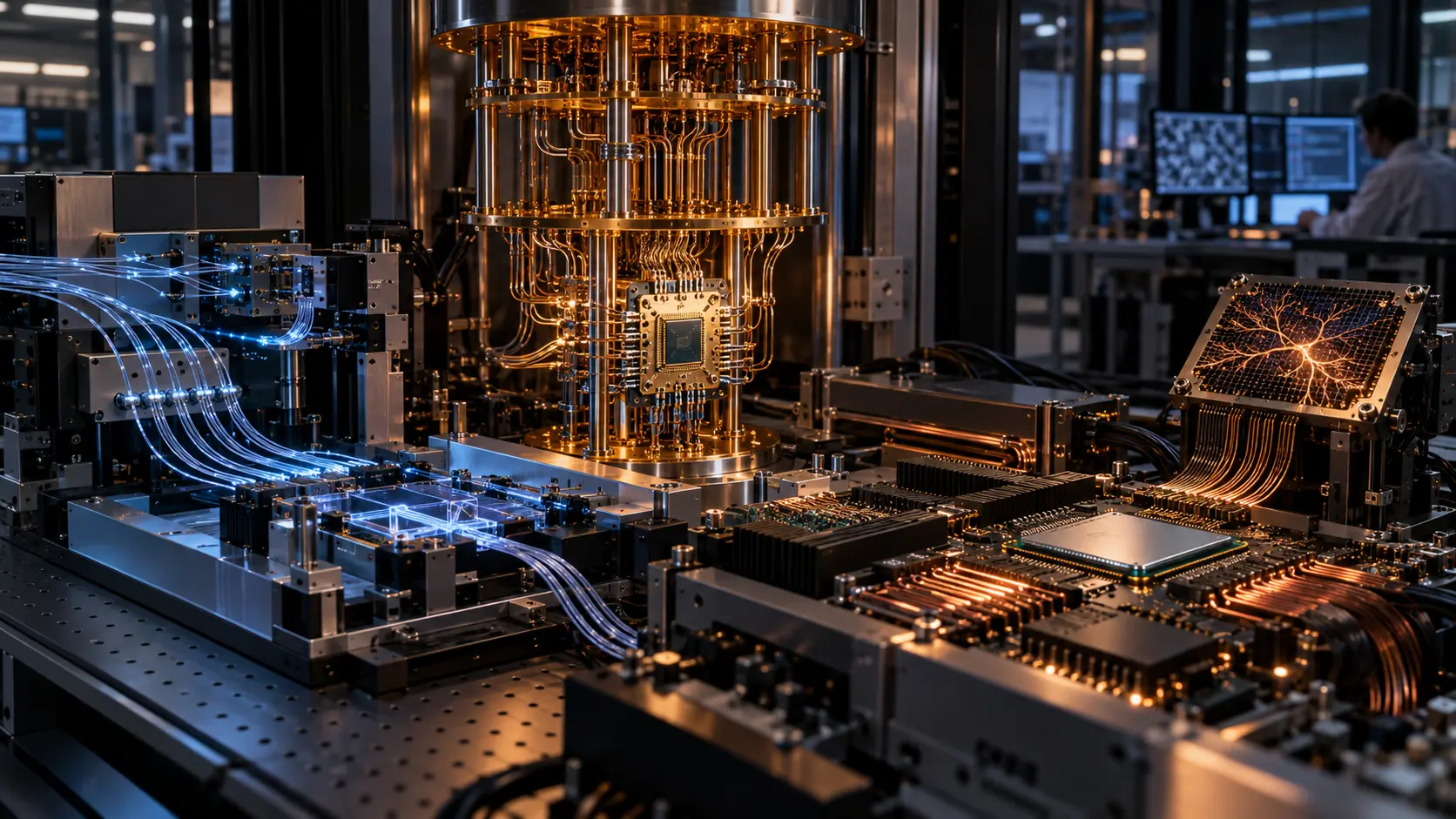
The future of computing is unlikely to be defined by a single technology replacing today's processors. Instead, the industry is moving toward a more diverse landscape in which different types of hardware are optimized for different tasks. Quantum computers, photonic processors, neuromorphic chips, specialized AI accelerators, advanced memory systems, and new packaging technologies are all developing in parallel. Rather than producing one universal successor to the conventional computer, these technologies are more likely to form heterogeneous systems in which each architecture handles the workloads it performs best.
For decades, improvements in computing depended heavily on silicon transistors becoming smaller, faster, and cheaper. This pattern drove the rapid development of personal computers, smartphones, cloud platforms, and modern artificial intelligence. As transistor scaling becomes more difficult and expensive, however, the industry can no longer rely on miniaturization alone to deliver large performance gains. Power consumption, heat, memory bandwidth, manufacturing complexity, and the physical limits of electronic devices are forcing engineers to look for new approaches.
The phrase beyond silicon chips does not necessarily mean that silicon will disappear. Silicon remains deeply embedded in global semiconductor manufacturing and will continue to support most computing systems for the foreseeable future. What is changing is the assumption that all important computation should be performed using the same basic architecture. New processors increasingly combine conventional silicon with specialized components designed for particular workloads.
Quantum computing is the most radical example because it changes the mathematical model of computation itself. Classical computers represent information using bits, while quantum computers use qubits that can exhibit superposition, interference, and entanglement. These properties allow quantum algorithms to approach certain problems differently from classical machines.
The potential advantage is highly specialized. Quantum computers are not expected to make everyday applications such as web browsing, word processing, or conventional database operations dramatically faster. Their strongest long-term applications may involve quantum chemistry, materials simulation, cryptography, and particular mathematical problems where suitable quantum algorithms exist.
The main obstacle is reliability. Qubits are extremely sensitive to noise and environmental interference. Useful large-scale quantum computers will require quantum error correction, which encodes logical qubits across many physical qubits. This creates substantial hardware overhead and makes fault-tolerant quantum computing one of the most difficult engineering challenges in the field.
If scalable quantum systems are eventually built, they will probably operate as specialized accelerators connected to classical infrastructure. Conventional processors will still manage storage, networking, user interfaces, and much of the surrounding computation. A quantum processor may be called only when a problem contains a subtask that can genuinely benefit from quantum algorithms.
Photonic computing takes a different approach by using light to transmit information and, in some cases, perform calculations. Optical communication already forms the backbone of high-speed telecommunications because light can carry large amounts of data efficiently over long distances. Researchers and semiconductor companies are now trying to bring similar advantages inside data centers and computing packages.
One of the strongest opportunities for photonics is communication between chips. Modern AI systems often contain large numbers of processors that must exchange enormous amounts of data. Electrical interconnects become increasingly power-hungry as bandwidth rises. Optical links can provide high data rates while reducing some of the energy cost associated with moving information.
Photonic processors may also accelerate particular mathematical operations. Light waves can interfere and propagate through optical components in ways that naturally implement some forms of linear algebra. This makes photonic computing especially interesting for artificial intelligence, where matrix operations account for a large share of the workload.
The challenge is that optical computation does not replace every function performed by electronics. Memory, control logic, branching, and general-purpose computation remain easier to implement electronically. Optical devices can also be affected by noise, temperature changes, manufacturing variations, and limitations in numerical precision. Converting information between electronic and optical forms can introduce additional energy costs.
For these reasons, photonic computing is also likely to develop through hybrid architectures. Optical components may handle communication and selected high-throughput calculations, while electronic processors manage control, memory, and general-purpose tasks. The boundary between optical and electronic computing could become increasingly blurred as photonic components are integrated more closely with conventional chips.
Neuromorphic computing is inspired by another model: the organization of biological nervous systems. Instead of processing instructions sequentially and constantly moving information between separate processor and memory units, neuromorphic architectures often use large networks of simple computational elements that behave somewhat like artificial neurons and synapses.
Many neuromorphic systems are event-driven. Their components remain mostly inactive until relevant signals arrive, which can greatly reduce power consumption. This makes neuromorphic chips attractive for sensors, robotics, autonomous systems, wearable devices, and other applications where continuous perception must be performed with limited energy.
Spiking neural networks are one of the main computational models associated with neuromorphic hardware. Information is represented through discrete events called spikes, and neurons respond according to the timing and pattern of incoming signals. This differs significantly from the dense matrix operations used in most modern deep-learning systems.
The energy advantages can be impressive for suitable tasks, but neuromorphic computing faces major limitations. Training spiking networks remains more difficult than training conventional neural networks, software ecosystems are immature, and standardized programming methods are still developing. Many mainstream AI workloads do not map naturally onto neuromorphic hardware.
As a result, neuromorphic processors are more likely to complement conventional AI chips than replace them. A robot, for example, could use a neuromorphic processor for low-power sensory processing while relying on a conventional accelerator for complex planning or large neural networks.
Other next-generation computing approaches are also emerging. Analog computing has regained attention because certain mathematical operations can be performed directly through physical electrical properties rather than through sequences of digital instructions. Analog accelerators may be useful for machine learning and scientific computation, but they must overcome challenges involving noise, precision, calibration, and reproducibility.
Compute-in-memory architectures attempt to reduce the cost of moving data by performing calculations directly where information is stored. This is attractive because data movement has become one of the largest sources of energy consumption in modern processors. By combining memory and computation more closely, these systems could improve efficiency for AI and other data-intensive workloads.
New memory technologies may support this approach. Devices that can both store information and participate in computation are being explored as potential building blocks for future accelerators. However, durability, manufacturing consistency, precision, and integration with existing semiconductor processes remain significant challenges.
Chiplets and three-dimensional integration provide another path forward without abandoning conventional electronics. Instead of building one large monolithic processor, designers can combine multiple smaller dies within a package. Different chiplets can contain CPUs, GPUs, memory controllers, AI accelerators, or other specialized functions.
Three-dimensional stacking can place memory directly above or near processing units, shortening the distance data must travel. This can improve bandwidth and energy efficiency, especially for workloads such as artificial intelligence that depend heavily on memory access. Advanced packaging therefore acts as a bridge between traditional semiconductor scaling and more specialized computing architectures.
The importance of memory illustrates why the future of computing cannot be judged only by processor speed. Modern workloads often spend a large share of their time and energy moving information rather than performing arithmetic. A faster processor provides little benefit if it is constantly waiting for data.
This has led to a broader shift in computer architecture. Performance increasingly depends on the entire system: processors, memory, networking, packaging, cooling, and software. The most successful next-generation computers will probably be designed around the movement of data as much as around the execution of calculations.
Artificial intelligence is accelerating this transition. Large AI models require enormous computational throughput, memory bandwidth, and communication between processors. No single architecture is optimal for training, inference, data preparation, networking, and on-device AI at the same time.
This encourages heterogeneous computing. A future AI system might use CPUs for general-purpose tasks, GPUs for large parallel workloads, specialized accelerators for inference, optical links for high-bandwidth communication, neuromorphic processors for event-driven sensing, and advanced memory technologies to reduce data movement. Quantum processors could be added when certain scientific or mathematical subproblems justify their use.
Software will determine whether such systems are practical. A collection of specialized processors is useful only if programmers can coordinate them efficiently. Compilers, operating systems, machine-learning frameworks, scheduling software, and programming models must decide which tasks belong on which hardware.
This creates a significant challenge because specialization can fragment the computing ecosystem. Developers already face differences between CPUs, GPUs, and custom accelerators. Adding optical, neuromorphic, quantum, and memory-centric processors increases complexity further. The industry will need better abstractions so that software can take advantage of specialized hardware without requiring every programmer to understand the physical details of each architecture.
Energy efficiency will be another decisive factor. As data centers grow and AI workloads expand, power and cooling are becoming fundamental constraints. Future chips will be evaluated not only by how quickly they compute but also by how much useful work they deliver per watt.
This favors specialized hardware because a processor designed for a narrow task can often avoid much of the overhead of a general-purpose architecture. However, specialization is worthwhile only when the workload is common enough to justify the additional hardware and software complexity.
Manufacturing will also shape which technologies succeed. A research prototype can demonstrate a remarkable new computing principle, but commercial adoption requires reliable mass production, high yields, manageable costs, and integration with existing supply chains. Silicon has remained dominant partly because the industry has spent decades refining its manufacturing ecosystem.
Emerging architectures must therefore compete not only on theoretical performance but also on economics. A new processor may be technically superior for a certain calculation yet remain impractical if it is expensive to manufacture, difficult to program, or unreliable at scale.
This is why the future of computing is unlikely to involve a sudden replacement of conventional processors. Technological transitions usually happen incrementally. New architectures first appear in specialized applications where their advantages are strongest and then expand if manufacturing and software improve.
Quantum processors may begin with chemistry and scientific simulation. Photonic systems may spread through data-center interconnects before taking on more computation. Neuromorphic chips may establish themselves in low-power sensing and robotics. Compute-in-memory technologies may become important for AI inference. Chiplets and 3D stacking may connect all of these components into increasingly sophisticated packages.
The common theme is specialization. As traditional transistor scaling becomes less capable of delivering uniform improvements, computer architects are finding performance gains by matching hardware more closely to workloads. Different processors can exploit different physical principles, numerical formats, memory structures, and communication methods.
This also changes the meaning of a computer. Instead of one dominant processor executing almost everything, next-generation computers may function more like coordinated ecosystems of accelerators. The main processor may increasingly act as an orchestrator, assigning work to specialized components according to the requirements of each task.
The transition beyond conventional silicon computing therefore does not point toward one successor technology. Quantum, photonic, neuromorphic, analog, and memory-centric systems each solve different problems and face different limitations. None provides a universal replacement for today's CPUs and GPUs.
The future of computing will most likely emerge from their combination. Conventional silicon will remain essential, but it will increasingly be surrounded by specialized hardware designed to overcome specific limits in computation, communication, memory, and energy use. The next generation of computers will be defined less by a single revolutionary chip than by the ability to integrate many architectures into efficient, flexible, and highly specialized systems.
