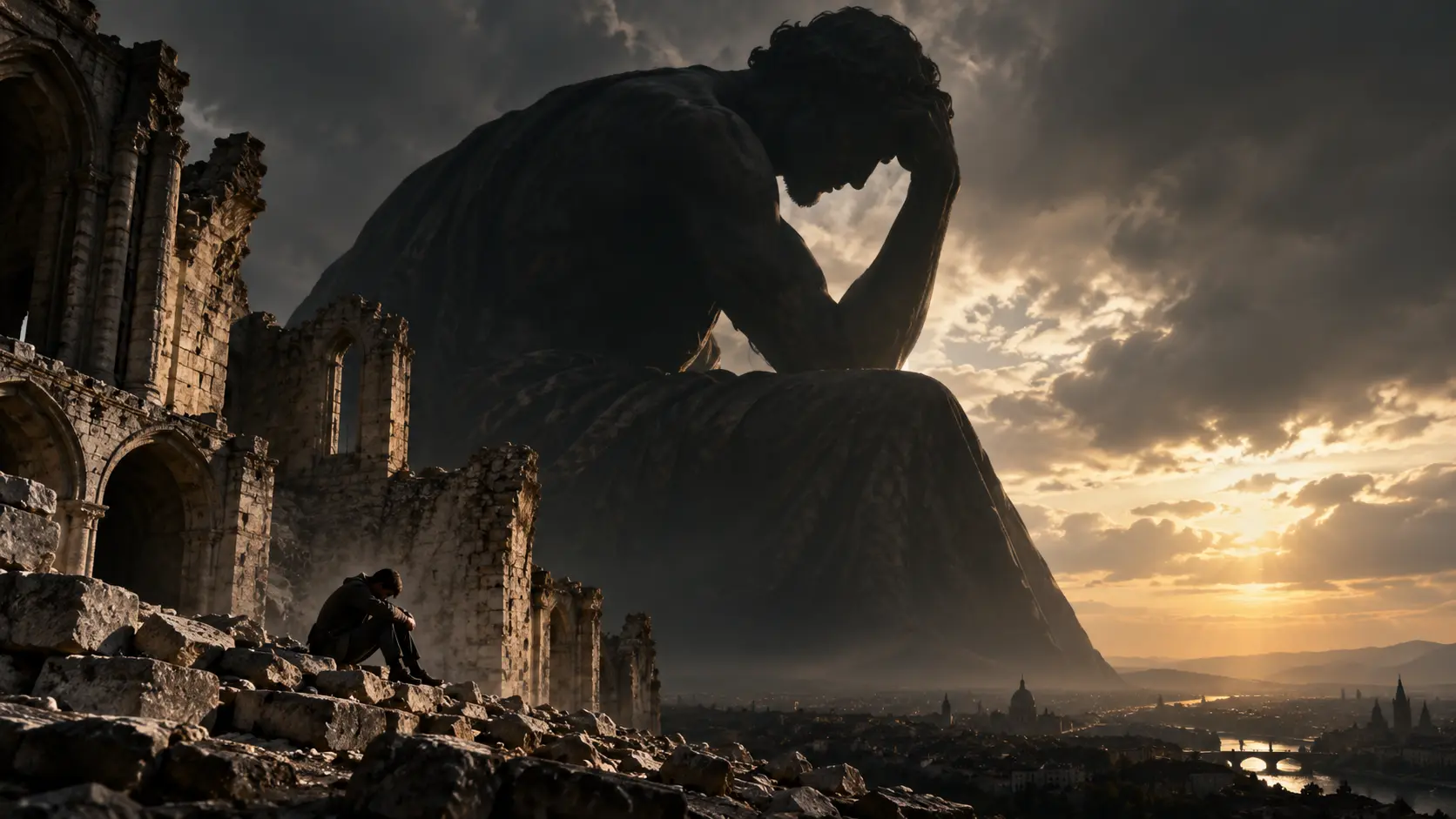
Suffering puts religious belief under pressure because it forces abstract claims about God into contact with concrete pain. It is one thing to affirm that God is good, just, powerful, and present when life is stable. It is another to hold those beliefs when someone is grieving, ill, betrayed, abandoned, or facing an injustice that seems to have no resolution. At such moments, traditional formulas can sound distant from lived experience. The believer may not necessarily reject God, but may begin to reinterpret who God is in order to make faith emotionally bearable.
This reinterpretation can take many forms. A God who judges may become only compassionate. A God who commands may become only affirming. A God who allows mystery may become a symbol of inner strength. Providence may be reframed as resilience. Prayer may become self-regulation. Salvation may become healing from pain. The aim is understandable: the believer is trying to preserve meaning in a situation where the inherited image of God seems unbearable or incoherent.
The problem is not that religious ideas should never be reexamined in light of suffering. Traditions themselves have wrestled with this tension for centuries. The existence of pain, especially undeserved pain, has always raised serious questions about divine goodness and justice. Religious reflection that ignores suffering becomes shallow. But reflection can move in two different directions. It can deepen faith by forcing more serious engagement with mystery, or it can gradually reshape God into whatever form causes the least discomfort.
This distinction is difficult because suffering creates a strong emotional need for relief. A person who has lost someone may not be seeking a philosophical argument about divine providence. They may be asking whether God abandoned them. Someone living with chronic illness may no longer find it meaningful to hear that suffering has a purpose. A victim of injustice may experience talk of forgiveness as premature or even offensive. In such circumstances, reinterpretation can feel like a necessary form of survival.
The temptation is strongest when traditional explanations are offered too quickly. Saying that suffering is “part of God’s plan,” that “everything happens for a reason,” or that pain is simply a test can reduce a complex experience to a formula. These responses may be sincere, but they can sound cruel when they are used to close the question rather than accompany it. If traditional religious language appears unable to take suffering seriously, believers may naturally search for another account of God.
One alternative is to emphasize divine solidarity rather than divine explanation. Instead of trying to explain why suffering occurs, faith may focus on the idea that God is present with those who suffer. In Christian theology, for example, the suffering of Christ has often been interpreted as a sign that God is not distant from human pain. This does not solve every philosophical question, but it shifts the emphasis from explanation to presence.
Another approach is to emphasize human freedom. Some forms of suffering result from human violence, negligence, betrayal, or injustice rather than direct divine action. This preserves moral responsibility and avoids treating every tragedy as something God actively caused. Yet free will cannot explain all suffering. Disease, natural disasters, genetic conditions, and many other forms of pain remain.
Other interpretations stress the limits of human understanding. From this perspective, the fact that suffering cannot be explained does not prove that it is meaningless. This position preserves mystery, but it can also frustrate believers who need more than an appeal to limits. Mystery can be a serious theological category, but it can also become a way of avoiding difficult questions if used carelessly.
The modern therapeutic framework offers another path. Suffering is interpreted primarily through trauma, grief, emotional regulation, and recovery. This perspective can be extremely valuable because it gives people language for real psychological processes. It can help distinguish spiritual struggle from clinical distress and prevent religious communities from moralizing every form of pain.
Yet therapeutic reinterpretation can also narrow the religious question. If God becomes meaningful only insofar as belief in God helps people cope, then divine reality is subordinated to psychological function. The question shifts from “Who is God in the face of suffering?” to “Which image of God helps me suffer less?” That is a significant change.
The same shift can happen with divine goodness. A person in pain may find it impossible to believe in a God who permits suffering and therefore redefine goodness as whatever supports human flourishing. God then becomes good because God validates, heals, reassures, and protects. Any traditional teaching that appears harsh is reinterpreted as a human distortion.
This may produce a more compassionate theology, but it can also make human emotional response the final standard by which God is judged. The believer no longer asks whether a difficult doctrine might contain truth despite being painful. Instead, pain itself becomes evidence that the doctrine is false or unhealthy.
That move is understandable, but it carries risks. Emotional distress can reveal that a teaching has been misused or interpreted cruelly, but discomfort alone does not settle theological truth. Some beliefs are painful because they are distorted. Others are painful because reality itself is difficult. A mature faith must distinguish between the two.
Suffering can also tempt believers toward the opposite extreme: a harsher God. Instead of seeking comfort, some people interpret pain as punishment. Every setback becomes divine judgment. Illness becomes evidence of spiritual failure. Loss becomes correction. This can produce a theology of fear in which suffering is constantly moralized.
That interpretation may feel coherent because it gives pain a clear cause, but it can be deeply destructive. It may intensify guilt, blame victims, and make compassion seem spiritually suspicious. It also assumes knowledge of divine intention that human beings do not possess. The desire for explanation can become so strong that almost any explanation feels better than uncertainty.
This reveals a deeper pattern: suffering creates not only a need for comfort, but also a need for meaning. Human beings often prefer a difficult explanation to no explanation at all. Religion can satisfy this need by placing suffering within a larger story. The danger appears when the story is created too quickly or shaped too closely around the believer’s emotional needs.
Artificial intelligence may intensify this tendency because it can generate multiple interpretations instantly. A person grieving can ask why God allowed something terrible and receive theological, psychological, philosophical, and spiritual responses within seconds. If one answer is unsatisfying, another can be requested. The user can continue until a version of God appears that feels emotionally possible.
This flexibility can be helpful, especially when it exposes the user to the diversity of religious thought. It can show that traditions themselves contain different responses to suffering. But it can also encourage theological customization. God becomes progressively adapted to the user’s pain.
A person hurt by religious authority may prefer a God without judgment. Someone crushed by guilt may prefer a God who only accepts. Someone angry at injustice may prefer a God defined almost entirely by liberation. Someone traumatized by unpredictability may prefer a God who guarantees order. In each case, a legitimate human need can become the organizing principle of theology.
The risk is not that these themes are false. Mercy, liberation, order, compassion, and acceptance can all belong to serious religious traditions. The distortion appears when one need expands until it defines the whole of God.
Suffering can therefore become a lens that clarifies or distorts. It can expose shallow theology and force believers to abandon simplistic explanations. But it can also narrow faith around a wound. The person begins to accept only the image of God that fits what their pain can tolerate.
This is where the distinction between healing and truth becomes important. A belief can be emotionally comforting and false. Another can be psychologically damaging because it has been badly applied rather than because it is false. The emotional effect of a doctrine matters, but it is not the only criterion.
A religion that ignores this distinction risks becoming therapeutic rather than theological. God is interpreted according to what produces healing, and the painful parts of tradition are gradually removed. Yet a religion centered only on comfort may be unable to speak when suffering cannot be eliminated.
The strongest religious traditions do not promise that all pain will become understandable. They often preserve lament, protest, uncertainty, and grief. They allow believers to speak honestly about divine absence without immediately dissolving the tension. This can be spiritually difficult, but it prevents faith from becoming an exercise in forced optimism.
Lament is important because it allows suffering to remain a religious experience without requiring instant explanation. A person can protest before God without abandoning God. They can say that something is wrong without pretending to know why it happened. In this sense, lament resists both despair and cheap consolation.
This kind of faith is less emotionally efficient than instant reinterpretation. It does not always provide a satisfying image of God. It may require the believer to live with unresolved tension between divine goodness and human pain. But that tension can preserve intellectual and spiritual honesty.
The relationship between suffering and reinterpretation is therefore unavoidable. Every generation asks old questions in the light of new forms of pain. Religious language must be capable of addressing real human experience. The danger is not reinterpretation itself, but reinterpretation that is driven only by the need to remove discomfort.
A God who can never disturb, remain silent, permit mystery, or contradict human expectations may become emotionally easier to believe in, but also less transcendent. The divine becomes increasingly shaped by what the believer requires.
On the other hand, a theology that refuses all change can become equally distorted. If traditional explanations are used to minimize trauma, excuse injustice, or silence grief, believers may rightly reject them. Faith must be able to learn from suffering without being completely redesigned by it.
The challenge is to preserve both compassion and transcendence. Human pain must be taken seriously, but God cannot simply become the projection of whatever form of comfort the sufferer needs most. Theology should be capable of comforting the wounded while also admitting that some questions remain unresolved.
Suffering is therefore one of the places where religious transformation happens most powerfully. Pain exposes the gap between doctrine and experience. Into that gap enter new interpretations, new images of God, and new ways of understanding faith.
Some of these interpretations may deepen religion. Others may quietly change its center. The decisive question is whether suffering becomes a path through which faith grows more honest, or a pressure under which God is gradually remade in the image of human need.