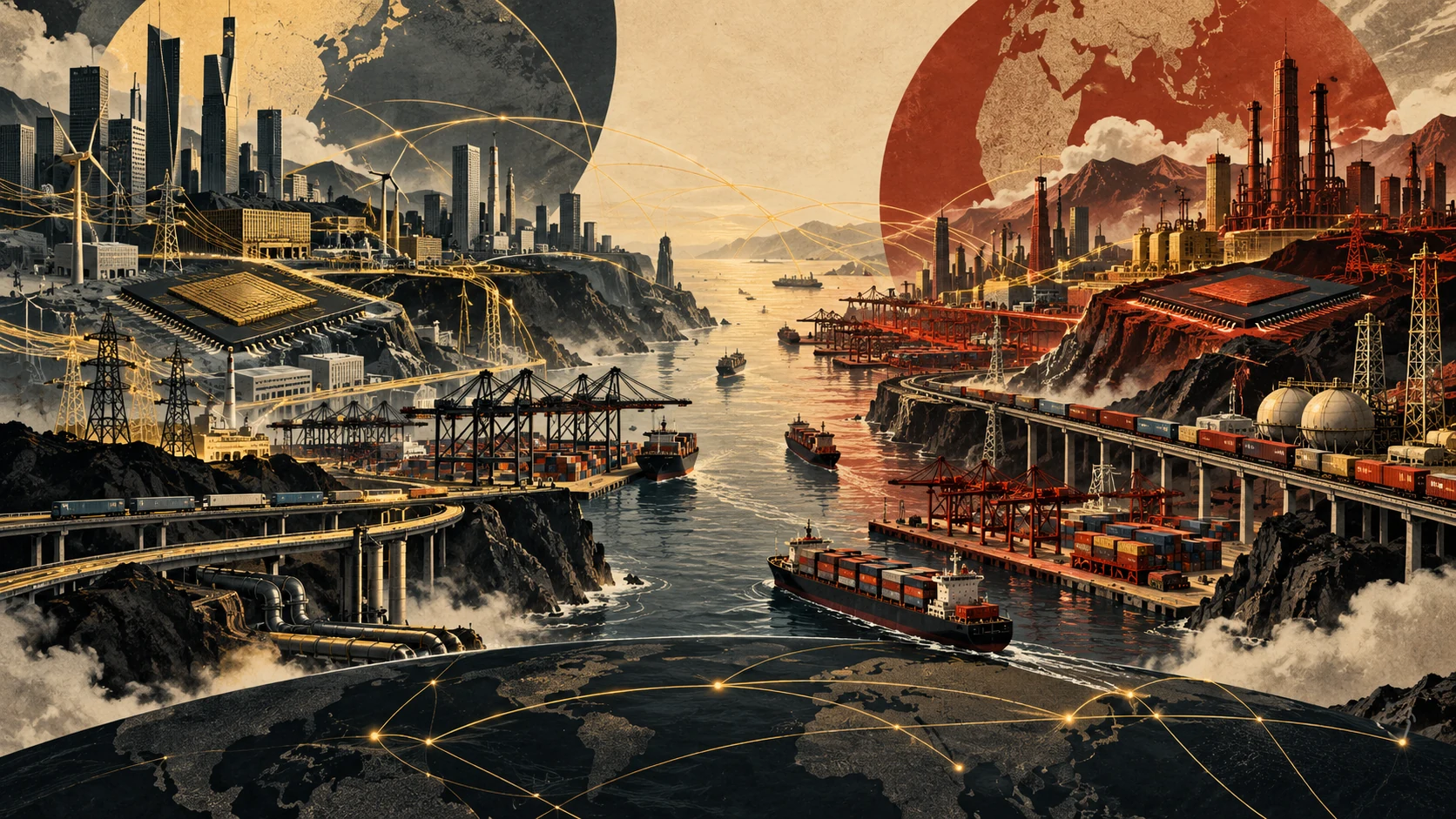
Global economic competition is changing. For decades, many governments and companies organized production around a relatively simple goal: efficiency. Firms searched for the lowest-cost suppliers, concentrated production where it was cheapest, reduced inventories, and built global supply chains designed to minimize waste. Governments generally encouraged trade, specialization, and cross-border investment because these arrangements lowered prices and increased productivity.
Efficiency still matters, but it is no longer the only criterion. Governments and businesses have become more concerned with what happens when trade relationships are disrupted, critical technologies become inaccessible, energy supplies are threatened, or geopolitical tensions affect production. A supply chain that is highly efficient during normal conditions may become dangerously fragile during a crisis. As a result, resilience, strategic autonomy, and economic security have become increasingly important parts of economic decision-making.
This shift reflects a broader change in how economic power is understood. Wealth, production, and trade remain central, but governments are paying greater attention to dependence. A country may be rich and technologically sophisticated while still relying on foreign suppliers for semiconductors, energy, pharmaceuticals, critical minerals, or telecommunications equipment. Those dependencies may appear harmless when international relations are stable. They become strategic vulnerabilities when access can be restricted.
The new economic rivalry is therefore not simply a competition over who produces the most. It is also a competition over who controls important technologies, infrastructure, resources, standards, supply chains, and financing networks. Power increasingly depends on the ability to continue operating when international economic relationships become less reliable.
Technology lies at the center of this rivalry because advanced economic activity depends on capabilities that are difficult to reproduce. Semiconductors, artificial intelligence, cloud computing, telecommunications equipment, biotechnology, advanced manufacturing, aerospace systems, and specialized software all require enormous amounts of capital, knowledge, research, infrastructure, and skilled labor.
These industries rarely exist in isolation. They depend on ecosystems. A semiconductor industry requires chip designers, fabrication plants, specialized machinery, chemicals, advanced materials, engineering talent, software tools, packaging facilities, and reliable electricity. A country may be strong in one part of this chain while remaining dependent on foreign suppliers in another.
This specialization has enormous economic benefits. No country needs to master every stage if it can trade with others. But specialization also creates strategic dependence. If access to a critical input is suddenly restricted, downstream industries may struggle even when they remain competitive in every other respect.
This is why advanced technologies have become instruments of state power. Export controls, investment restrictions, licensing rules, subsidies, procurement policies, and research funding can all influence who gains access to strategically important capabilities. Governments increasingly treat certain technologies not merely as commercial products but as foundations of national security and future industrial strength.
Control over technology can create long-term advantages because technological development is cumulative. Countries with strong research institutions attract skilled workers. Skilled workers help build successful companies. Successful companies generate profits and experience that finance further innovation. Suppliers cluster around growing industries, universities develop relevant expertise, and investors become more willing to finance new ventures.
This cumulative process makes technological leadership difficult to reproduce quickly. A government cannot create an advanced industrial ecosystem simply by spending money on factories. It also needs human capital, technical knowledge, suppliers, institutions, research capacity, infrastructure, and years of practical experience.
The same logic applies to companies. A firm controlling a widely used software platform or technical standard may gain power because customers become dependent on its ecosystem. Switching can require replacing equipment, retraining workers, converting data, rewriting software, or changing relationships with customers and suppliers. Technological dependence therefore becomes economic leverage.
Energy remains equally important because every modern economy depends on reliable power. Manufacturing, transportation, agriculture, digital infrastructure, housing, and logistics all require energy. A country with advanced technology but insecure energy supplies can still face serious economic vulnerability.
Oil and natural gas continue to influence geopolitics because many countries depend on imports for transportation, heating, electricity, or industrial production. Concentrated dependence on one supplier can create political leverage. A government may hesitate to confront a major energy provider if losing access would trigger severe shortages or inflation.
The transition toward renewable energy changes this pattern but does not eliminate energy dependence. Wind and solar power can reduce reliance on continuously imported fuels, particularly for countries with few domestic fossil resources. Yet renewable systems depend on grids, batteries, transmission infrastructure, specialized equipment, and minerals such as copper, lithium, nickel, graphite, and rare earth elements.
The geography of energy power is therefore changing rather than disappearing. Control over oil and gas remains important, while control over electricity systems, battery production, critical minerals, advanced manufacturing, and grid technology becomes more significant.
Energy security increasingly means having alternatives. A country that can obtain energy from several suppliers, generate more power domestically, store fuel, shift between technologies, and reduce demand during emergencies is less vulnerable than one dependent on a single source.
Infrastructure determines whether those alternatives are real. A country may have access to several potential natural gas suppliers but still lack the terminals needed to import liquefied natural gas. It may possess excellent renewable resources but lack transmission lines connecting them to cities and industrial centers. It may own strategic reserves but lack refining capacity.
Economic security therefore depends on systems rather than isolated resources. Energy, technology, transportation, finance, and industry must function together.
Critical minerals reveal this interdependence especially clearly. Digitalization has not made the economy immaterial. Advanced technologies still require physical resources. Batteries need processed minerals. Electrical networks require vast quantities of copper and other metals. Electronics depend on specialized materials. Wind turbines, electric motors, and defense systems may rely on rare earth elements.
Possessing mineral reserves, however, does not automatically create strategic power. Mining is only one stage of the supply chain. Minerals must be processed, refined, transported, converted into components, and incorporated into finished products. A country with large deposits may still depend on foreign technology, capital, processing facilities, or manufacturers.
This distinction between resources and capabilities is central to the new economic rivalry. The strongest position may belong not to the country that owns the largest mineral reserve but to the country that controls the processing technology, manufacturing capacity, or industrial standards required to turn that resource into something useful.
Supply chains connect all these forms of power. Modern products are rarely made entirely within one country. A vehicle may contain components produced across several continents. A smartphone combines minerals, chips, software, displays, batteries, sensors, manufacturing equipment, logistics, and intellectual property from many different sources.
Global supply chains developed this way because specialization lowers costs. Firms purchase each input from the producer that can provide it most efficiently. Inventories can be minimized because reliable transportation and communication allow parts to arrive when needed.
This system works extremely well when disruptions are rare. It becomes more vulnerable when supply is highly concentrated or when geopolitical conflict affects trade.
A single bottleneck can interrupt production far downstream. A factory may have nearly every component required for a product and still be unable to complete it because one specialized chip is unavailable. A battery producer may have factories and customers but lack a processed mineral. A manufacturer may have suppliers but lose access to shipping routes or financing.
The problem is not globalization itself. The problem is concentrated dependence without alternatives.
This realization has changed the meaning of resilience. In economic terms, resilience is the ability to continue functioning, adapt, and recover when part of the system is disrupted. It can involve maintaining inventories, using multiple suppliers, building backup capacity, diversifying transportation routes, developing domestic production, or establishing agreements with trusted partners.
Resilience often costs money. A company that purchases from two suppliers instead of one may pay more. Maintaining larger inventories ties up capital. Building spare production capacity can look inefficient during normal conditions. Governments that support domestic production may spend more than they would by purchasing from the cheapest global supplier.
These costs explain why resilience was often neglected when geopolitical risk appeared low. Efficiency rewards are immediate and measurable, while the benefits of backup capacity remain invisible until something goes wrong.
The economic logic resembles insurance. Paying for fire insurance appears unnecessary every year the building does not burn. That does not make the insurance worthless. Its value lies in reducing the consequences of an event that may be unlikely but extremely costly.
Strategic autonomy is related to resilience but broader. It refers to the ability of a country to make important economic and political decisions without becoming excessively constrained by external dependence. It does not necessarily mean self-sufficiency.
Complete self-sufficiency would be extremely costly for most countries. Modern economies rely on international specialization precisely because no country can efficiently produce everything it consumes. Strategic autonomy instead focuses on avoiding dependencies that could become intolerable during a crisis.
A country may decide, for example, that importing ordinary consumer products creates little strategic risk but relying entirely on one foreign supplier for military communications, critical medicines, electricity-grid equipment, or advanced semiconductors is unacceptable. The distinction depends on the consequences of losing access.
This introduces security considerations into ordinary economic policy. A government may accept higher costs to maintain domestic capacity in a strategic industry. It may subsidize research, support factories, limit foreign ownership of certain infrastructure, or establish stockpiles.
These actions can conflict with traditional economic reasoning focused narrowly on comparative advantage. If another country can produce a component more cheaply, standard trade logic suggests importing it. But if the component is essential and foreign access might disappear during a crisis, the cheapest option may not be the safest.
The relevant calculation therefore changes from cost alone to cost plus risk.
Businesses are making similar calculations. Companies increasingly examine not only supplier prices but also political stability, transportation routes, regulatory exposure, sanctions risk, natural disasters, and geographic concentration.
A supplier may offer the lowest price but create unacceptable vulnerability if nearly all production comes from one region. A slightly more expensive second supplier may reduce the probability of catastrophic interruption.
This has encouraged strategies such as diversification, regionalization, nearshoring, and production within politically aligned countries. The objective is not necessarily to abandon global trade but to restructure it around greater reliability.
Such changes are often described as a movement from just-in-time toward just-in-case production. Traditional just-in-time systems minimize inventories and rely on highly predictable deliveries. Just-in-case strategies hold more reserves and accept some redundancy to reduce vulnerability.
Neither model is universally superior. Large inventories are expensive, and excessive redundancy can reduce productivity. The appropriate balance depends on how critical the input is, how volatile demand is, and how difficult replacement would be.
Economic security therefore requires prioritization. Not every supply chain deserves strategic protection. Governments that treat every industry as essential risk wasting resources and protecting inefficient companies.
The strongest case for intervention usually involves goods or capabilities whose disruption would create broad economic or security consequences and whose supply cannot be restored quickly through ordinary markets.
Semiconductors are often treated this way because they support many industries simultaneously. Energy infrastructure has similar importance. Certain pharmaceuticals, communications systems, defense technologies, and critical minerals can also create systemic vulnerabilities.
The challenge is distinguishing genuine strategic importance from ordinary lobbying. Companies have incentives to describe their own industries as essential because strategic designation can bring subsidies, protection, and favorable regulation.
Industrial policy has therefore returned to the center of economic debate. Industrial policy refers broadly to government efforts to influence the development of particular sectors, technologies, or capabilities. It can include subsidies, tax incentives, public research, procurement, training programs, infrastructure investment, financing, and trade measures.
Supporters argue that governments sometimes need to intervene because private markets may underinvest in strategically important capabilities. A company may not build expensive spare capacity that benefits the whole economy during a crisis. Firms may also underinvest in research whose benefits spread to competitors. New industries can struggle to reach efficient scale even when they have long-term potential.
Critics point to serious risks. Governments may subsidize politically connected firms, misjudge which technologies will succeed, protect inefficient producers, or encourage wasteful competition between countries. Once subsidies begin, companies may organize politically to preserve them long after the original justification disappears.
The debate is therefore not simply between government action and free markets. The more difficult question is when public intervention improves long-term economic capacity and when it merely redistributes resources toward favored industries.
Good industrial policy requires clear objectives. Supporting research may be justified differently from protecting an uncompetitive producer indefinitely. Financing infrastructure can create broad benefits, while subsidizing one firm's ordinary operating costs may mainly transfer public money to shareholders.
Competition also matters. Strategic industries still need pressure to improve. If protection eliminates the threat of failure entirely, companies may become complacent and inefficient. A resilient economy should avoid replacing foreign dependence with permanent dependence on domestic monopolies.
Strategic autonomy can therefore conflict with competition if governments support national champions so aggressively that domestic alternatives disappear. A large national company may reduce dependence on foreign suppliers while simultaneously increasing dependence on one domestic supplier.
Economic security requires attention to both external and internal concentration.
Financial systems form another part of this rivalry. International trade depends on currencies, banks, payment systems, credit, insurance, and capital markets. Countries that control widely used financial infrastructure possess influence because others need access to it.
Financial sanctions demonstrate this power. Restricting a country's banks or companies from international financing can make trade and investment much more difficult. Freezing assets or limiting access to major payment channels can reduce the practical usefulness of wealth that still legally belongs to the target.
This has encouraged some governments to reduce financial dependence by diversifying reserves, creating alternative payment arrangements, or conducting more trade in different currencies.
Again, the result is a tension between efficiency and autonomy. Established financial systems are widely used because they are liquid, convenient, and trusted. Alternatives may be less efficient. But governments may still invest in them because dependence itself carries geopolitical risk.
The same pattern appears repeatedly. The most efficient supplier, technology, currency, platform, or transportation route tends to attract more users. Greater use creates scale and reinforces its advantage. Eventually, the system becomes difficult to replace.
Efficiency can therefore create concentration, and concentration can create power.
Technology standards provide a good example. When an industry adopts a common technical standard, interoperability improves and costs fall. But if one country or group of companies controls essential elements of that standard, others may become dependent on their intellectual property or technical ecosystem.
Standards can shape markets for decades because companies invest around them. Equipment, software, training, and infrastructure become compatible with the established system. Replacing it later can be extremely expensive.
This is why governments increasingly participate in international standard-setting. The issue may look technical, but standards can influence which companies gain access to markets and which technologies become globally dominant.
Data and digital infrastructure create similar advantages. Countries and companies with large platforms can accumulate information that improves artificial intelligence, advertising, logistics, and product development. Cloud providers can become deeply integrated into thousands of businesses. Telecommunications networks can become essential national infrastructure.
Dependence on these systems creates efficiency but also raises questions about sovereignty, privacy, security, and continuity. A government may become concerned if critical public services rely entirely on foreign digital infrastructure that could theoretically become inaccessible.
The response is not necessarily national isolation. Countries can require redundancy, data portability, interoperability, cybersecurity safeguards, or diversified providers. Strategic autonomy often means preserving the ability to switch rather than owning everything domestically.
This idea of switching capacity is one of the most useful ways to understand economic security. Dependence becomes dangerous when alternatives cannot be activated quickly.
A country importing most of its oil may still be secure if it can buy from many producers through flexible shipping networks. A country importing a smaller share of natural gas through a single pipeline may be more vulnerable because replacement is difficult.
Likewise, a company purchasing all of its software from one provider may be less resilient than one with a credible migration plan, even if both spend the same amount.
Security therefore depends not only on where resources come from but also on how replaceable they are.
Time is another essential factor. Some dependencies can be resolved in weeks. Others require years.
Finding another supplier of a common consumer product may be easy. Building an advanced semiconductor fabrication plant, developing a new mining industry, constructing an electricity grid, or training thousands of specialized engineers is not.
The longer substitution takes, the greater the strategic power held by the current supplier.
This gives economic rivalry an important temporal dimension. Governments are not merely asking who controls resources today. They are asking how long it would take to build alternatives if access disappeared.
The answer influences policy. A country may tolerate dependence where substitution is easy but invest heavily in areas where rebuilding capacity would take a decade.
Foreign investment has also become more politically sensitive for this reason. Traditionally, investment was often judged mainly according to whether it created jobs, capital, and growth. Governments increasingly ask additional questions. Does the investor gain control over critical infrastructure? Will strategic technology be transferred abroad? Could ownership create political leverage later?
Investment screening therefore reflects the broader transition from purely economic criteria toward economic-security criteria.
The same shift affects mergers and acquisitions. A takeover may be financially efficient but strategically concerning if it transfers ownership of essential technology or infrastructure to a foreign company. Competition authorities and national-security institutions may evaluate the same transaction through different lenses.
Trade policy is changing as well. Tariffs, export controls, local-content requirements, subsidies, and procurement rules are increasingly used not only to protect traditional industries but to shape future technological and strategic capabilities.
These policies can produce retaliation. One country subsidizes a strategic industry, competitors respond with their own support, and economic rivalry intensifies. Trade becomes more politically structured.
This does not necessarily mean globalization is ending. Global trade remains deeply embedded in production, and complete economic separation between major powers would be extremely costly. What is changing is the pattern of globalization.
Supply chains may become more politically segmented. Countries may trade most intensely within networks of trusted partners while reducing dependence in strategically sensitive sectors. Some industries may remain highly global, while others become more regional.
This creates a world of selective interdependence rather than complete economic separation.
The transition carries costs. Duplicating factories, holding larger inventories, subsidizing domestic industries, and choosing politically safer suppliers can increase prices. Consumers may ultimately pay part of these costs.
Governments therefore face a difficult trade-off. Too little resilience leaves the economy vulnerable. Too much emphasis on autonomy can sacrifice the productivity gains created by specialization and competition.
Security can become an excuse for protectionism if the definition of strategic industry expands without limit. Almost any industry can claim some connection to national resilience. If every dependency is treated as unacceptable, the result can be an expensive and inefficient economy.
The objective should therefore be resilience without isolation.
A resilient economy uses international trade but avoids catastrophic single points of failure. It maintains domestic capabilities where necessary, diversifies suppliers where possible, invests in infrastructure, keeps strategic reserves when appropriate, and develops relationships with trusted partners.
Such an economy accepts interdependence but tries to make that interdependence mutual and manageable.
Autonomy also does not require that every country possess the same capabilities. Alliances and partnerships can create collective resilience. Several countries can specialize while agreeing to maintain reliable access for one another.
This can be far more efficient than every country attempting to build a complete domestic supply chain. A group of trusted partners may collectively possess mining, processing, manufacturing, technology, finance, and markets even when no individual member controls all of them.
The reliability of those partnerships becomes part of economic power.
Large domestic markets provide another advantage because companies want access to consumers. Governments controlling major markets can use regulation, standards, procurement, and investment rules to influence global businesses.
A country does not need to dominate production if foreign producers depend heavily on its customers. Market access itself becomes leverage.
Small countries can still possess substantial influence when they control specialized technologies, resources, infrastructure, or financial functions that others need. Economic power is therefore not determined by size alone.
A relatively small economy that controls a unique technological capability may have leverage over much larger trading partners. The relevant question is always dependence and substitutability.
The new rivalry also changes how companies think about geography. A factory location is no longer evaluated solely through wages, taxes, and transport costs. Political stability, access to energy, cybersecurity, sanctions exposure, infrastructure reliability, and proximity to strategic markets increasingly matter.
Companies may choose a somewhat more expensive country because it offers greater predictability and lower geopolitical risk.
This can create opportunities for economies that are not the cheapest producers but are considered reliable. Institutional stability itself becomes an economic asset.
Countries with dependable legal systems, strong infrastructure, skilled workers, and stable international relationships may attract investment from firms seeking resilience.
Economic security is therefore not simply about controlling resources. It is also about creating trust.
Trust reduces the need for costly redundancy. Companies are more willing to specialize when they believe contracts will be honored and trade will remain open. Governments are more comfortable relying on foreign suppliers when political relationships appear durable.
As trust declines, economies compensate with inventories, domestic production, alternative suppliers, and strategic reserves. The economic cost of geopolitical rivalry is therefore partly the cost of replacing trust with redundancy.
This makes international institutions and rules economically valuable even when they do not eliminate conflict. Predictable trade rules, investment agreements, dispute mechanisms, and technical standards reduce uncertainty and make specialization safer.
When these institutions weaken, private companies must spend more on protection against political risk.
The consequences reach consumers even when the rivalry appears to involve only governments and corporations. Strategic competition can influence energy prices, technology costs, vehicle prices, employment patterns, investment, and taxes.
Public subsidies must be financed. Redundant supply chains can raise production costs. Trade restrictions can reduce competition. At the same time, greater resilience can reduce the economic damage caused by severe disruptions.
The benefits are therefore most visible when something goes wrong, while the costs are often paid continuously.
This is another reason economic-security policy is difficult. Governments are effectively paying today to reduce uncertain future losses. Too little preparation can look efficient until a crisis occurs. Too much preparation can waste resources on threats that never materialize.
The problem cannot be solved through perfect prediction. It requires judgment about which dependencies would be most damaging if disrupted.
The most important vulnerabilities are often those that combine three characteristics: the input is essential, supply is highly concentrated, and substitution takes a long time. When all three conditions are present, dependence can become a major source of external power.
Technology, energy, and critical minerals frequently meet these conditions, which is why they occupy such a central place in contemporary economic strategy.
The competition over these sectors is not purely defensive. Governments also see them as sources of future growth. Advanced technologies create high-value industries, skilled employment, productivity gains, and export opportunities. Energy systems determine industrial competitiveness. Control over processing and manufacturing can capture more value from natural resources.
Economic security and industrial ambition therefore often reinforce each other.
A government supporting semiconductor production may argue both that chips are strategically essential and that the industry will create economic growth. Investment in renewable energy may be justified through climate goals, energy security, and industrial development simultaneously.
These overlapping objectives make policy more politically attractive but also harder to evaluate. A program can fail at one goal while succeeding at another.
The rivalry between major powers is therefore increasingly multidimensional. Military strength remains important, but economic capacity shapes how long countries can sustain strategic competition. Technology determines the sophistication of industry and defense. Energy determines whether the economy can continue operating. Financial systems influence access to capital. Supply chains determine whether production can be maintained.
Economic power has become inseparable from national power.
Yet economic rivalry is constrained by the fact that the major participants often remain deeply connected. Companies have investments across borders, consumers depend on imported goods, and technologies rely on multinational supply chains.
Using economic dependence as a weapon can therefore impose costs on both sides.
This mutual vulnerability can discourage extreme measures, but it can also motivate governments to reduce dependence before future conflicts emerge.
The paradox is that attempts to gain security can themselves increase rivalry. When one country subsidizes strategic industries or restricts technology exports, others may interpret the action as threatening and respond with their own policies.
The result can be a cycle in which each side's attempt to become safer makes the other feel less secure.
Managing this dynamic requires recognizing that economic security is not a binary condition. No large modern economy can eliminate all dependence, and trying to do so would undermine many of the benefits that made global prosperity possible.
The practical goal is to distinguish healthy interdependence from dangerous vulnerability.
Healthy interdependence exists when several alternatives are available, both sides benefit from the relationship, and disruption can be absorbed. Dangerous dependence exists when one side controls an essential resource or capability that the other cannot replace within an acceptable period.
This distinction provides a better framework than simply dividing production into domestic and foreign.
A foreign supplier can be secure if alternatives exist and relationships are stable. A domestic monopoly can be a vulnerability if it has no backup and its failure would disrupt the entire economy.
Resilience therefore depends on redundancy, diversity, adaptability, and institutional capacity rather than nationality alone.
The shift from efficiency toward resilience should not be understood as the abandonment of economics. It is an expansion of what counts as an economic cost.
Traditional calculations emphasize prices, wages, capital expenses, and productivity. Economic-security calculations also include the expected cost of disruption, coercion, conflict, technological denial, and recovery.
A cheaper supply chain can be more expensive in the long run if its failure would stop an entire industry.
Likewise, a more expensive domestic or diversified supply chain can provide economic value through reduced vulnerability.
The challenge is measuring that value realistically rather than using security as a justification for unlimited intervention.
The new economic rivalry is ultimately about control over options. Countries with diversified energy systems can resist pressure from individual suppliers. Countries with strong technological capabilities can continue innovating when access is restricted. Companies with several suppliers can withstand disruptions. Governments with deep financial markets and strong alliances have more ways to respond to crises.
Power comes from having alternatives when others do not.
This is why resilience, autonomy, and security have become central economic concepts. They describe the capacity to keep choosing under pressure.
A resilient economy does not need to avoid every shock. It needs enough flexibility to absorb disruption without surrendering essential decisions to whoever controls a critical bottleneck.
The global economy will continue to depend on trade, specialization, and international cooperation because the benefits remain too large to abandon. But the assumptions surrounding those relationships have changed. Governments and companies are increasingly unwilling to treat uninterrupted access as guaranteed.
Efficiency remains valuable, but efficiency without resilience can create dependence. Strategic autonomy offers protection, but autonomy pursued without regard to cost can become isolation. Economic security therefore requires balance: openness without naivety, redundancy without waste, and industrial capacity without permanent protection from competition.
The defining economic question of the new rivalry is no longer simply who can produce most cheaply. It is who can continue producing, innovating, financing, and trading when normal relationships break down. Technology, energy, critical minerals, supply chains, and industrial policy all matter because they determine that capacity.
In this environment, economic power belongs increasingly to countries and companies that can combine efficiency with resilience. The strongest position is not complete independence, which is rarely realistic, but the ability to endure disruption, replace lost connections, and preserve freedom of action. As economic relationships become more strategic, the capacity to keep functioning when access is threatened becomes one of the most important forms of power in the global economy.
