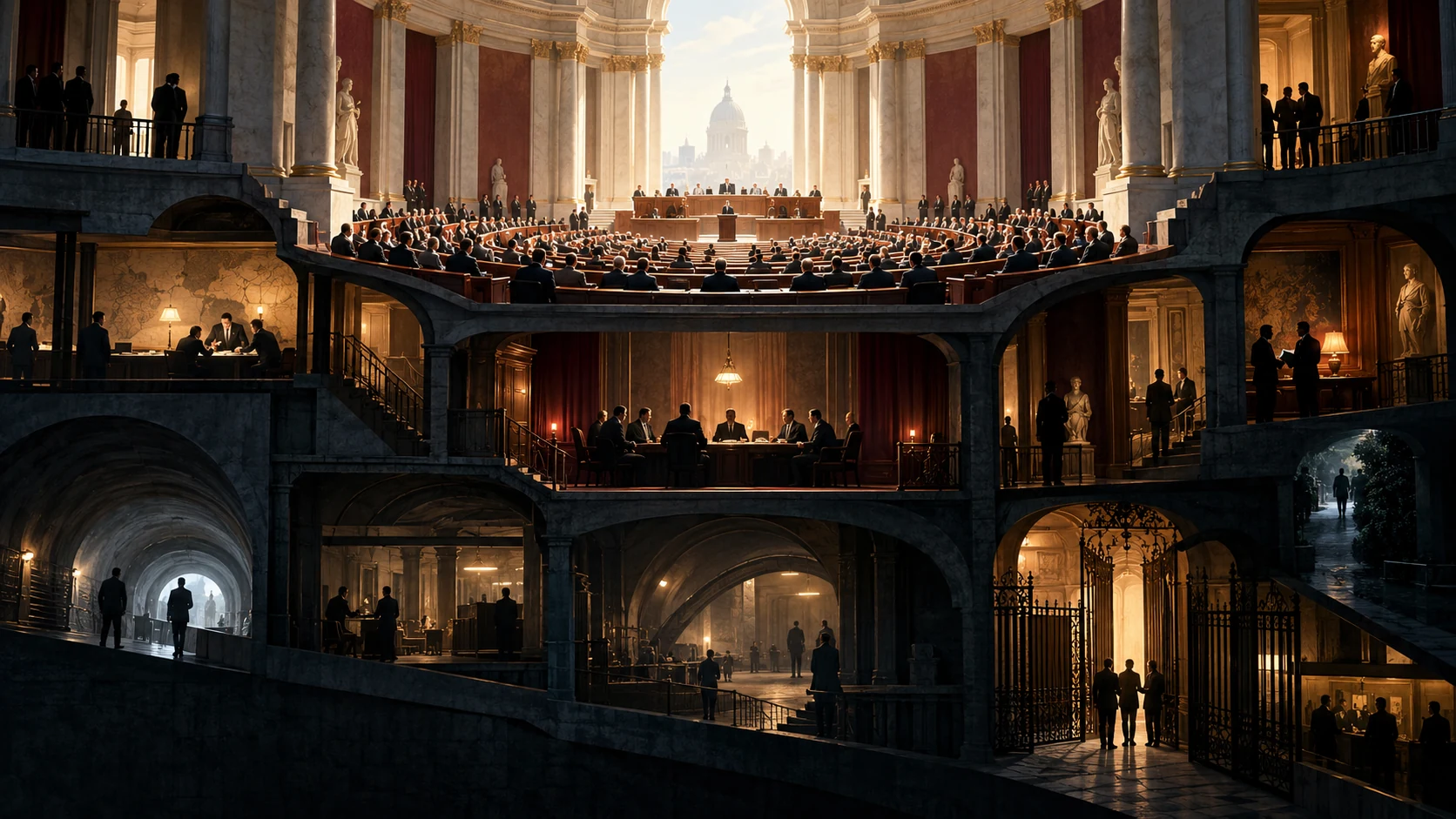
Political power is easiest to recognize when someone makes an official decision. A legislature passes a law, a government approves a budget, a president issues an order, a court overturns a regulation, or voters choose between competing parties. These are visible exercises of power because the actors, procedures, and outcomes can usually be identified. Yet focusing only on formal decisions gives an incomplete picture of how power works. Political influence also operates by determining which issues reach decision-makers, which alternatives are taken seriously, who receives information, and who is allowed meaningful access to the political process.
Visible power operates in arenas where conflict is open. Different actors express competing preferences, and an institution resolves the disagreement through a vote, ruling, executive decision, or administrative action. These forms of power are relatively easy to study because they leave records. We can identify who voted for a bill, which court issued a decision, or which government approved a policy.
However, the choices placed before these institutions have already been shaped by earlier processes. A parliament can vote only on proposals that reach its agenda. A minister can choose only among the options presented or developed by political and administrative staff. A court can usually decide only the cases brought before it. Public consultation may involve only the groups that know how to participate or have enough resources to remain involved. Power therefore operates not only at the moment of decision but throughout the process that defines the decision itself.
One less visible form of power is control over the agenda. Political institutions have limited time and attention. Thousands of social problems may exist, but only some become subjects of legislation, regulation, budget decisions, or public debate. Actors able to determine which issues receive attention can influence political outcomes before any formal vote occurs.
Suppose a group wants stricter regulation of a particular industry. If the proposal receives a hearing and is defeated, the exercise of power is visible: supporters and opponents competed, and one side prevailed. But if industry representatives, committee leaders, or party officials prevent the issue from reaching serious discussion at all, the outcome may be similar even though no vote occurs. The absence of a decision can itself reflect power.
A second form of less visible influence involves control over participation. Institutions often appear open in principle while remaining difficult to access in practice. Regulatory consultations may require technical expertise. Parliamentary hearings may invite only a limited set of organizations. Legal proceedings can be expensive. Political parties may rely on established networks when selecting candidates or advisers. These arrangements shape whose preferences enter the political process.
Access matters because political decision-makers depend on information from others. Groups that regularly meet officials can explain their concerns, provide data, propose language for legislation, and respond quickly to new developments. Groups without similar access may struggle to make their interests visible. Unequal participation can therefore create unequal influence even when formal rules appear neutral.
Information is another important source of invisible power. Government leaders rarely have enough time to investigate every issue themselves. They rely on briefings, reports, expert advice, media coverage, bureaucratic analysis, and recommendations from staff. Those who select and interpret this information can affect what leaders perceive as important or possible.
This influence does not always involve deception. A report can be factually accurate while emphasizing some consequences and giving less attention to others. Experts can reasonably disagree about forecasts. Bureaucracies may prioritize information that fits their institutional responsibilities. Political actors can therefore shape decisions by controlling emphasis rather than fabricating facts.
A deeper form of power involves shaping what people consider normal, realistic, or politically possible. Political actors do not choose among every imaginable policy. They operate within assumptions about what markets can tolerate, what voters will accept, what institutions can implement, what legal rules permit, and what political traditions regard as legitimate. These assumptions define boundaries around debate.
Such boundaries can change. Policies once regarded as impossible can become mainstream, while formerly accepted practices can become politically unacceptable. Social movements, intellectual debates, economic crises, technological change, and shifts in public values can alter the range of ideas treated as legitimate. Actors who influence these deeper assumptions exercise a form of power that is difficult to measure because its effects appear in how people think about choices rather than in any single decision.
This does not mean invisible power is always deliberate. Institutional routines can create political effects without anyone consciously designing them. A complicated regulatory system may favor large companies because they can afford specialized legal teams. A public consultation conducted only online may unintentionally exclude people with limited digital access. A committee may repeatedly hear from familiar organizations simply because officials find them easier to contact. Power can emerge from structures and routines as well as intentional strategy.
Economic inequality can also become politically significant through these mechanisms. Wealth does not automatically produce control over public decisions, but it can make continuous participation easier. Wealthy organizations can employ permanent staff, hire experts, commission research, and maintain regular contact with government officials. Less resourced groups may participate only during moments of crisis. The difference in continuity can translate into differences in influence.
Political parties exercise both visible and invisible power in similar ways. Their visible power appears when elected representatives vote. Their less visible power appears earlier, when parties decide who becomes a candidate, which policies enter the platform, which legislators receive committee positions, and which issues are considered strategically important. Voters choose among candidates, but parties help determine which candidates and ideas become available for voters to choose from.
Media and communication systems also affect the visibility of issues. News organizations do not control political outcomes directly, but decisions about coverage can influence what citizens and politicians perceive as urgent. Digital platforms can amplify some subjects rapidly while others receive little attention. Public visibility can place pressure on governments, while lack of attention can make it easier for issues to remain unresolved.
The concept of invisible power should be used carefully. It should not become a vague claim that unseen forces secretly determine everything. Political systems contain competition, uncertainty, and genuine disagreement. Powerful actors often fail. Governments lose elections, wealthy companies lose regulatory battles, social movements change established policies, and experts are ignored. Invisible power is not absolute control; it is the capacity to structure the environment in which political choices are made.
Recognizing these less visible forms of influence improves political analysis because it moves attention beyond final decisions. A vote tells us which option won, but not necessarily why those particular options were available. A law shows what a legislature approved, but not which proposals were excluded before debate. A government announcement reveals a decision, but not which advisers, institutions, interests, or assumptions shaped it.
Political power therefore exists at several levels. It operates openly when institutions make binding decisions. It operates less visibly when actors control agendas, access, and information. It operates more deeply when social and institutional conditions shape which ideas appear realistic or legitimate. Understanding politics requires examining all of these levels because the most important exercise of power may occur long before anyone raises a hand to vote.
Agenda-Setting Power: Who Decides What Politics Talks About?
Political decisions do not begin when legislators vote or when a president signs a law. Long before a formal decision is made, someone must decide which problems deserve attention, which proposals will be discussed, which questions will be investigated, and which issues can be postponed or ignored. This is the essence of agenda-setting power. It is the ability to influence what enters the political conversation before the competition over final decisions even begins.
Governments face far more demands than they can address at once. Legislatures receive countless proposals, ministries confront multiple policy problems, public agencies operate with limited budgets, and political leaders have only so much time and attention. Because institutional capacity is scarce, not every issue can receive equal consideration. Political systems must constantly prioritize. The actors who influence these priorities exercise an important form of power.
Agenda setting can be formal. Parliamentary leaders may control which bills reach the floor. Committees may decide whether to hold hearings. Government leaders may determine which proposals enter cabinet discussions. Agencies may choose which regulatory problems deserve investigation. Budget procedures may place some spending decisions on the table while excluding others. These choices can profoundly affect political outcomes because a proposal that never reaches the decision stage cannot be approved there.
Agenda setting can also occur through political strategy. Parties decide which subjects to emphasize during elections and which controversies they would rather avoid. Governments may focus public attention on issues where they believe they have an advantage. Opposition parties may try to elevate topics that expose government weaknesses. Interest groups may spend years attempting to transform a specialized concern into a national political issue. Social movements often begin by trying to make previously neglected problems impossible for political institutions to ignore.
This means that political victory does not always require winning a vote. Preventing a question from being discussed can be an effective form of influence. Suppose a group strongly opposes a proposed regulatory reform. It might try to defeat the reform after it is introduced, but it may prefer to stop the proposal from reaching the agenda at all. If no committee considers it, no minister adopts it, and no major party supports it, the group may achieve its objective without any visible confrontation.
The opposite strategy is equally important. Groups seeking change often struggle first for recognition of the problem. A concern may exist for years before governments treat it as a matter requiring public action. Campaigners may collect evidence, build coalitions, attract media attention, organize demonstrations, or persuade experts and public officials to take the issue seriously. Their initial goal is not necessarily to win a specific policy but to move the subject from the margins of political discussion to the center of institutional attention.
Political events can rapidly reshape agendas. Economic crises, wars, natural disasters, scandals, technological changes, court decisions, and social movements can push previously neglected topics to the front of political debate. When circumstances change suddenly, institutions may devote enormous resources to problems that received little attention only months earlier. Agenda-setting power is therefore significant but never absolute. Political actors can try to control attention, yet unexpected events can disrupt their priorities.
Media organizations also play a role in agenda formation. News coverage does not determine what governments must do, but sustained attention can raise the political cost of ignoring an issue. Politicians monitor public discussion because visibility can affect elections, reputation, and pressure from constituents. A problem repeatedly covered in national news may become more difficult for officials to postpone, while an issue receiving little attention may remain confined to specialized institutions.
Digital communication has complicated this process. Traditional political and media organizations once played a stronger role in determining which issues became nationally visible. Social media and online networks can now elevate subjects rapidly, sometimes before established institutions have responded. Yet digital attention is uneven and often temporary. An issue can become highly visible for several days without developing the organizational support needed to produce lasting institutional action.
Bureaucracies also possess agenda-setting capacity because they define problems in administrative terms. Public agencies collect data, classify risks, issue reports, conduct inspections, and recommend reforms. Their technical assessments can determine whether an issue is treated as urgent, routine, or outside the agency's responsibility. An issue defined as a major safety risk, for example, may attract regulatory attention more quickly than one categorized as a minor administrative concern.
Expert communities can influence agendas in similar ways. Economists, scientists, lawyers, security specialists, medical professionals, and other experts help define which problems appear serious and which solutions seem feasible. Political leaders may rely on them to identify emerging risks that are not yet visible to the public. Expertise can therefore place new issues on the agenda, but it can also narrow discussion if certain approaches are treated as technically unrealistic before political debate begins.
Institutional structure determines who has agenda power. In some political systems, executives control much of the legislative agenda. In others, parliamentary committees, coalition parties, regional governments, courts, or independent agencies possess greater influence. Federal systems divide political attention across multiple levels of government, allowing an issue blocked nationally to advance locally or regionally. The design of institutions therefore affects not only who makes decisions but also who can decide which decisions will be considered.
Agenda control also interacts with resources. Well-organized groups are often better able to maintain attention over long periods. They can employ specialists, monitor committees, respond to consultations, and keep an issue alive even when public interest is low. Poorly organized groups may struggle to maintain similar pressure, especially when their members are numerous but individually have little incentive to participate.
However, access to the agenda does not guarantee victory. Once an issue reaches formal debate, opponents may mobilize, information may change, public opinion may shift, and political coalitions may collapse. Agenda setting creates an opportunity for decision; it does not determine the final result. The distinction is important because political power often operates in stages. One group may be powerful enough to force discussion but not powerful enough to control what happens next.
The study of agenda-setting power therefore encourages a broader way of thinking about politics. Instead of examining only who wins elections or votes, it asks why some questions become politically urgent while others remain invisible. It asks who can introduce proposals, who can delay them, who has access to decision-makers, and which institutions control scarce political attention.
A political system is shaped not only by the decisions it makes but also by the decisions it never considers. Controlling the agenda can be as consequential as winning a vote because formal choices occur only after a much earlier struggle over what deserves to be chosen. Power begins before the decision itself, in the competition to define what politics is going to be about.
