Economic growth occurs when an economy produces more goods and services over time. In the short run, production can rise because unemployed workers return to jobs or factories use previously idle capacity. Sustainable long-term growth is different. It requires the economy to expand what it is capable of producing, not simply use existing resources more intensively.
Productivity is the foundation of this process. Productivity measures how effectively labor and other inputs are transformed into valuable output. If a worker can produce twice as much in an hour because of better tools, skills, or organization, the economy can grow without requiring twice as many working hours.
Productivity matters because there are limits to how much growth can come from adding workers or extending working time. Populations do not grow indefinitely, and people cannot work unlimited hours. Long-term improvements in living standards therefore depend heavily on producing more value from each unit of labor and capital.
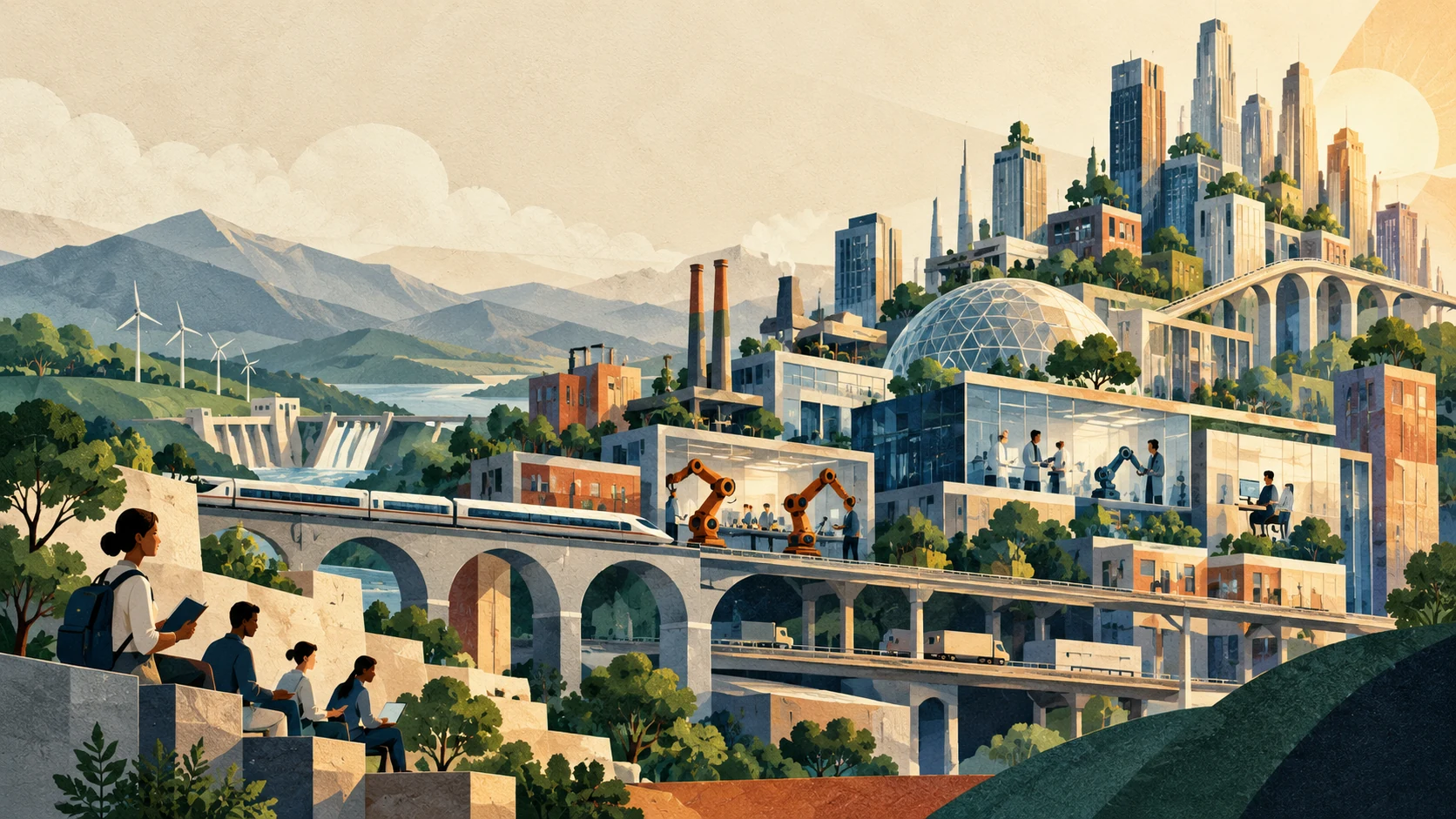
Investment helps raise productivity by expanding the stock of physical capital. Businesses purchase machinery, build factories, develop software, improve logistics, and create new facilities. Governments build roads, ports, energy systems, and other infrastructure. These investments allow future production to become larger or more efficient.
Investment requires a trade-off between the present and the future. Resources used to build a factory cannot simultaneously be used to produce consumer goods. Economies that invest more may sacrifice some current consumption in exchange for greater future capacity.
Not all investment is equally productive. A project creates lasting growth only if it improves the economy's ability to generate useful output. Poorly planned infrastructure or factories that produce little value can absorb resources without raising productivity.
Technology is another major source of growth. A technological improvement allows the same inputs to produce more output or better products. Technology includes machines and software, but also production methods, scientific knowledge, management systems, and organizational innovations.
The spread of existing technology can be as important as invention itself. A new method may initially be developed by one company or country, but the broader economic gains often come when thousands of firms adopt it.
Adoption can take time because businesses need compatible equipment, skilled workers, financing, and organizational changes. Productivity may therefore rise gradually even after an important technology becomes available.
Human capital supports both innovation and adoption. Workers with stronger education, health, and skills can perform more complex tasks and adapt to new technologies. Engineers may design better systems, technicians maintain equipment, managers improve operations, and workers learn new processes.
Education contributes most to growth when it produces useful capabilities rather than simply credentials. The quality of learning matters, as does the match between skills and economic opportunities.
Health is part of human capital as well. A healthier workforce misses fewer days, learns more effectively, and can work productively for longer. Public health improvements can therefore contribute directly to economic performance.
Research and development generate new knowledge. Businesses invest in research when they expect future profits, while governments and universities often support basic science whose benefits are difficult for private firms to capture fully.
Knowledge has unusual economic characteristics because one person's use of an idea does not necessarily prevent others from using it. Once discovered, a method can sometimes be replicated widely at low cost. This allows innovation to generate large spillover benefits.
Institutions influence whether investment and innovation occur. Businesses are more willing to commit resources when contracts are reliable, property rights are reasonably secure, and rules are predictable. Financial systems help direct savings toward productive projects.
Competition can also support growth by forcing firms to improve. Companies facing strong rivals have incentives to reduce costs and innovate. At the same time, firms need some expectation of reward for successful innovation. Economic systems therefore balance competitive pressure with incentives for research and investment.
Infrastructure raises the productivity of private capital. A factory is far more useful when connected to reliable electricity, roads, ports, and telecommunications. Public investment can therefore increase the returns to private investment.
Trade can promote growth by allowing firms to access larger markets, import advanced equipment, and specialize in activities where they are relatively efficient. Exposure to international competition can also force domestic firms to improve.
Economic growth can also come from better allocation of resources. An economy may become more productive even without new technology if labor and capital move from inefficient uses toward more productive ones. Removing barriers that trap workers or capital in low-productivity activities can therefore raise output.
Urbanization has historically supported this process by bringing workers and firms closer together. Dense economic areas can reduce transportation costs, improve matching between employers and workers, and allow ideas to spread more quickly.
Demographics influence growth as well. An expanding working-age population can increase total output. But population growth alone does not guarantee higher living standards because output must grow faster than population for average income to rise.
Short-term economic recoveries should therefore be distinguished from long-term growth. After a recession, output may rise rapidly as unemployed workers return to jobs and unused factories reopen. This is important, but it does not necessarily mean the economy's underlying productive capacity has increased.
Long-term growth occurs when that capacity itself expands. New technology, more capital, better skills, stronger infrastructure, and improved organization allow the economy to produce more even after existing resources are fully employed.
Savings and finance support this transformation by making funds available for investment. However, very high saving is not automatically beneficial if funds are not invested productively. The quality of investment matters as much as the quantity.
Stable macroeconomic conditions can make long-term planning easier. Very high inflation, repeated financial crises, or unpredictable policy can discourage investment. Stability does not create growth by itself, but it provides an environment in which productive decisions are easier to make.
Growth also involves structural change. As productivity rises, workers often move from agriculture toward manufacturing and services, while new industries replace older ones. This process can raise incomes but also create disruption as occupations and regions adjust.
The benefits of growth may not be distributed equally. An economy can become more productive while some workers experience stagnant wages or job displacement. Growth increases the total resources available, but institutions and labor-market conditions influence how those gains are shared.
Environmental constraints also matter. Growth based entirely on increasing resource use may be difficult to sustain. Technological improvements that reduce energy use, pollution, or material consumption per unit of output can make growth less resource-intensive.
Sustainable economic growth therefore depends on more than simply producing more this year than last year. It requires continuous improvement in the economy's productive capacity. Investment builds capital, human capital strengthens workers, technology expands what is possible, infrastructure connects economic activity, and institutions shape incentives.
The deepest source of long-term growth is the ability to combine these elements more effectively over time. Economies grow sustainably when they learn how to produce more value from available resources while continuously expanding the knowledge, skills, capital, and institutions that make future production possible.