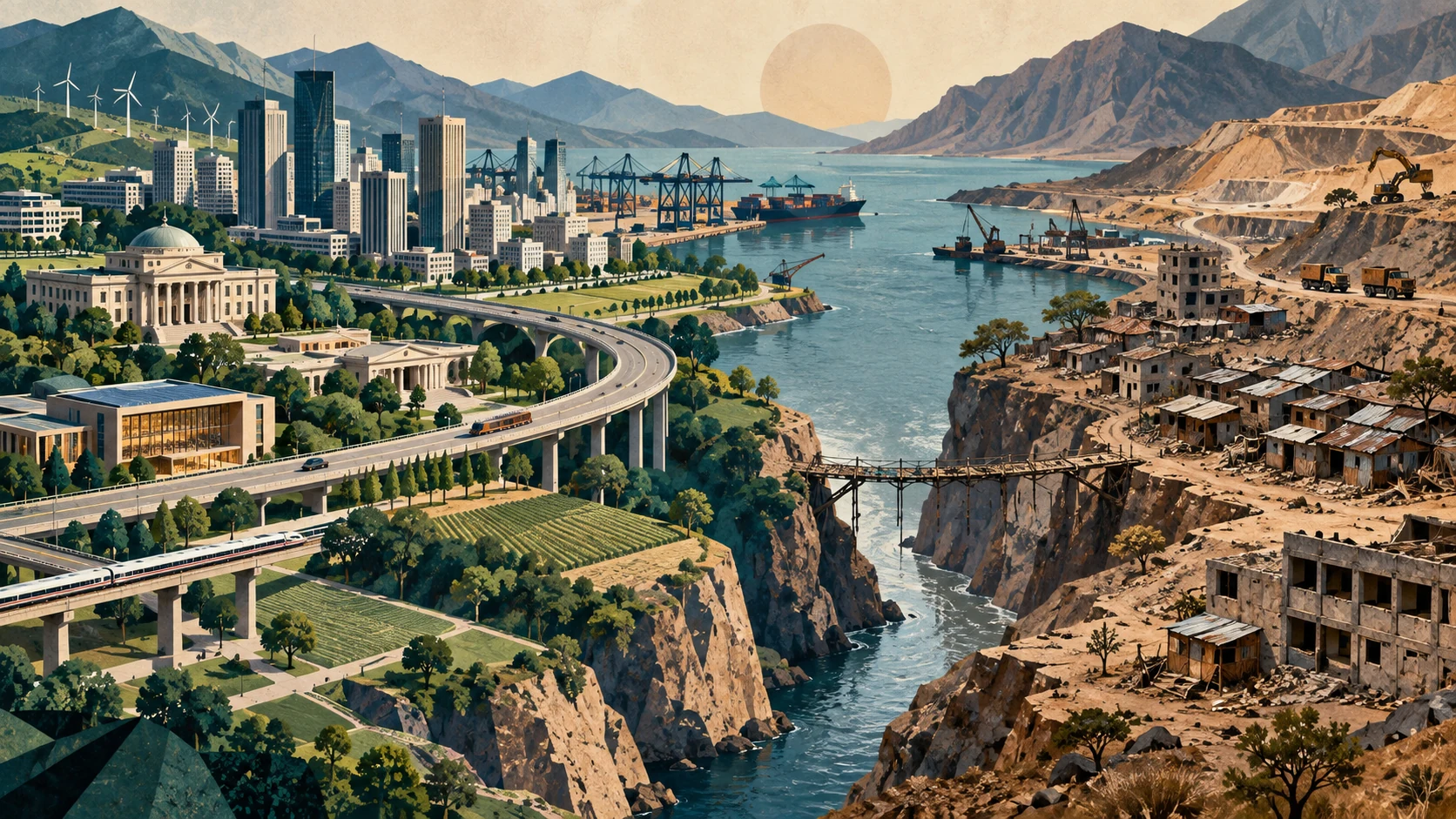
The differences in living standards between countries are among the largest and most persistent facts in economics. Some societies can provide high incomes, reliable infrastructure, advanced healthcare, and broad access to education, while others struggle to meet basic needs. These gaps cannot be explained by a single factor. Economic development is a long process involving productivity, human capital, technology, institutions, infrastructure, trade, investment, geography, and political stability.
Productivity is at the center of the explanation. Productivity refers to how much valuable output workers can produce with a given amount of time and resources. A worker using modern machinery, reliable electricity, efficient logistics, and advanced software can produce far more than someone performing similar tasks with limited tools.
Higher productivity allows businesses to pay higher wages without necessarily becoming uncompetitive. It also creates more income that can be saved, invested, taxed, and used to improve living standards. Countries become richer over the long run mainly by increasing the amount of value produced per worker.
Physical capital contributes directly to this process. Roads, ports, factories, power plants, telecommunications networks, machinery, and computers allow workers to perform tasks more efficiently. Building this capital requires investment, which means sacrificing some present consumption in order to create greater productive capacity in the future.
Human capital is equally important. Education, health, training, and experience increase the productive capabilities of individuals. A healthy, skilled workforce can adopt complex technologies, solve problems, manage organizations, and create new ideas.
Education alone, however, is not enough. Skills must be useful in the economy, institutions must allow people to apply them, and businesses need incentives to invest. A highly educated workforce can still be underproductive if infrastructure is unreliable or economic opportunities are limited.
Technology is one of the strongest drivers of long-term development. Better methods allow societies to produce more with the same resources. Technological progress includes not only inventions but also organizational improvements, agricultural techniques, management practices, logistics, and the diffusion of existing knowledge.
Poorer countries do not always need to invent new technologies to benefit from them. They can adopt methods developed elsewhere. In principle, this creates opportunities for rapid catch-up. In practice, successful adoption often requires education, finance, infrastructure, legal stability, and firms capable of integrating new techniques.
Institutions help determine whether these investments happen. Institutions include laws, courts, property rights, government agencies, political systems, financial structures, and social norms. When contracts are enforceable and property is reasonably secure, people have stronger incentives to invest because they expect to benefit from future returns.
Weak institutions can create the opposite incentives. If businesses fear arbitrary confiscation, corruption, or unstable rules, they may avoid long-term projects. Entrepreneurs may spend resources protecting themselves politically rather than improving products. Investors may send capital abroad instead of financing domestic activity.
Political stability is therefore economically important, although stability alone does not guarantee prosperity. Frequent conflict, unpredictable changes in policy, or breakdowns in public order can destroy capital and discourage investment. Stable institutions allow businesses and households to make plans that extend years into the future.
Infrastructure connects economic activity. A farmer may be highly productive in the field but still earn little if poor roads make it expensive to reach customers. A factory cannot operate efficiently with frequent power failures. Digital businesses need reliable telecommunications. Infrastructure therefore amplifies the value of labor and capital.
Financial systems also matter because productive projects often require funds before they generate income. Banks and capital markets help move savings toward borrowers and investors. When finance is weak or inaccessible, entrepreneurs may be unable to expand even when profitable opportunities exist.
Trade can support development by allowing countries to specialize, access larger markets, import technology, and obtain goods they cannot efficiently produce themselves. Export industries can bring foreign currency and expose firms to international competition.
Trade is not a guaranteed path to prosperity, however. Countries differ in their ability to benefit from global markets, and rapid changes can disrupt particular workers and industries. The quality of institutions, infrastructure, education, and domestic firms influences whether trade leads to broad-based development.
Geography also matters. Landlocked countries often face higher transportation costs. Tropical climates can increase the burden of some diseases and affect agricultural productivity. Access to navigable rivers or ports can reduce trade costs. Natural resources can generate wealth but can also create political and economic problems when governments become dependent on resource revenue.
Resources alone therefore do not determine prosperity. Some resource-rich countries remain poor, while countries with few natural resources have achieved high incomes through human capital, trade, institutions, and technology. The way resources are managed is often more important than their mere presence.
Population patterns influence development as well. A growing working-age population can support rapid growth if jobs and education expand. But rapid population growth without sufficient investment can place pressure on schools, housing, and infrastructure.
History matters because development is cumulative. Countries inherit legal systems, infrastructure, educational institutions, political traditions, levels of trust, and patterns of land ownership from the past. Colonial rule, war, migration, and previous policy choices can leave effects that persist for generations.
This creates path dependence. A society with good schools and functioning institutions can more easily build advanced industries, which generate tax revenue that supports further improvements. A country with weak institutions and low investment can become trapped in the opposite cycle.
Economic development is therefore not simply a matter of making one policy change. It involves building capabilities over long periods. Education becomes more valuable when firms can use skilled workers. Infrastructure becomes more valuable when businesses invest. Technology spreads more quickly when finance and institutions support adoption.
Successful development also requires the ability to adapt. Industries that drive growth in one period may decline later. Countries need institutions that allow workers, capital, and businesses to move toward new opportunities.
The differences between rich and poor countries cannot be reduced to culture, geography, trade, or government alone. Prosperity emerges from the interaction of productive capabilities and the institutions that allow them to develop. Productivity, human capital, technology, infrastructure, finance, trade, and stability reinforce one another.
Development is therefore best understood as a cumulative process. Countries become richer by building the ability to produce more valuable goods and services over time. The process can accelerate when investments complement one another, but it can also stall when institutions, infrastructure, or human capital remain weak. Persistent prosperity is ultimately built through the long-term accumulation of productive capabilities and the systems that allow people to use them effectively.