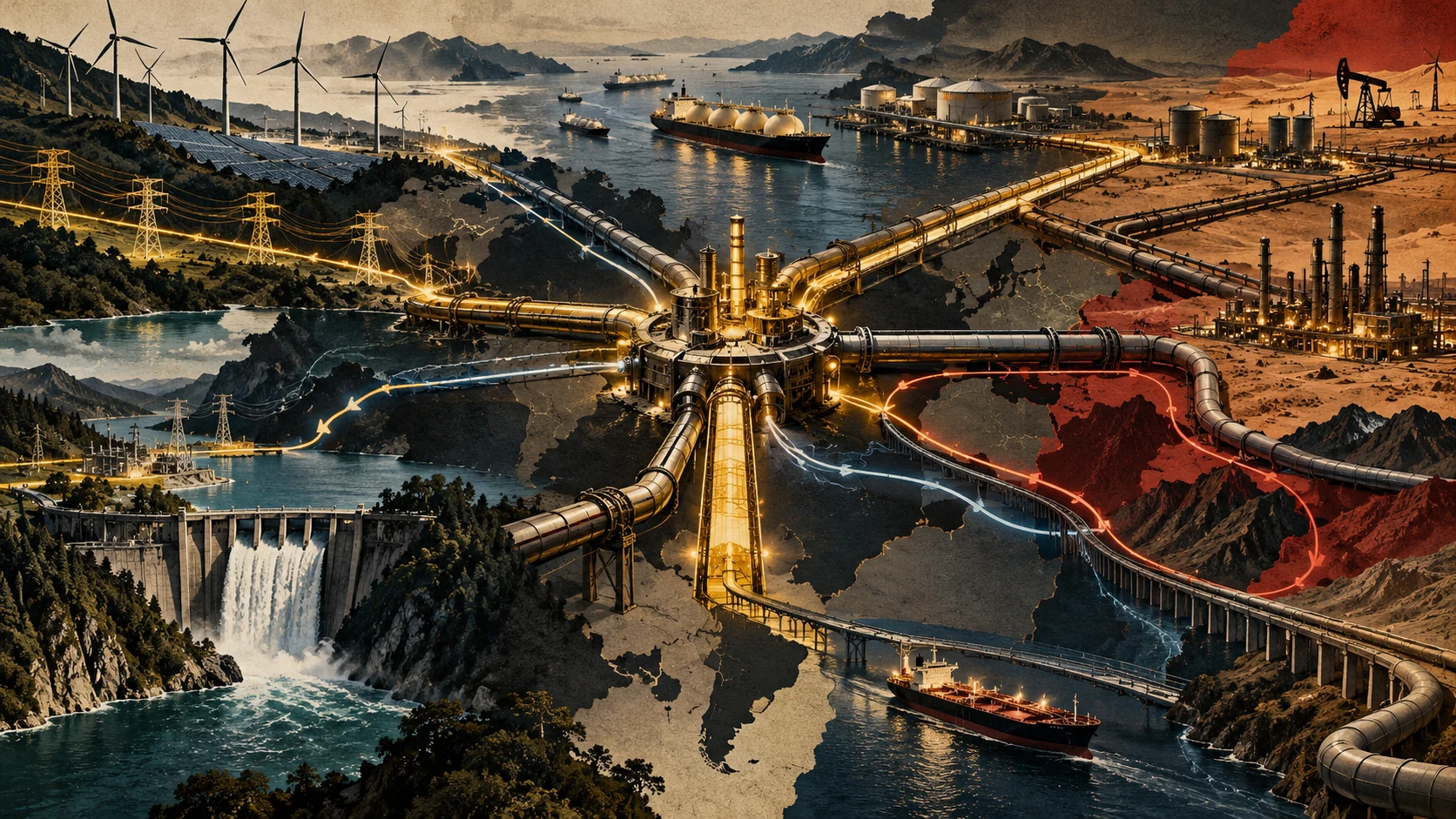
Energy is not just another commodity traded in markets. It is a basic input into almost every part of a modern economy. Factories need electricity and fuel, transportation depends on energy, homes require heating or cooling, digital infrastructure consumes large amounts of power, and agriculture relies on energy for machinery, fertilizers, irrigation, processing, and logistics. Because so many activities depend on continuous and affordable energy, control over energy supply can become a source of both economic and geopolitical power.
Energy security refers to the ability of a country or economy to obtain sufficient energy reliably, at manageable cost, and without excessive vulnerability to disruption. This does not mean producing all energy domestically. Many prosperous countries import substantial amounts of fuel or electricity. What matters is whether supply is dependable, diversified, physically accessible, and supported by infrastructure capable of handling shocks.
A country can therefore be energy secure while importing much of what it consumes, provided it has many suppliers, reliable transportation routes, adequate storage, strong infrastructure, and the financial capacity to obtain energy even during periods of stress. Conversely, a country with domestic resources can still face insecurity if its infrastructure is weak, refining capacity is insufficient, electricity grids are unreliable, or production depends on technology and equipment that are difficult to replace.
Oil provides one of the clearest examples of energy's strategic importance. Modern transportation systems still depend heavily on petroleum products, and oil is also used throughout industry and petrochemical production. Because oil is globally traded, disruptions in major producing regions can affect prices far beyond the countries directly involved. A supply shock in one part of the world can increase transportation and production costs elsewhere, even for countries that do not import directly from the affected producer.
This global pricing mechanism gives major oil producers a form of economic influence. Countries with large reserves and substantial production capacity can affect international markets through changes in output, especially when spare production elsewhere is limited. Their influence is not unlimited, because high prices encourage substitution, conservation, new investment, and increased production by competitors. Even so, oil-producing states can possess geopolitical leverage when other countries depend heavily on imported crude or refined products.
Natural gas creates a somewhat different pattern of dependence. Unlike oil, which can be transported relatively easily by tanker, natural gas has historically depended more heavily on pipelines linking specific producers and consumers. Liquefied natural gas, or LNG, has made gas markets more flexible by allowing gas to be cooled, transported by ship, and converted back into gaseous form at import terminals. Even so, building LNG infrastructure requires substantial investment, and not every country has enough terminals, storage, or pipeline connections to switch suppliers quickly.
This physical structure matters because dependence on one gas supplier can create political vulnerability. If a country relies heavily on a single pipeline system, changing suppliers may require years of infrastructure investment. The supplier can therefore gain bargaining power because the buyer's alternatives are limited. Energy dependence becomes geopolitical when interruption of supply could create serious economic or political consequences.
Electricity introduces another dimension because it must usually be produced and consumed almost simultaneously, with storage still limited relative to total demand in many systems. Electricity grids must constantly balance supply and demand. If generation falls unexpectedly or transmission systems fail, the effects can be immediate. For this reason, energy security depends not only on having enough fuel but also on maintaining a stable electrical system.
Modern economies are becoming increasingly dependent on electricity as transport, heating, manufacturing, and digital services electrify. Data centers, telecommunications networks, hospitals, financial systems, railways, factories, and households all require reliable power. A country may therefore become less dependent on imported fossil fuels while becoming more dependent on grid resilience, electricity storage, transmission networks, and the materials needed to build renewable generation.
Renewable energy changes the geography of energy power but does not eliminate geopolitical dependence. Wind and solar energy reduce the need for continuous fuel imports because the energy source itself is domestic and naturally replenished. Once a solar farm or wind installation is operating, it does not require imported coal, oil, or gas to generate electricity. This can improve energy security, particularly for countries that previously relied heavily on imported fuels.
However, renewable systems require equipment, minerals, manufacturing capacity, electricity networks, and storage. Solar panels, batteries, wind turbines, transformers, power electronics, and transmission infrastructure all depend on complex industrial supply chains. Concentration in the production or processing of critical materials can create new forms of dependence even as dependence on fossil fuels declines.
The energy transition therefore does not remove geopolitical competition. It changes what the strategically important resources are. Lithium, nickel, cobalt, copper, rare earth elements, battery manufacturing, grid equipment, and advanced energy technologies can all become important to national energy strategy. A country that replaces imported oil with imported batteries or critical components may improve its position in some respects while creating vulnerabilities in others.
Diversification is one of the most important principles of energy security because dependence becomes dangerous when alternatives are weak. A country that purchases natural gas from several suppliers through multiple routes is less vulnerable to disruption than one relying on a single pipeline. An electricity system combining several generation technologies may be more resilient than one dominated by a single fuel source, especially if supply conditions vary.
Diversification does not mean using every possible energy source equally. It means avoiding situations in which failure of one supplier, route, technology, or infrastructure system would create severe consequences. The value of diversity is similar to the value of diversification in finance: it reduces dependence on any single point of failure.
Infrastructure determines whether diversification is real or merely theoretical. A country may identify several potential suppliers, but they provide little security if there are no ports, pipelines, transmission lines, storage facilities, or interconnections capable of delivering the energy. Physical infrastructure turns alternatives into practical options.
Ports that can receive oil or LNG, pipelines connecting regions, strategic storage facilities, electricity interconnectors, domestic transmission networks, refineries, and power plants all contribute to energy security. Their importance often becomes most visible during crises. A pipeline that appears redundant during normal times may become essential when another route fails. Excess storage may seem inefficient until imports are disrupted.
This is one reason energy systems often require some redundancy. In ordinary commercial logic, unused capacity can appear wasteful. But systems designed only for maximum efficiency under normal conditions may be fragile when conditions change. Spare generation, fuel reserves, alternative import routes, and backup infrastructure have value because they provide insurance against disruption.
Strategic petroleum reserves are a familiar example. Governments maintain emergency stocks not because storing oil is always the most profitable use of resources, but because access to fuel during a severe disruption has economic and national-security value. Electricity systems use similar forms of resilience through reserve capacity, interconnections, backup generation, and demand-response mechanisms.
Energy security affects inflation because energy costs enter almost every stage of production and distribution. When oil prices rise, transportation becomes more expensive. When natural gas prices rise, heating and electricity costs may increase. Energy-intensive industries such as chemicals, metals, cement, glass, and fertilizers can face sharply higher production costs. Those costs can then spread through supply chains.
The effect on consumer prices can be broad. Food prices may rise because farmers pay more for fertilizer, machinery, refrigeration, and transportation. Manufacturers may increase prices because energy and shipping become more expensive. Households may spend more on fuel and utilities, leaving less money for other purchases. An energy shock can therefore generate inflation even when domestic demand has not increased.
This kind of inflation presents policymakers with a difficult problem. Raising interest rates can reduce demand, but it cannot directly create additional gas, oil, or electricity. Monetary policy may prevent an energy shock from spreading into persistent generalized inflation, but it cannot solve the physical shortage itself. Energy security therefore has consequences for macroeconomic stability as well as national strategy.
Industrial competitiveness is also closely tied to energy. Some industries consume enormous amounts of electricity, gas, or heat. Steel, aluminum, chemicals, fertilizers, paper, glass, and other sectors may choose locations partly based on energy price and reliability. A country with abundant, predictable, and reasonably priced energy can attract investment that would be uneconomic in a region with expensive or unstable supply.
Energy costs can therefore shape the industrial structure of entire countries. Cheap hydropower may support electricity-intensive industries. Abundant natural gas can make chemical production more competitive. Reliable renewable electricity may become increasingly important for industries trying to reduce carbon emissions. Energy policy is thus connected to industrial policy because the availability and price of energy influence where production occurs.
Reliability matters as much as price. A factory can sometimes tolerate high electricity costs better than frequent power failures. Interruptions damage equipment, halt production, waste materials, and make delivery schedules unreliable. Businesses operating in unstable electricity systems may purchase private generators or batteries, increasing costs further. Weak energy infrastructure can therefore act as a hidden tax on economic activity.
The connection between energy and economic sovereignty becomes clearer when a country depends heavily on external suppliers for essential inputs. Energy imports are not inherently a loss of sovereignty. International trade can be efficient and mutually beneficial. The problem arises when dependence is concentrated and the supplier can credibly threaten to interrupt access.
A country in this position may become reluctant to take political actions that could provoke the supplier. Energy relationships can therefore influence foreign policy. Governments may moderate sanctions, diplomatic criticism, military cooperation, or trade policies if they fear losing access to crucial fuel supplies.
The supplier's power depends on the buyer's alternatives, but the relationship can also run in the opposite direction. A producer that depends heavily on one export market may be vulnerable if the customer reduces purchases. Energy trade often creates mutual dependence rather than one-sided control. The balance of power depends on which side can adjust more easily.
This is fundamentally a bargaining problem. A gas-producing country with several potential buyers has more leverage than one connected to only a single market. An importing country with several suppliers and large storage facilities has more leverage than one dependent on a single pipeline. Economic power comes from alternatives, and energy markets are no exception.
Transportation infrastructure is crucial because energy resources are useful only if they can reach consumers. Pipelines, shipping routes, ports, canals, railways, and transmission lines can all become strategic assets. Control over key routes may affect the flow of energy between producers and markets.
Maritime chokepoints are particularly important because large volumes of oil and gas can pass through relatively narrow routes. Conflict, accidents, piracy, or political restrictions in these areas can disrupt global supply. The strategic importance of such routes explains why major powers pay close attention to freedom of navigation and maritime security.
Pipelines create even more specific dependencies. Once a pipeline is built, producer and consumer may become connected for decades. The producer needs the customer, and the customer needs the supply. This can support stable cooperation, but it can also create vulnerability if political relations deteriorate.
Electricity interconnections produce similar relationships. Cross-border power trade can improve efficiency and resilience because countries can share surplus electricity. But dependence on imported electricity can become sensitive during periods when neighboring systems are also under stress. Interconnections therefore increase both cooperation and interdependence.
Domestic energy production can reduce some vulnerabilities, but self-sufficiency is not always the most efficient goal. Producing every form of energy domestically regardless of cost can make an economy poorer and less competitive. Complete independence may also be impossible for countries lacking particular natural resources.
The more realistic objective is often resilience rather than autarky. A resilient energy system can continue functioning when one source fails. It combines domestic production, diversified imports, storage, flexible demand, strong infrastructure, and international cooperation. The goal is not to eliminate dependence but to prevent dependence from becoming coercive.
Energy efficiency contributes to this strategy because the cheapest unit of energy to secure is often the one that does not need to be consumed. Better insulation, more efficient industrial equipment, improved vehicles, and efficient appliances can reduce exposure to supply shocks. A country that needs less energy to produce a unit of economic output is less vulnerable to price increases.
Efficiency can also improve foreign-policy flexibility. If a government can reduce consumption quickly during a crisis, a supplier's ability to use energy as leverage decreases. Demand flexibility therefore functions as a form of strategic reserve.
Electrification can also strengthen security when it allows economies to shift from imported fuels toward domestically generated electricity. Electric vehicles, heat pumps, and industrial electrification can reduce oil and gas dependence if the electricity system itself is diversified. But electrification increases the importance of grid investment and reliable generation.
Grid infrastructure is often one of the least visible parts of energy security. Building renewable power plants is not enough if transmission lines cannot carry electricity from areas where it is generated to places where it is needed. Aging or congested grids can limit the value of new generation capacity.
Transmission also helps balance variability. Wind may be strong in one region while weak in another. Solar production varies by time and weather. Larger interconnected grids can move power across regions, reducing the need for every area to balance supply independently.
Storage provides another source of flexibility. Batteries can balance electricity over relatively short periods, while other storage technologies can serve longer durations depending on geography and economics. Pumped hydro, thermal storage, hydrogen-based systems, and fuel reserves can all contribute in different ways.
No single technology solves every problem. The reliability of an energy system usually comes from combining multiple technologies and forms of flexibility. A system with renewable generation, storage, dispatchable power, strong transmission, demand response, and international interconnections may be more resilient than one relying heavily on any single resource.
Nuclear power is another element of energy-security debates. Nuclear plants can provide large amounts of low-carbon electricity with relatively small volumes of fuel. Because nuclear fuel can be stored for long periods, nuclear generation can reduce exposure to short-term fossil-fuel supply shocks. However, nuclear power requires significant capital, specialized expertise, long construction periods, strict safety systems, and secure fuel-cycle supply chains.
Countries therefore evaluate nuclear power differently depending on their institutions, geography, financing capacity, industrial base, and public preferences. The broader lesson is that energy security is not achieved by identifying one universally superior source. It depends on how the entire system fits together.
Cybersecurity has become part of energy security as well. Modern electricity grids, pipelines, refineries, and industrial systems increasingly depend on digital controls. Cyberattacks can disrupt energy infrastructure without physically destroying it. As energy systems become more connected and automated, protecting software and communications becomes as important as protecting power plants and pipelines.
Physical sabotage remains another concern. Energy infrastructure is often geographically dispersed and difficult to defend completely. Pipelines extend across long distances, transmission lines cover vast areas, and offshore facilities operate far from population centers. Resilience therefore requires not only preventing attacks but also ensuring that damaged systems can be repaired quickly.
Climate and weather risks also influence energy security. Drought can reduce hydropower production. Extreme heat can increase electricity demand for cooling. Severe cold can increase heating demand while disrupting some forms of infrastructure. Storms can damage transmission networks, ports, and offshore installations.
A secure energy system must therefore be able to handle environmental variability as well as geopolitical shocks. Diversified generation, regional interconnections, storage, demand flexibility, and resilient infrastructure all help reduce the impact of extreme events.
Energy security also shapes public finances. Countries that import large amounts of fuel can face deteriorating trade balances when prices rise. Governments may respond by subsidizing electricity, fuel, or heating to protect households and businesses. These subsidies can become extremely expensive during severe price shocks.
Energy exporters face different fiscal risks. Governments that depend heavily on oil or gas revenue can benefit enormously when prices are high but suffer when prices fall. Their budgets, exchange rates, and political systems may become closely tied to global energy markets. Energy abundance can therefore create both power and vulnerability.
Exporting countries gain greater strategic flexibility when they diversify their economies rather than depending overwhelmingly on one commodity. A producer that needs continuously high energy prices to finance public spending may have less freedom than its large reserves initially suggest. Resource ownership creates power only when the owner can withstand changes in demand and price.
This reinforces a broader principle: economic power depends not merely on possessing a resource but on controlling it under favorable conditions. A country may have enormous oil reserves but lack the technology, investment, infrastructure, or political stability needed to exploit them. Another may possess few domestic resources yet achieve high energy security through diversified trade, strong institutions, storage, and efficient infrastructure.
Technology can shift these balances over time. Hydraulic fracturing changed the position of some oil and gas producers. LNG expanded the geographic flexibility of gas trade. Falling costs of solar and wind power opened new options for countries with limited fossil-fuel resources. Battery improvements may further change the economics of electricity systems and transportation.
Technological change can therefore weaken established forms of energy power. A supplier that once controlled an indispensable resource may lose leverage if consumers develop substitutes. At the same time, new technologies can create new dependencies on minerals, manufacturing capacity, intellectual property, or specialized equipment.
Energy transitions have always had geopolitical consequences because different energy systems favor different resources and regions. A world dominated by coal creates one geography of power. A world dominated by oil creates another. A more electrified system based heavily on renewables, storage, nuclear energy, and digital grids will create yet another pattern of strategic advantage.
This does not mean fossil fuels will become irrelevant immediately. Energy systems contain long-lived infrastructure, and transitions take time. Vehicles, industrial plants, pipelines, refineries, buildings, and power stations remain in operation for years or decades. During the transition, countries may face overlapping dependencies on both old and new energy systems.
That overlap can itself create vulnerability. Underinvestment in existing supply before replacement systems are ready can produce shortages, while excessive investment in old infrastructure can create expensive assets that later become less useful. Energy policy therefore requires managing timing as much as choosing technologies.
Foreign policy reflects these realities. Governments negotiate long-term supply contracts, support overseas energy projects, build strategic relationships with producing states, protect shipping routes, and participate in international energy institutions. Energy considerations often interact with defense, trade, climate policy, development finance, and diplomacy.
Sanctions demonstrate the connection particularly clearly. Restricting another country's energy exports can reduce its revenue, but doing so can also raise global prices and impose costs on importing countries. The effectiveness of sanctions therefore depends partly on whether alternative supplies exist and whether buyers can adjust.
Energy exporters also face limits when trying to use supply as leverage. Cutting exports reduces the customer's supply, but it may also reduce the producer's revenue and encourage the customer to find permanent alternatives. Using energy coercively can therefore undermine the supplier's long-term market position.
The strongest energy position is often not complete dominance over others but low vulnerability to any single relationship. Countries with diversified suppliers, diversified energy sources, strong storage, robust grids, domestic capabilities, efficient demand, and flexible infrastructure have more freedom to make political decisions without fearing immediate economic disruption.
That freedom is one of the clearest forms of geopolitical power. A country that can withstand an energy shock can maintain policies that would be difficult for a more dependent state. It can impose sanctions, resist coercion, endure temporary price increases, and negotiate from a stronger position.
Energy security also affects domestic political stability. Sudden increases in fuel or electricity prices can create intense public pressure because energy is essential and highly visible in household budgets. Governments may face protests, industrial shutdowns, or demands for subsidies when costs rise sharply. Foreign dependence can therefore become a domestic political vulnerability.
For businesses, stable energy prices improve planning. Companies are more willing to build factories and make long-term investments when they can predict future operating costs. Highly volatile energy prices create uncertainty that can delay investment or encourage companies to relocate production.
For households, reliable and affordable energy affects basic living standards. Heating, cooling, transportation, lighting, refrigeration, and digital access all depend on it. Energy insecurity can therefore reduce both economic productivity and quality of life.
The broader significance of energy becomes clear when it is treated as infrastructure rather than merely as a commodity. Oil, gas, electricity, and renewable energy are not isolated products. They form part of systems that make nearly every other economic activity possible. When those systems are reliable, they fade into the background. When they fail, the consequences spread quickly through prices, production, transportation, employment, and politics.
Energy security is therefore a form of economic security. It protects countries from inflationary shocks, supports industrial competitiveness, strengthens resilience during crises, and reduces exposure to external coercion. It also expands political freedom by giving governments more alternatives when international relationships deteriorate.
The most secure countries are not necessarily those with the largest oil fields, gas reserves, or renewable resources. Resource abundance helps, but power comes from the combination of supply, infrastructure, technology, financial capacity, diversification, and the ability to adapt. A country with many alternatives can absorb disruption. A country dependent on one supplier, one route, or one technology cannot.
This is why the capacity to switch matters as much as the amount of energy available. Multiple suppliers, interconnected grids, flexible generation, strategic reserves, strong transmission, energy efficiency, and diversified technologies all increase the ability to say no to unfavorable conditions. They reduce the power that any single producer, route, or disruption can exercise over the economy.
Energy security is ultimately about maintaining freedom of action. Economies cannot function without continuous access to energy, and states that cannot secure that access become vulnerable to price shocks, industrial decline, and political pressure from abroad. Those that build resilient and diversified systems gain more than reliable electricity and fuel. They gain the ability to pursue economic and foreign-policy choices without being constrained by the threat that a single disrupted supply line can bring the entire system under pressure.
