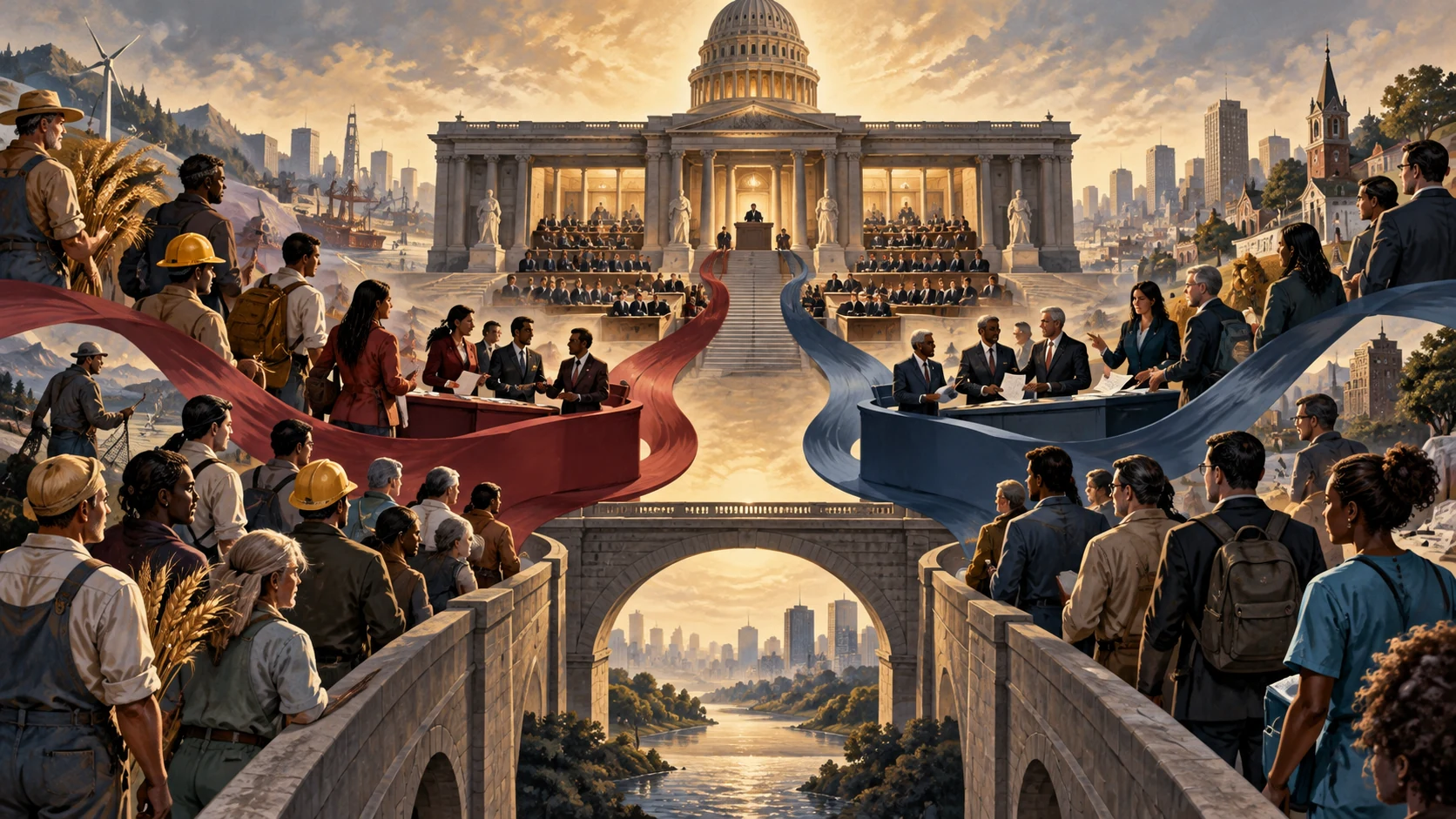
Political parties are often described mainly as organizations that compete in elections. They choose candidates, publish platforms, campaign for votes, and try to win public office. These activities are important, but they represent only one part of what parties do. Political parties also organize legislatures, form governments, build coalitions, coordinate policy, recruit political elites, distribute positions, mobilize citizens, and connect different institutions. Much of modern representative government would be extremely difficult to operate without them.
The need for parties begins with a basic problem of political coordination. A national legislature may contain hundreds of representatives. Each member could theoretically act independently, but a chamber composed entirely of individuals negotiating every issue from the beginning would have difficulty making stable decisions. Parties reduce this complexity by grouping politicians around shared programs, identities, constituencies, and strategic goals.
This allows voters to make more understandable choices. Most citizens cannot investigate every candidate's position on every policy. Party labels provide information. A voter who recognizes a party's general ideology or governing record can use that information to estimate how its candidates are likely to behave. The party therefore acts as a political shortcut, linking individual candidates to a broader program.
Before elections even occur, parties influence who can become a serious candidate. They recruit potential officeholders, organize nomination procedures, provide campaign infrastructure, distribute endorsements, and sometimes provide direct financial support. A person with little party backing may struggle to compete against someone supported by an established national organization.
Candidate selection gives parties substantial power over the composition of political elites. Parties can promote younger politicians, protect incumbents, encourage representation from particular regions or social groups, or favor candidates with certain ideological positions. Internal party decisions therefore affect what choices later appear on the public ballot.
Parties also mobilize voters. Campaigning requires volunteers, data, local organizations, advertising, fundraising, transportation, communication, and sustained contact with supporters. Established parties develop this capacity over many election cycles. They can identify likely voters, organize events, distribute campaign materials, and encourage turnout.
After the election, party organization becomes even more important. Legislators must decide who will lead the chamber, who will serve on committees, which bills will receive priority, and how negotiations with the executive will proceed. Parties organize these tasks by creating leadership structures and expectations about cooperation.
Party discipline varies between political systems. In some legislatures, representatives usually vote with their party. In others, individual members have greater independence. Even where discipline is weak, however, parties provide information and coordination. Legislators often rely on party colleagues to understand complex proposals and predict how votes will develop.
Committees are another area where parties organize power. Legislative committees review bills, conduct investigations, hold hearings, and oversee government agencies. Parties often determine committee membership and leadership, giving them influence over which representatives specialize in particular policy areas and which issues receive attention.
Government formation makes parties especially important in parliamentary systems. If one party wins a majority of seats, it can usually form a government. If no party has a majority, several parties may negotiate a coalition. These negotiations can determine the government's policy program, distribution of cabinet positions, budget priorities, and procedures for managing future disagreement.
Much of what later appears as a public government decision may have been negotiated inside this coalition long before a formal parliamentary vote. Parties bargain over taxes, public spending, ministerial appointments, regulatory reforms, and legislative schedules. Public institutions make the official decision, but party organizations often structure the agreement that made the decision possible.
Even in presidential systems, parties connect the executive and legislature. A president may need support from legislators belonging to the same or different parties. Negotiations over legislation, appointments, budgets, and oversight depend heavily on party relationships. Divided government can make these negotiations especially important.
Parties also distribute political positions. Cabinet posts, committee leadership roles, parliamentary offices, campaign responsibilities, and other positions often depend on party decisions. Control over these opportunities gives party leaders influence over political careers. A legislator who consistently opposes party leadership may retain an elected seat but lose access to prestigious positions or future support.
This system can promote coordination, but it can also concentrate power inside party organizations. If a small group controls nominations, campaign resources, and internal appointments, politicians may become highly dependent on party leaders. Different parties address this problem in different ways, using internal elections, membership votes, primaries, conventions, or decentralized local structures.
Parties also aggregate interests. Modern societies contain many groups with different priorities: workers, employers, retirees, students, regional communities, religious organizations, environmental groups, farmers, professionals, and many others. Governments cannot respond independently to every demand. Parties combine these interests into broader political programs.
This process requires compromise. A party may contain constituencies that disagree over taxation, trade, social policy, energy, or public spending. Internal negotiations help determine which demands become official party positions. Political bargaining therefore occurs not only between parties but within them.
This internal bargaining is often invisible to the public. By the time a policy appears in a manifesto or legislative proposal, significant negotiation may already have taken place among party leaders, interest groups, elected officials, and activists. Parties simplify political choices for voters partly because they resolve some conflicts before those choices reach the electorate.
Parties also provide continuity. Individual politicians come and go, but party organizations can survive for decades. They preserve political traditions, maintain local networks, train new leaders, and remember previous governing experiences. This continuity helps political systems function across electoral cycles.
Opposition parties perform important functions even when they are not governing. They criticize government policy, investigate failures, propose alternatives, and prepare candidates who may eventually take office. A credible opposition can make governments more accountable because leaders know voters have an organized alternative available.
Competition between parties can therefore strengthen representative government, but parties can also create problems. Strong polarization may make compromise difficult. Party loyalty can encourage legislators to defend their own side even when oversight is necessary. Internal party structures can become closed and unresponsive. In some systems, parties may rely heavily on powerful donors or narrow constituencies.
Weak parties create different difficulties. If political organizations are unstable or purely personal, legislatures may become fragmented. Politicians may switch alliances frequently, governments may struggle to maintain majorities, and voters may find it difficult to know what candidates actually represent. Strong institutions therefore need parties that are organized enough to coordinate politics but open enough to remain accountable.
Parties also shape the political agenda. They decide which issues receive prominence in campaigns, which proposals enter legislative negotiations, and which conflicts are worth emphasizing. A governing party may deliberately avoid issues that could divide its coalition. An opposition party may focus attention on subjects that expose government weaknesses.
Because parties operate across elections, legislatures, governments, and civil society, they link different arenas of political power. A social demand may enter a party through activists, become part of an electoral platform, move into coalition negotiations, and eventually become legislation. Parties provide one of the main channels through which social interests are transformed into government action.
Their importance becomes especially clear when we distinguish formal decisions from the negotiations that precede them. A parliament may formally approve a law, but party leaders may already have agreed on its main provisions. A cabinet may announce a policy, but the policy may reflect negotiations among coalition partners. A candidate may win an election, but party organizations helped determine that the candidate would compete in the first place.
Political parties therefore do far more than seek votes. They organize political careers, structure legislative behavior, coordinate institutions, aggregate competing interests, and make governing coalitions possible. Elections determine which parties gain power, but parties themselves determine much of how that power is organized and exercised. To understand modern government, it is necessary to look not only at constitutions and public offices, but also at the organizations that connect them.
