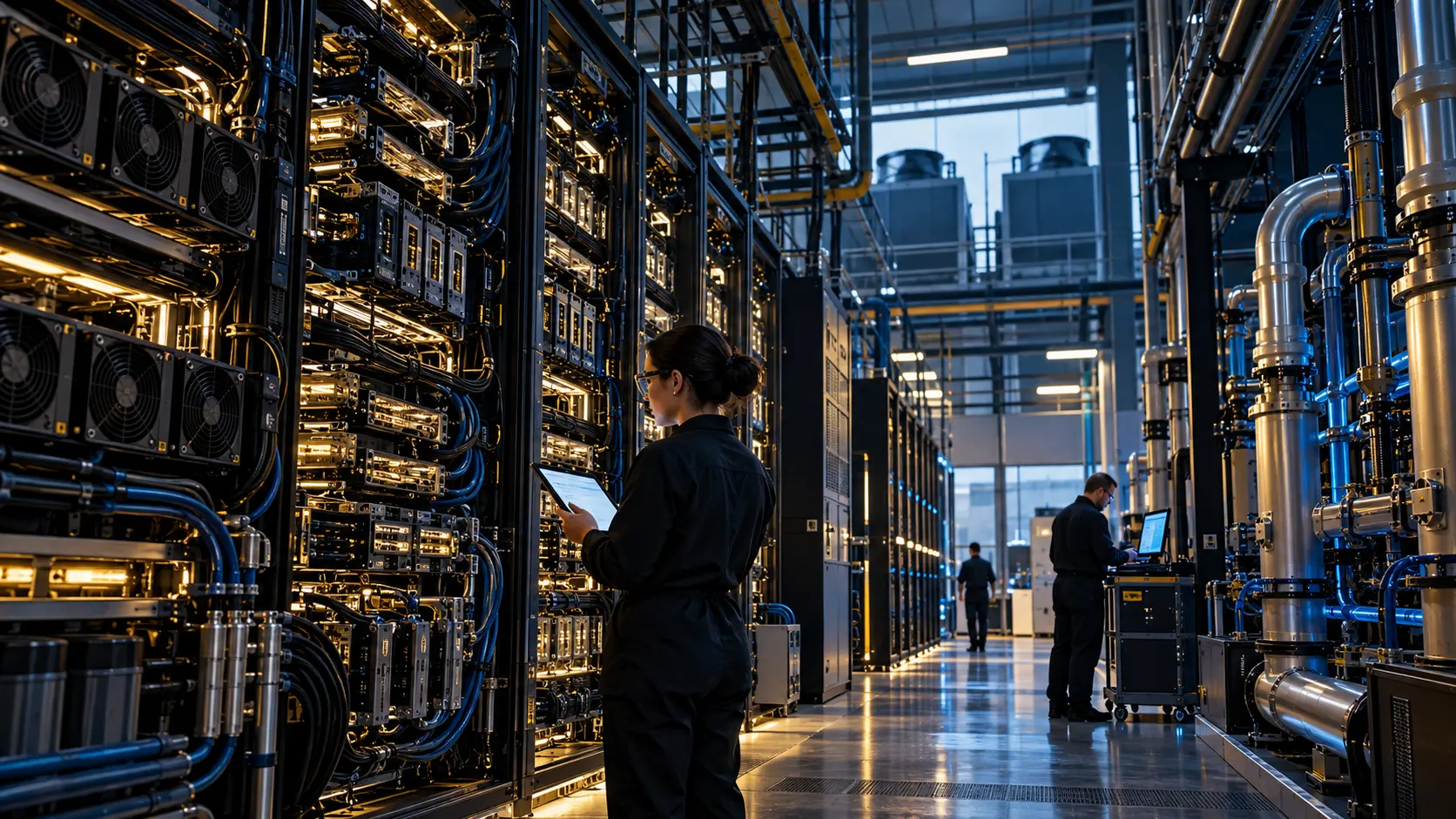
Modern artificial intelligence depends on far more than algorithms and software. Behind every advanced AI system is a large physical infrastructure made up of processors, memory, storage, high-speed networks, data centers, cooling systems, and enormous amounts of electricity. As AI models become larger and more capable, the infrastructure required to train and operate them has become an important part of the technology economy. Understanding AI infrastructure means understanding the machinery that makes artificial intelligence possible at scale.
AI systems need large amounts of computing power because they perform vast numbers of mathematical operations. A modern machine learning model can contain billions of adjustable parameters, which are numerical values that determine how the model processes information. During training, these parameters are repeatedly modified as the system learns patterns from large datasets. This requires processing enormous quantities of data through the model many times, often across thousands of computing devices working together.
Traditional central processing units, or CPUs, are still important, but they are not always the most efficient tools for this type of workload. CPUs are designed to handle a wide variety of computing tasks and to execute complex instructions quickly. AI workloads, however, often involve many similar mathematical operations that can be performed in parallel. This is where specialized accelerators become important.
Graphics processing units, or GPUs, were originally developed to handle the parallel calculations required for computer graphics. Their architecture also makes them highly effective for machine learning. A GPU contains many processing units that can work on large groups of calculations simultaneously. This allows AI developers to process the mathematical operations used in neural networks much faster than would often be possible with general-purpose CPUs alone.
GPUs are not the only accelerators used for AI. Companies have also developed other specialized chips designed specifically for machine learning, including application-specific integrated circuits and other forms of AI processors. These chips may be optimized for particular mathematical operations, power efficiency, or types of workloads. The broader trend is clear: as artificial intelligence grows, computing increasingly depends on hardware designed specifically for AI rather than relying entirely on conventional processors.
Memory is just as important as processing power. AI models must constantly move data between processors and memory while calculations are being performed. If the processor has to wait for data, expensive computing capacity goes unused. For this reason, modern AI accelerators often rely on very fast memory systems capable of delivering large amounts of information with extremely high bandwidth.
This creates a technical challenge. A powerful processor is useful only if the rest of the system can keep it supplied with data. The speed of memory, the distance between chips, and the design of the connections between them can therefore have a major effect on AI performance. In large systems, improving data movement can be just as important as increasing raw processing speed.
Storage is another part of AI infrastructure. Training models can require very large datasets containing text, images, audio, video, scientific information, or other forms of digital content. These datasets must be stored, organized, and delivered efficiently to computing systems. Training also produces checkpoints, logs, and intermediate results that may need to be preserved.
When thousands of processors are working on the same model, networking becomes critical. The processors must exchange information continuously so that the work remains synchronized. Ordinary data center networks may not always provide enough speed or sufficiently low latency for the largest AI workloads. Specialized high-speed networking technologies are therefore used to connect accelerators within servers and across entire clusters.
This is one reason large AI systems are often built as clusters rather than as single computers. A cluster combines many servers and accelerators into a coordinated computing system. Software divides the workload among the available machines and manages communication between them. From the perspective of the AI model, thousands of individual processors can function as parts of one much larger computational engine.
Training is one of the most demanding stages in the life of an AI model. During training, the system processes examples, compares its outputs with desired results, calculates errors, and adjusts its internal parameters. This cycle is repeated many times across large datasets. The total amount of computation can be enormous.
Training large models can require thousands of accelerators operating continuously for extended periods. These systems must remain synchronized while moving huge quantities of data between processors and memory. If networking is too slow, storage cannot deliver data fast enough, or hardware failures interrupt the process, the efficiency of the entire training run can suffer.
Training therefore requires more than simply having a large number of GPUs. The accelerators need high-speed memory, fast interconnections, reliable storage, optimized software, and careful scheduling. The surrounding infrastructure must also provide enough electricity and cooling to keep the machines operating at full capacity.
Running a trained model, often called inference, has different requirements. During inference, the model is no longer learning from a dataset in the same way. Instead, it uses its existing parameters to respond to new inputs. When someone asks an AI assistant a question, requests an image, or uses an automated translation service, the system is performing inference.
A single inference request may require far less computing than training the model, but popular AI services can receive enormous numbers of requests. As a result, the total infrastructure needed for inference can also become very large. A service used by millions of people must be able to process many requests simultaneously while keeping response times short.
Latency is particularly important during inference. Users expect interactive AI systems to respond quickly. Providers therefore need to place computing resources where they can serve demand efficiently and reduce delays. This can involve distributing inference systems across multiple data centers and geographic regions.
Training and inference also create different economic pressures. Training workloads are often concentrated into very large computing clusters and may be scheduled around hardware availability. Inference workloads are more closely tied to continuous user demand. A company may therefore need one type of infrastructure for developing new models and another for serving those models reliably to customers.
Data centers provide the environment where much of this infrastructure is located. AI systems require dense concentrations of processors, memory, storage, and networking equipment. These machines produce substantial heat and consume significant amounts of electricity, so ordinary server rooms are often insufficient for the most demanding workloads.
Power delivery has become one of the defining challenges of AI data centers. High-performance accelerators can consume large amounts of electricity, and thousands of them may operate in the same facility. The data center must therefore receive enough power from the electrical grid and distribute it safely to the equipment.
Backup power remains important as well. AI infrastructure is expensive, and interruptions can disrupt training jobs or make services unavailable. Data centers use systems such as uninterruptible power supplies and generators to maintain operations during electrical failures. The exact design depends on the level of reliability required and the cost of downtime.
Cooling has also become more difficult as computing density increases. Powerful AI accelerators generate large quantities of heat in a small area. Traditional air cooling may not always be sufficient for the densest systems, which has increased interest in liquid cooling.
Liquid cooling can move heat away from processors more efficiently than air in many high-density environments. Cooling fluid can circulate near components that generate the most heat, reducing the need to move enormous quantities of air through server rooms. These systems require specialized equipment, but they can support higher computing densities.
The relationship between AI and energy extends beyond the data center itself. Rapid growth in computing demand can influence where companies build facilities, how they negotiate electricity contracts, and which regions can support new projects. Locations with abundant power, reliable grids, suitable network connections, and available land may become more attractive for AI infrastructure.
This has made electricity an increasingly strategic input for the technology industry. A company may have access to processors but still be unable to deploy them if sufficient electrical capacity is not available. In some regions, connecting a large new data center to the grid can require upgrades to substations, transmission lines, or other infrastructure.
Energy cost also affects the economics of AI. Because large computing clusters can operate continuously, small differences in electricity prices can translate into substantial operating expenses. Providers therefore consider not only the cost of hardware but also long-term energy availability and pricing.
Semiconductors sit at the center of this infrastructure. AI accelerators depend on advanced chip manufacturing, high-performance memory, power-management components, networking chips, and many other semiconductor products. Growing demand for AI therefore increases the economic importance of the semiconductor supply chain.
The most advanced processors are difficult and expensive to produce. Manufacturing them requires sophisticated fabrication plants, specialized equipment, advanced packaging, and access to high-quality materials. AI growth can therefore increase competition for limited manufacturing capacity and strengthen the strategic importance of leading semiconductor producers.
Advanced packaging has become especially important because modern AI systems often need several high-performance chips to work together closely. Packaging technologies can place processors, memory, and other components in configurations that reduce the distance data must travel. This can improve performance and energy efficiency.
High-bandwidth memory is another critical component. AI accelerators need rapid access to large quantities of data, and conventional memory designs may create bottlenecks. Specialized memory technologies are therefore used to increase the rate at which data can move between memory and processors.
The importance of networking also extends beyond individual data centers. Companies that operate AI services need high-capacity connections between facilities, storage systems, and users. Fiber-optic networks help move datasets, model files, and user traffic across regions. Large technology companies may operate private backbone networks specifically to support this type of demand.
Cloud computing plays a major role in making AI infrastructure available to more organizations. Building a large accelerator cluster independently requires substantial capital and technical expertise. Cloud providers can spread the cost of these systems across many customers and allow companies to rent access to AI hardware when needed.
This lowers some barriers to entry, but it can also create new forms of dependence. Organizations may become reliant on a small number of cloud providers that control access to scarce accelerators, specialized networking, and managed AI services. The concentration of AI infrastructure can therefore influence competition within the technology sector.
The cost structure of AI helps explain why large companies often have an advantage. Training advanced models can require expensive hardware, large engineering teams, and substantial energy consumption. Operating popular AI services adds continuing inference costs. Companies with access to large amounts of capital and existing data center infrastructure are better positioned to absorb these expenses.
At the same time, better software and more efficient model designs can reduce infrastructure requirements. Researchers and engineers work to improve algorithms, compress models, use lower-precision calculations, and schedule hardware more effectively. These techniques can allow the same computing infrastructure to perform more useful work.
Efficiency is important because simply adding more hardware is not always practical. Data centers face limits involving electricity, cooling, floor space, network capacity, and equipment availability. Improvements in software can therefore have physical and economic benefits by reducing the amount of infrastructure needed for a given workload.
AI infrastructure is also becoming more distributed. The largest models are often trained in centralized data centers, but smaller models can run on personal computers, smartphones, vehicles, and industrial equipment. This is sometimes described as edge AI because computation takes place closer to where the data is generated.
Running AI locally can reduce latency, improve privacy, and reduce the amount of data that must travel to remote servers. However, edge devices have tighter limits on power, memory, and cooling. This creates demand for efficient processors designed to perform AI tasks within much smaller energy budgets.
The expansion of artificial intelligence therefore affects several industries at once. Semiconductor manufacturers benefit from demand for advanced processors and memory. Data center operators need to build facilities capable of supporting increasingly dense computing systems. Network providers must handle larger data flows, while energy companies face new sources of electrical demand.
This interdependence makes AI infrastructure an economic issue as well as a technical one. The availability of chips, data centers, electricity, and network capacity can influence how quickly companies and countries can develop and deploy advanced AI systems. Access to computing power is increasingly treated as a strategic resource.
Governments are also paying more attention to the physical foundations of AI. Policies related to semiconductor manufacturing, energy infrastructure, cloud computing, data centers, and export controls can directly affect access to advanced computing systems. The ability to develop AI may therefore depend not only on software expertise but also on industrial capacity.
The growth of AI reveals that digital technologies are ultimately rooted in the physical world. A sophisticated model may appear to exist only as software, but it depends on chips manufactured in specialized factories, installed in data centers, connected through high-speed networks, supplied with electricity, and cooled continuously.
AI infrastructure brings all of these systems together. Training requires enormous concentrations of computing power, fast memory, and high-speed communication between processors, while inference requires scalable systems capable of serving users reliably and quickly. As artificial intelligence becomes more widely used, the infrastructure behind it will increasingly shape demand for semiconductors, data centers, electricity, and global network capacity.
The future of AI will therefore be influenced not only by improvements in algorithms but also by the ability to build and operate the physical systems those algorithms require. Computing power has become a strategic industrial input, and the companies and countries that can secure advanced chips, efficient data centers, reliable energy, and high-speed networks will be better positioned to participate in the next stage of artificial intelligence development.