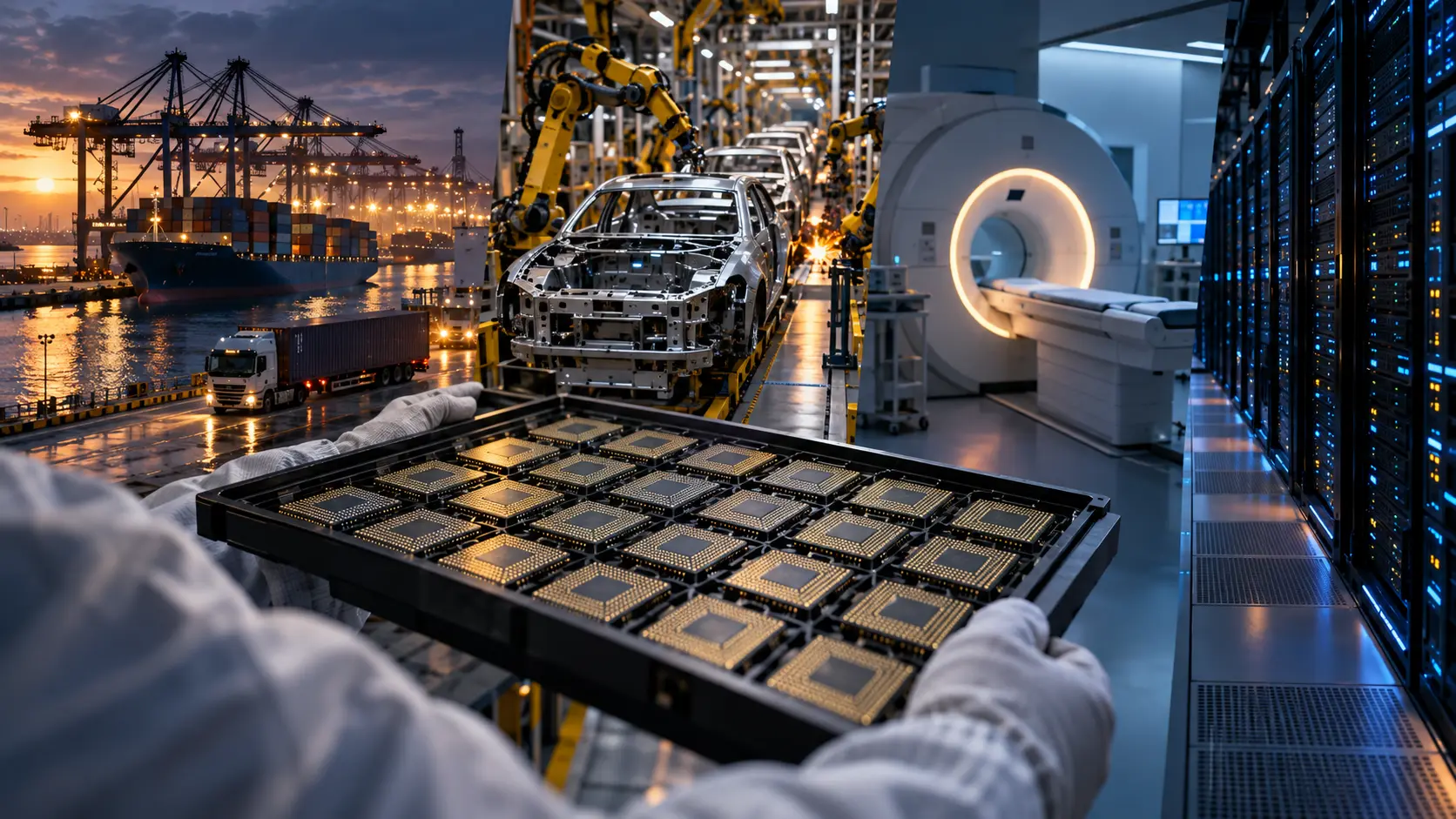
Semiconductors are essential to the global economy because they provide the computing and control functions behind modern technology. They are found in smartphones, vehicles, telecommunications networks, factories, data centers, medical equipment, payment systems, military hardware, and countless other products. What began as a specialized electronics industry has become part of the basic infrastructure of economic activity. The importance of semiconductors now extends far beyond the technology sector because almost every major industry depends on reliable access to chips.
A semiconductor is a material whose electrical behavior can be precisely controlled. In practice, the term is also widely used to describe the chips made from semiconductor materials, especially silicon. These chips contain transistors and other microscopic components that process information, store data, manage power, control machines, and connect devices. Different chips perform different functions. Some act as powerful processors, others store memory, convert signals, manage batteries, control motors, or handle communications. Together, they form the hidden electronic foundation of much of the modern economy.
The importance of semiconductors is especially clear in the automotive industry. A modern vehicle contains many electronic control systems responsible for functions such as engine management, braking, airbags, navigation, entertainment, battery control, driver assistance, and communications. Electric vehicles require even more advanced electronics to manage batteries, power conversion, sensors, and propulsion systems. As cars become more connected and automated, the number and sophistication of their chips continue to increase. A shortage of a relatively inexpensive component can therefore prevent manufacturers from completing vehicles worth tens of thousands of dollars.
Telecommunications depend just as heavily on semiconductors. Mobile phones, cellular base stations, fiber-optic systems, routers, satellites, and data centers all require specialized chips to transmit and process information. Modern communications networks must handle enormous volumes of data while keeping energy consumption and delays under control. That requires advanced processors, networking chips, memory, radio-frequency components, and power-management devices. Without a steady supply of semiconductors, expanding broadband networks, maintaining mobile infrastructure, and developing newer generations of communications technology become significantly more difficult.
Industrial production has also become increasingly dependent on chips. Factories use semiconductors in robots, motors, sensors, programmable controllers, machine-vision systems, and automated production equipment. Even industries that do not manufacture electronic products rely on computerized machinery for logistics, quality control, inventory management, and energy efficiency. Semiconductor shortages can therefore interrupt production far beyond electronics. A missing control chip can stop a machine, delay an assembly line, or reduce the output of an entire factory.
Artificial intelligence has made the economic role of semiconductors even more visible. Training and operating advanced AI systems require large amounts of computing power, much of it supplied by specialized processors designed to handle many calculations simultaneously. These systems also depend on high-speed memory, networking equipment, storage, and sophisticated power electronics. As companies and governments invest in AI infrastructure, access to advanced chips has become closely connected to competitiveness in software, cloud computing, scientific research, and automation.
Financial services provide another example of semiconductor dependence that is less visible to consumers. Banks, stock exchanges, payment processors, insurance companies, and financial technology firms rely on large computing systems to process transactions, detect fraud, manage risk, and store information. Credit card terminals, ATMs, smartphones, authentication devices, and secure servers all contain chips. Semiconductor availability therefore affects not only physical manufacturing but also the digital systems that allow money and information to move through the economy.
Defense and national security add another dimension to the importance of semiconductors. Modern military equipment relies on advanced electronics for communications, navigation, surveillance, radar, guidance, computing, and cybersecurity. Many civilian technologies, including satellites and communications networks, also have security implications. Governments increasingly view secure access to certain classes of semiconductors as a strategic requirement rather than simply a commercial concern. This has made chips an important subject in trade policy, industrial policy, and international relations.
The global semiconductor industry is unusual because no single country controls every stage of production. Chip design, manufacturing equipment, raw materials, wafer fabrication, packaging, and testing are distributed across different regions. Some countries and companies specialize in advanced design, while others dominate particular manufacturing steps, equipment categories, or materials. This specialization developed over decades because semiconductor production is extremely complex and because different parts of the supply chain require different types of expertise.
At the same time, some critical parts of semiconductor production are geographically concentrated. Leading-edge manufacturing capacity is located in a relatively small number of places, while certain types of manufacturing equipment and specialized materials come from a limited group of suppliers. This concentration can make the industry efficient under normal conditions, but it also creates vulnerability. Natural disasters, political tensions, transport disruptions, power shortages, or problems at a major supplier can affect companies thousands of kilometers away.
The economic consequences of chip shortages became particularly clear when disruptions in global supply chains exposed how difficult semiconductor production is to adjust quickly. Manufacturers in industries such as automobiles and consumer electronics faced delays because the chips they needed were unavailable in sufficient quantities. The problem could not be solved simply by building more production lines within a few weeks. Semiconductor factories require highly specialized equipment, controlled environments, experienced engineers, and complex supply networks. Expanding capacity can take years and demands enormous investment.
Another difficulty is that not all chips are interchangeable. A manufacturer may need a specific semiconductor designed for a particular voltage, temperature, communication standard, or electronic system. Substituting another chip can require redesigning hardware, changing software, performing safety tests, or obtaining new regulatory approvals. This means that a shortage of one apparently modest component can have consequences that are far larger than the price of the chip itself.
The economics of semiconductor manufacturing also encourage specialization and concentration. Advanced fabrication plants cost billions of dollars to build and equip. Their machinery must operate at extreme levels of precision, and manufacturers must produce large volumes to justify the investment. Developing a new production process also requires substantial research, experimentation, and engineering expertise. These barriers make it difficult for new competitors to enter the market quickly, particularly at the most advanced levels of manufacturing.
Because of these challenges, governments have become more interested in technological autonomy. This does not necessarily mean producing every type of chip entirely within national borders. Complete self-sufficiency would be extremely difficult because the supply chain is deeply international. Instead, countries often seek to reduce dependence on a small number of foreign suppliers, expand domestic manufacturing, support research, secure access to critical equipment, and develop partnerships with politically reliable trading partners.
These policies reflect a broader change in how semiconductors are viewed. For many years, the industry was primarily treated as a commercial sector shaped by cost, innovation, and global specialization. It is now increasingly considered part of strategic infrastructure. Governments worry that losing access to advanced chips could weaken important industries, slow technological development, or limit military capabilities. As a result, semiconductor investment, export controls, subsidies, and technology restrictions have become important tools of economic and geopolitical policy.
Competition over advanced chips is particularly significant because leadership in semiconductor technology can influence leadership in other fields. High-performance computing, artificial intelligence, advanced communications, aerospace, and scientific research all benefit from access to powerful processors. Countries that depend entirely on external suppliers may therefore see semiconductor access as a source of strategic vulnerability. Conversely, countries that control important parts of the supply chain can gain economic and political influence.
The pursuit of greater semiconductor independence, however, involves trade-offs. Building more factories in different regions can improve resilience, but it is expensive. Government support can encourage investment, yet it cannot quickly reproduce decades of accumulated technical knowledge. Manufacturing plants also depend on international networks of equipment suppliers, chemical producers, software companies, and skilled workers. Even a newly built domestic fab may remain dependent on technologies imported from abroad.
This interdependence explains why semiconductor supply chains are both resilient and fragile. They are resilient because thousands of specialized firms contribute knowledge and technology from around the world. They are fragile because some of those contributions are extremely difficult to replace. A disruption at one critical point can spread through many industries, while rebuilding missing capacity may require years rather than months.
The importance of semiconductors therefore comes from more than the value of the chips themselves. Their greater significance lies in the economic activity they enable. A small semiconductor can control a vehicle, operate part of a telecommunications network, regulate factory equipment, secure a financial transaction, or perform calculations for an artificial intelligence system. When chips are readily available, their role often remains invisible. When supply is interrupted, their importance becomes immediately apparent.
Semiconductors have become strategic resources because modern economies increasingly depend on computation, connectivity, automation, and electronic control. Their production requires vast investment, rare technical expertise, and a highly interconnected international supply chain that cannot be reorganized quickly. As governments and companies compete to secure access to advanced technologies, the importance of semiconductors will continue to influence industrial policy, trade relationships, national security, and the balance of technological power across the global economy.