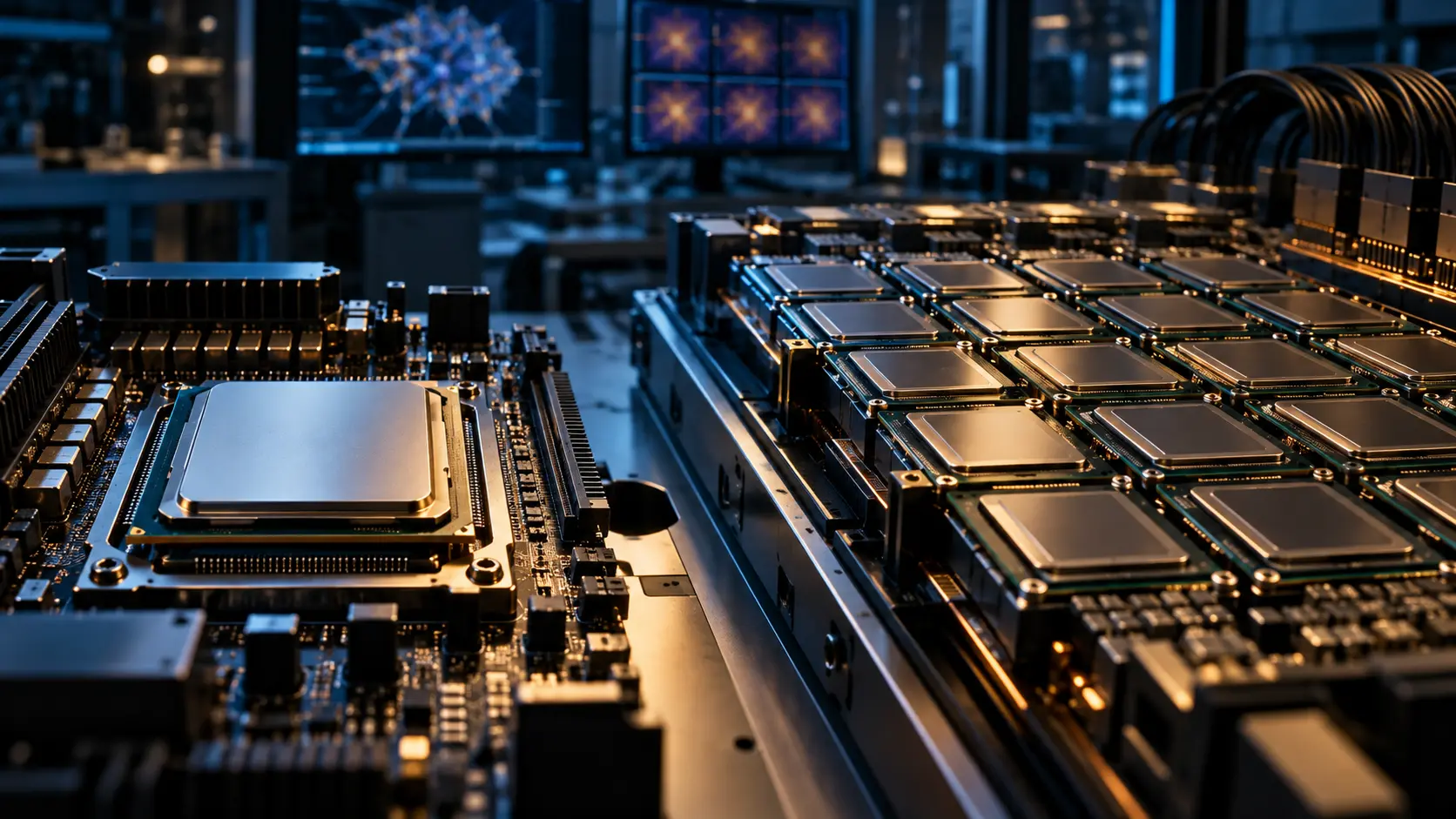
The difference between a CPU and a GPU comes down mainly to how each processor is designed to organize and execute work. A CPU, or central processing unit, is built to handle a wide variety of tasks with flexibility and strong performance on complex sequences of instructions. A GPU, or graphics processing unit, is designed to perform many similar calculations at the same time. Neither is universally better than the other. Their architectures are optimized for different kinds of computing, which is why both remain essential in modern systems.
The CPU is the general-purpose processor at the center of most computers. It runs operating systems, manages applications, handles input and output, coordinates memory access, and executes the many different instructions required by software. Modern CPUs usually contain several powerful processing cores. Each core is designed to execute complicated sequences of instructions efficiently, including tasks that involve frequent decisions, branches, and changes in execution.
This flexibility is one of the CPU's greatest strengths. Many everyday computing tasks cannot easily be divided into thousands of identical operations. Opening an application, responding to user input, managing files, processing network traffic, and coordinating different parts of a program often require a processor that can rapidly switch between different kinds of work. CPUs are designed precisely for this environment.
A GPU follows a different philosophy. GPUs originally became important because computer graphics require large numbers of similar mathematical operations. To display a three-dimensional scene, for example, a computer may need to calculate the positions, colors, lighting, and textures of millions of pixels and graphical elements. Many of these calculations can be performed independently and simultaneously.
Instead of relying on a relatively small number of highly capable cores, GPUs contain many more processing units optimized for parallel work. This architecture allows a GPU to perform large numbers of similar calculations at once. If a problem can be divided into thousands of smaller operations that follow similar mathematical patterns, a GPU can often complete the work far more efficiently than a CPU.
This difference can be understood through a simple analogy. A CPU resembles a small team of highly skilled workers who can handle complicated and varied assignments. A GPU resembles a much larger workforce designed to perform many similar tasks simultaneously. The first approach is better when the work requires flexibility and frequent decisions, while the second excels when the job can be divided into many repeated operations.
The comparison becomes more technical when memory and data movement are considered. CPUs are designed to minimize the time required to access the information needed for individual tasks. They typically use sophisticated cache systems that keep frequently needed data close to the processor. This helps reduce latency, which is the delay between requesting information and receiving it.
GPUs are generally optimized more heavily for throughput, meaning the total amount of work completed over time. They need to feed many processing units simultaneously, so their memory systems are designed to move large quantities of data quickly. High memory bandwidth is especially important when thousands of operations need access to large arrays of numbers.
This difference between latency and throughput helps explain why CPU vs GPU comparisons cannot be reduced to a simple question of which processor is faster. A CPU may complete a complicated sequence of dependent instructions very efficiently, while a GPU may outperform it dramatically on a workload that can be executed in parallel. Performance depends on the structure of the problem.
Artificial intelligence is particularly well suited to GPUs because modern machine learning relies heavily on mathematical operations that can be performed in parallel. Neural networks process large arrays of numerical values representing model parameters, input data, and intermediate calculations. Many of these operations involve multiplying and adding large collections of numbers.
Matrix multiplication is especially important. A matrix is a rectangular arrangement of numbers, and multiplying matrices is a common operation in machine learning. During both training and inference, AI models repeatedly perform these calculations across enormous amounts of data. Because many parts of a matrix operation can be calculated independently, they can be distributed across many GPU processing units.
This parallelism allows GPUs to process AI workloads much faster than conventional CPUs in many situations. Instead of calculating one small group of values at a time, a GPU can perform a large number of related calculations simultaneously. The result is much higher throughput for the mathematical operations that dominate neural network workloads.
Training a large AI model makes this advantage particularly important. During training, data passes through the model, predictions are generated, errors are measured, and the model's parameters are adjusted. This process is repeated many times across very large datasets. The total amount of computation can be enormous.
Using CPUs alone for such workloads would often make training much slower and less economically practical. GPUs allow developers to divide the calculations across large numbers of processing units, dramatically reducing the time required. Large training systems can go even further by connecting thousands of GPUs so they work together on the same model.
GPUs are also useful during inference, which is the process of running a trained model to generate outputs. When an AI system answers a question, recognizes an object in an image, or generates text, it is performing large numbers of mathematical calculations using the model's existing parameters. These operations also benefit from parallel processing.
However, inference requirements can differ from training requirements. Training generally emphasizes maximum computational throughput across very large workloads, while inference may place greater importance on latency, cost, and energy efficiency. A system serving millions of users needs to provide answers quickly without using unnecessary computing resources.
For this reason, AI systems do not always use GPUs in the same way. Some inference workloads run on GPUs, while others use CPUs or specialized AI accelerators. Smaller models may run efficiently on processors built into smartphones, laptops, or edge devices. The best hardware depends on the size of the model, the number of users, response-time requirements, and cost.
The growing importance of GPUs in AI has also led processor designers to add hardware specifically optimized for machine learning. Modern GPUs may include specialized units designed for matrix and tensor operations. Tensors are multidimensional collections of numbers commonly used in AI systems. Dedicated hardware can perform these calculations more efficiently than general-purpose processing units.
Different numerical formats can also affect performance. Many AI calculations do not require the same level of numerical precision as scientific computing or financial applications. By using lower-precision formats where appropriate, processors can perform more operations using less memory and electricity. GPUs and AI accelerators increasingly include hardware designed around these formats.
Memory capacity has become another important limitation. Large models can contain billions of parameters, and those parameters must be stored somewhere while the model is running. If the model does not fit into the memory available on one GPU, it may need to be divided across several processors. This introduces additional complexity because data must then move between devices.
High-bandwidth memory helps address this problem by allowing GPUs to access large amounts of data quickly. The speed at which information can move between memory and the processing units can determine how effectively the GPU is used. A powerful processor can sit partially idle if its memory system cannot supply data quickly enough.
Networking becomes equally important when many GPUs operate together. Large AI clusters connect accelerators using high-speed links so that they can exchange information during training or inference. If communication between processors is too slow, the entire system becomes less efficient because GPUs may spend time waiting for one another.
This is why modern AI infrastructure includes much more than GPUs themselves. High-performance systems require powerful CPUs, large amounts of memory, fast storage, specialized networking, and carefully designed software. A GPU may perform most of the heavy mathematical work, but other components coordinate the system and keep data moving.
CPUs remain especially important in this environment. They manage operating systems, prepare data, coordinate tasks, handle networking, execute application logic, and control the broader computing workflow. Even a server filled with powerful GPUs typically relies on CPUs for many essential functions.
This cooperation illustrates why the idea that GPUs are replacing CPUs is misleading. GPUs are accelerators rather than universal substitutes for general-purpose processors. They take over workloads for which massive parallelism provides an advantage, while CPUs continue to handle tasks requiring flexibility, sequential execution, complex branching, and system management.
Some AI tasks are also poorly suited to GPUs. A workload with many conditional decisions, irregular data structures, or small operations that cannot be efficiently grouped may run better on a CPU. Moving data to a GPU also has a cost, so using a GPU for very small workloads may provide little benefit.
The software must be designed to take advantage of the hardware as well. A program does not automatically become faster simply because a GPU is available. Developers need frameworks, libraries, and algorithms capable of dividing calculations efficiently across many processing units. Poorly parallelized software may leave much of the GPU unused.
This relationship between software and hardware played a major role in the rise of GPUs for artificial intelligence. As machine learning frameworks made it easier to express neural network calculations as parallel operations, developers could use GPUs without manually programming every low-level hardware detail. This made large-scale AI experimentation far more accessible.
The rapid development of deep learning increased demand further. As researchers discovered that larger neural networks trained on more data could produce major improvements in tasks such as image recognition, speech processing, and language modeling, the need for parallel computing grew. GPUs were already well suited to the underlying mathematics, making them a natural foundation for the expansion of modern AI.
This has had consequences across the technology industry. Demand for GPUs and related accelerators has increased the importance of advanced semiconductor manufacturing, high-bandwidth memory, chip packaging, data center construction, and electrical infrastructure. A processor architecture originally associated mainly with graphics has become a strategic component of global computing infrastructure.
Energy efficiency is now a central concern as well. Large AI systems can use thousands of accelerators simultaneously, so even small improvements in performance per watt can have significant economic effects. Chip designers therefore compete not only on raw speed but also on how much useful computation their processors can perform for each unit of electricity.
Specialized AI processors may sometimes outperform general-purpose GPUs on particular workloads because they remove features that are unnecessary for a specific task. This reflects a broader principle in computing: specialization can improve efficiency when the workload is well understood. GPUs themselves gained an advantage over CPUs in AI precisely because their architecture was better matched to highly parallel mathematics.
At the same time, specialization reduces flexibility. A CPU can run an enormous range of software because it was designed as a general-purpose processor. A highly specialized accelerator may perform one class of operations extremely efficiently but be unsuitable for many other tasks. Hardware design therefore involves trade-offs between versatility, performance, efficiency, and cost.
The CPU vs GPU distinction is ultimately about these trade-offs. CPUs are optimized for responsive, flexible execution of complex instruction sequences. GPUs are optimized for high-throughput parallel computation across large collections of similar operations. AI relies heavily on the second kind of workload, which is why GPUs have become so important.
That does not make the GPU a universally superior processor. Modern computers and AI systems depend on a combination of architectures working together. CPUs coordinate and manage complex programs, GPUs accelerate parallel mathematical workloads, and specialized processors handle tasks where even greater efficiency is possible.
The rise of artificial intelligence has made these architectural differences economically significant because modern models require unprecedented amounts of computation. GPUs provide a practical way to perform many of the mathematical operations behind neural networks at massive scale. Their importance comes not from being faster at everything, but from being exceptionally well matched to the type of parallel computation that contemporary AI demands.