Data centers are the physical facilities that keep much of the digital world running. Websites, cloud applications, banking systems, streaming platforms, business software, artificial intelligence services, and online communication tools all depend on computers housed in specialized buildings designed for continuous operation. Understanding how do data centers work means looking beyond servers themselves and examining the complex systems for power, cooling, networking, storage, security, and redundancy that make digital services reliably available.
At the center of a data center are servers. A server is a computer designed to provide computing resources, applications, or data to other systems. Unlike a personal computer, which is usually built for one user, servers are designed to handle many requests and often operate continuously. A single data center may contain thousands of servers, while the largest facilities can support extremely large computing fleets distributed across rows of equipment racks.
These servers perform different tasks. Some host websites and applications, others run databases, process transactions, store files, manage user accounts, or perform scientific calculations. Many modern data centers also contain specialized processors such as graphics processing units, or GPUs, which are widely used for artificial intelligence and other highly parallel computing workloads.
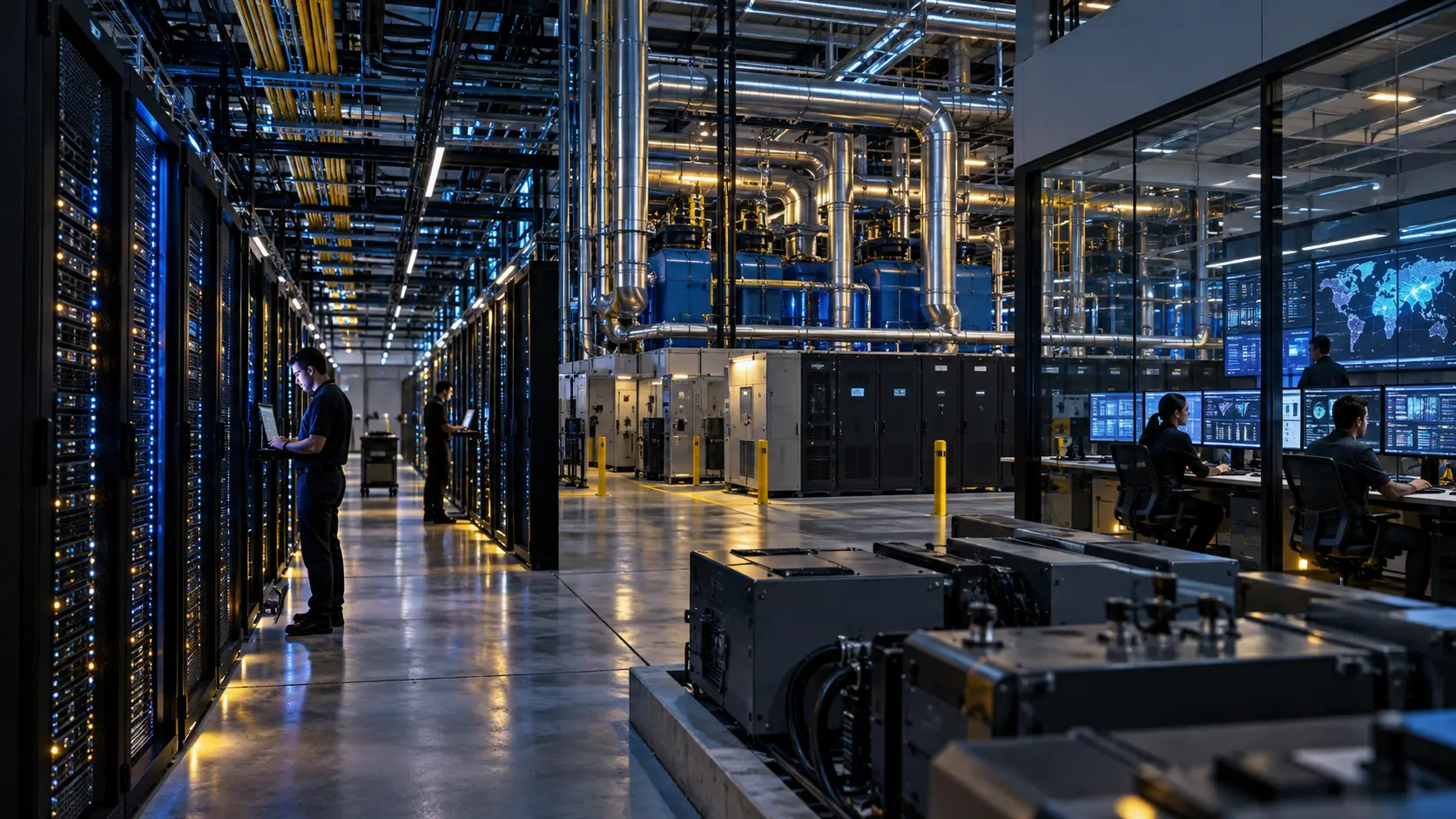
Servers are normally installed in standardized racks. These racks organize equipment vertically, allowing many machines to fit into a relatively small area while still providing access for power, cooling, and network connections. Data center operators carefully plan rack layouts because the position of equipment affects airflow, power distribution, cabling, and maintenance.
Storage systems are another essential part of data center infrastructure. Digital services depend on enormous amounts of stored information, including customer records, videos, business documents, software, financial data, backups, and machine learning datasets. Storage can be distributed across individual servers or provided through dedicated systems designed to make information available to many machines at once.
Data centers usually do not rely on a single copy of important information. Data may be duplicated across multiple drives, servers, or even separate facilities. This protects against hardware failures and allows services to continue operating if one component stops working. The exact approach depends on how important the data is, how quickly it must be recovered, and how much redundancy an organization is willing to pay for.
Networking connects all of these systems. Servers need to communicate with one another inside the facility and with users and other networks outside it. High-capacity switches and routers direct traffic through the data center, while fiber-optic and copper cables connect individual machines, storage systems, and networking equipment.
Large data centers may have several layers of networking designed to move enormous amounts of information with very low delay. Internal traffic can be especially intense because modern applications often depend on many servers working together. A single user action may trigger requests to databases, storage systems, authentication services, and other application components before a response is returned.
The external network connection is equally important. Data centers connect to internet service providers, telecommunications companies, private corporate networks, and sometimes internet exchange points. Large cloud and technology companies may operate their own long-distance fiber networks linking multiple data centers around the world.
All of this equipment requires electricity, and power systems are among the most critical parts of a data center. Servers cannot continue operating if their electricity supply disappears, even briefly. For this reason, facilities are usually designed with multiple layers of backup power.
Electricity normally arrives from the public grid and is distributed throughout the building through specialized electrical infrastructure. If the grid fails, uninterruptible power supply systems can provide immediate temporary power. These systems often use batteries to keep equipment running during the short interval before backup generators start.
Generators can then supply power during longer outages. Large data centers may maintain enough fuel and generating capacity to operate for extended periods if necessary. Critical electrical systems are often duplicated so that the failure of one component does not disable the entire facility.
Redundancy is a central principle of data center design. Instead of relying on one power path, one cooling system, or one network connection, operators often build multiple independent systems. If one fails or requires maintenance, another can take over.
This principle is sometimes described using configurations such as N+1 or 2N. In an N+1 design, the facility has enough equipment for normal operation plus at least one additional unit. In a 2N design, two complete sets of infrastructure may be available. Greater redundancy usually improves resilience, but it also increases construction and operating costs.
Cooling is another major challenge because computing equipment produces large amounts of heat. If that heat is not removed, processors can overheat, performance may fall, and hardware can be damaged. A data center must therefore control temperature continuously.
Traditional facilities often use large air-conditioning systems that move cool air through server rooms and remove hot air generated by equipment. Racks may be arranged in hot and cold aisles so that cool intake air and hot exhaust air remain separated. This improves efficiency by preventing the two air streams from mixing unnecessarily.
As computing density increases, cooling methods are becoming more sophisticated. High-performance processors, particularly those used for artificial intelligence, can generate much more heat within a small area than conventional server equipment. Some data centers therefore use liquid cooling, which transfers heat through water or other fluids rather than relying entirely on air.
Liquid cooling can place cooling components close to processors or, in some designs, immerse computing equipment in specialized fluids. These approaches can remove heat more efficiently from very dense computing systems, although they require different infrastructure and maintenance procedures.
Water usage can also become an important consideration. Some cooling systems use evaporation to remove heat, which can reduce electricity consumption under certain conditions but may increase water demand. Data center operators therefore make design choices based on local climate, energy prices, water availability, environmental requirements, and the type of computing workload.
Energy efficiency matters because data centers consume substantial amounts of electricity. Operators monitor how much power is used by computing equipment and how much is consumed by cooling, electrical conversion, lighting, and other support systems. Improving efficiency can reduce costs and limit the environmental impact of running large facilities.
Data centers also need sophisticated monitoring. Sensors continuously track temperature, humidity, power conditions, network performance, equipment health, and security systems. Software can alert operators when something begins to fail, allowing maintenance to occur before a small problem becomes a major outage.
Many routine operations are automated. Large facilities may manage thousands of machines, making manual administration impractical. Software can deploy applications, restart failed systems, move workloads, replace unavailable resources, and balance demand across different servers.
This ability to shift workloads is one reason cloud computing can provide reliable services even though individual computers fail regularly. Instead of treating each server as irreplaceable, large-scale systems are often designed so that workloads can move elsewhere when hardware fails. The software layer makes the overall service more resilient than any single machine.
Physical security is another essential part of data center operation. Facilities may use fences, surveillance cameras, security personnel, access badges, biometric systems, and restricted zones. Only authorized people can normally enter areas containing critical infrastructure.
Cybersecurity operates alongside physical protection. Data centers must defend networks and systems against unauthorized access, malware, data theft, and other digital threats. Security controls may include firewalls, encryption, identity systems, traffic monitoring, and strict administrative access policies.
Fire protection requires special attention because water-based systems can damage electronic equipment. Data centers may use early smoke detection and fire suppression technologies designed to control fires while minimizing harm to computers and electrical systems. Facilities are also divided into different areas so that one local incident does not necessarily affect the entire building.
The location of a data center can influence its performance and reliability. Operators consider access to inexpensive and stable electricity, network connectivity, land costs, climate, water availability, political stability, and exposure to natural hazards. A facility in an earthquake-prone region, for example, may require different structural protections from one built in an area vulnerable to flooding.
Latency also matters. The farther data must travel between users and servers, the longer communication can take. Companies therefore place data centers near important population centers and business markets when low response times are important.
At the same time, some facilities are built farther from cities because land and electricity may be cheaper. Different workloads have different geographic needs. A financial trading system may prioritize extremely low latency, while a backup archive can often be stored farther away without affecting users.
Data centers rarely operate in isolation. Large digital services may distribute applications across several facilities. If one data center becomes unavailable, traffic can be redirected to another. This geographic redundancy is particularly important for services that must remain online continuously.
Financial institutions depend heavily on this type of infrastructure. Banks and payment processors use data centers to manage transactions, customer accounts, risk systems, fraud detection, and digital banking. Because interruptions can affect large numbers of users and businesses, these systems are designed with strict availability and recovery requirements.
Enterprise applications also depend on data centers. Companies run accounting systems, supply chain software, communications tools, customer databases, and internal applications either in their own facilities or in cloud providers' data centers. Employees may interact with these systems through ordinary laptops, but the actual processing can occur in facilities hundreds or thousands of kilometers away.
Digital platforms use data centers at even larger scales. Search engines, social networks, streaming services, online stores, and communication platforms must process enormous volumes of requests. Their systems are distributed across many servers so that no single computer is expected to handle all traffic.
Artificial intelligence is creating new infrastructure demands. Training large AI models can require thousands of powerful processors working together for extended periods. These processors exchange huge amounts of data, making fast internal networking essential. They also consume substantial electricity and produce large amounts of heat, increasing pressure on power and cooling systems.
Running AI models for users can also require significant computing capacity. As AI services become integrated into search, productivity software, customer support, and other applications, data centers increasingly need specialized hardware optimized for these workloads.
The growth of AI illustrates why operating a data center involves much more than buying powerful computers. Processing capacity is useful only if the building can supply enough electricity, remove enough heat, move data quickly enough, and continue operating when components fail. Infrastructure limits can become just as important as processor availability.
Maintenance is therefore continuous. Drives fail, servers need replacement, filters require cleaning, batteries age, generators must be tested, and network equipment needs upgrades. Large data centers are designed so technicians can perform many of these tasks without interrupting customer services.
Some facilities are owned by individual companies, while others are operated by specialized providers. Colocation data centers rent physical space, power, cooling, and network access to customers that install their own equipment. Cloud providers go further by owning the computing infrastructure and renting its capacity as a service.
Hyperscale data centers represent the largest end of this industry. They are designed for companies that operate massive digital platforms or cloud services. Their scale allows extensive automation and standardized equipment, but it also makes decisions about electricity, networking, cooling, and construction economically significant.
Smaller facilities continue to play important roles. Edge data centers place computing resources closer to users or devices, reducing latency for applications that require fast responses. Telecommunications networks, industrial systems, and local digital services may use these smaller facilities alongside large regional data centers.
The reliability users experience online is therefore the result of many systems working together. A website that appears instantly on a phone may depend on servers, storage arrays, switches, fiber connections, cooling equipment, backup generators, software automation, and engineers monitoring the infrastructure. Most of this activity remains invisible unless something goes wrong.
Understanding how do data centers work reveals that the internet is not powered by computers alone. Continuous digital services require carefully engineered buildings capable of supplying power, removing heat, moving enormous volumes of data, protecting information, and surviving equipment failures. Data centers transform collections of physical machines into reliable digital infrastructure, making them essential to modern finance, business, communications, cloud computing, and artificial intelligence.