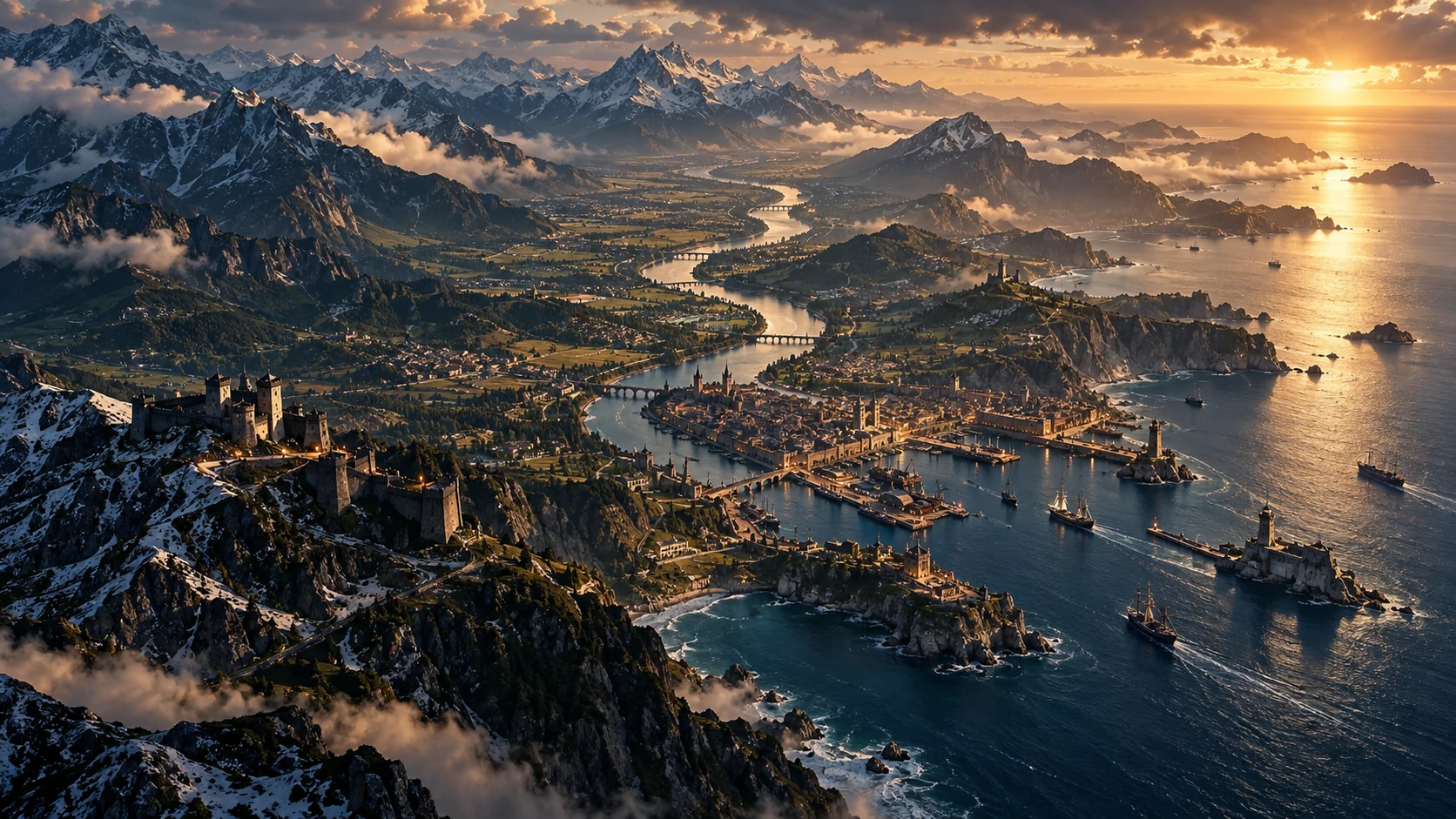
Geography influences the opportunities and constraints that every state faces. Countries differ in size, terrain, climate, neighbors, access to oceans, natural resources, transport routes, and distance from major centers of economic or military activity. These differences can affect how easily governments defend their territory, trade with the outside world, move military forces, develop infrastructure, and maintain political control. Geography does not determine a country's destiny, but it creates durable conditions that strategy must take into account.
Borders are among the most obvious geographic influences on security. A country sharing long land borders with several neighbors must devote attention and resources to those frontiers. The challenge becomes greater when borders cross open plains or sparsely populated regions that are difficult to monitor. By contrast, mountains, deserts, dense forests, and other difficult terrain can create natural obstacles to invasion, although modern technology has reduced rather than eliminated their defensive value.
The number and character of neighboring states also matter. A country surrounded by stable partners generally faces fewer immediate military concerns than one located in a region characterized by rivalry or weak political institutions. Governments cannot choose their neighbors, which means that regional security problems can persist across generations even as political leaders change. A state's foreign policy is often influenced by the need to manage relationships with nearby powers simply because geographic proximity makes those relationships impossible to ignore.
Distance has historically provided a degree of protection. Oceans and large stretches of difficult terrain make military operations more complicated because troops, equipment, fuel, food, and ammunition must travel farther. Long supply lines are expensive to maintain and vulnerable to disruption. Modern aircraft, missiles, satellites, and long-range naval forces have reduced the protective effect of distance, but they have not made logistics irrelevant. Geography still determines where forces can be based, how quickly they can move, and how easily they can be supplied.
Access to the sea has major economic and strategic consequences. Maritime transport can move enormous quantities of goods at relatively low cost, making ports essential connections between domestic economies and global markets. Coastal states can build commercial shipping networks, naval forces, and port infrastructure without depending entirely on neighboring countries for access to international trade. Landlocked states, in contrast, usually rely on roads, railways, rivers, or pipelines passing through other countries before reaching global markets.
This dependence does not mean that landlocked states are necessarily poor or weak. Efficient infrastructure, stable diplomatic relationships, regional integration, and productive economies can compensate for geographic disadvantages. However, transit dependence creates additional risks. Political disputes, war, infrastructure failures, or border restrictions in neighboring states can interrupt trade even when the landlocked country itself remains stable.
Coastlines differ greatly in strategic value. A long coast with few natural harbors may offer fewer advantages than a shorter coast containing deep, sheltered ports connected to major economic centers. Ports become especially important when they lie close to important shipping routes. Their value increases further when roads, railways, storage facilities, pipelines, industrial zones, and communications networks allow goods to move efficiently between the coast and the interior.
Mountains illustrate how geography can both protect and constrain. Mountain ranges can slow invading armies and create defensible borders, but they can also make domestic transportation difficult and expensive. Building roads, railways, power lines, and communication systems across rugged terrain requires major investment. Mountain regions may also contain communities that are relatively isolated from political and economic centers, complicating administration and development.
Rivers can play similarly complex roles. They provide water, support agriculture, enable transportation, generate electricity, and encourage settlement. Some rivers connect inland areas with the sea, creating natural commercial corridors. Others serve as political borders. When rivers cross several countries, however, they can become sources of geopolitical tension because upstream decisions about dams, irrigation, pollution, or water diversion may affect downstream populations.
Climate and agricultural geography also influence national power. Reliable food production reduces dependence on imports and can support large populations. Countries with limited water or arable land may become more dependent on global food markets. This dependence is usually manageable under normal conditions, but wars, export restrictions, transportation disruptions, or severe price increases can turn food security into a strategic concern.
Resource geography can shape foreign policy as well. Oil fields, gas reserves, mineral deposits, forests, fertile land, and freshwater are distributed unevenly. A state possessing valuable resources may gain export revenue and strategic importance, especially when international demand is high. Yet resource wealth does not automatically produce geopolitical strength. Extraction may depend on foreign technology, transportation networks, processing capacity, political stability, and access to global markets.
Location becomes especially important when a country sits between major regions. Some states occupy territory connecting continents or important economic zones. Others control islands, coastlines, mountain passes, river systems, or transportation corridors that neighboring powers consider strategically valuable. These countries may gain economic opportunities through trade and transit, but strategic location can also expose them to pressure from competing powers.
Narrow maritime passages are particularly influential. If a large share of international shipping must pass through a small number of straits or canals, countries located nearby can become disproportionately important. Disruption at such locations can force ships to take longer routes, increasing transport costs and delaying deliveries. This makes certain geographic points significant to governments far beyond the immediate region.
Geography also shapes military strategy. Armies require passable terrain, supply routes, fuel, communications, and secure bases. Navies need ports and access to navigable waters. Air forces depend on airfields, logistics, and distances between potential operating areas. Islands can serve as defensive barriers, observation points, or military bases, while valleys and mountain passes can channel movement into predictable routes.
The development of advanced technology has changed the meaning of geography without eliminating it. Missiles can cross great distances, satellites can observe remote regions, aircraft can move rapidly between continents, and digital networks allow information to travel almost instantly. Yet these technologies still depend on physical infrastructure. Satellites require ground stations. Data traffic depends heavily on cables. Aircraft need bases and fuel. Computer networks rely on electricity, data centers, and telecommunications equipment located in specific places.
Economic globalization has produced a similar transformation. Companies can coordinate production across multiple countries, but the physical movement of goods still depends on ports, ships, canals, railways, warehouses, and roads. Supply chains may appear globally dispersed while remaining vulnerable to a small number of geographic bottlenecks.
The political significance of geography also changes over time. A location considered remote in one era may become strategically important after the construction of a new canal, railway, pipeline, or port. New technologies can increase the value of previously neglected resources. Climate change may alter shipping routes, agricultural conditions, water availability, and the economic importance of certain regions. Geography is relatively permanent, but its strategic meaning is not.
For this reason, geographical analysis is most useful when combined with economics, technology, institutions, and political choice. Natural advantages only become effective power when states can use them. A country with excellent ports still needs infrastructure and competitive industries. A state protected by mountains still requires functioning institutions and capable armed forces. A strategic location can create commercial opportunities, but it may also attract external rivalry.
Geography therefore acts less like a fixed destiny than like the physical foundation on which national strategy is built. Governments cannot move their countries, replace their neighbors, or redesign their coastlines. They can, however, decide how to respond to these conditions. Through diplomacy, investment, technology, alliances, and infrastructure, states can reduce geographic vulnerabilities and make better use of geographic advantages. The enduring importance of geography lies precisely in this relationship between what cannot easily be changed and what political strategy can still influence.
