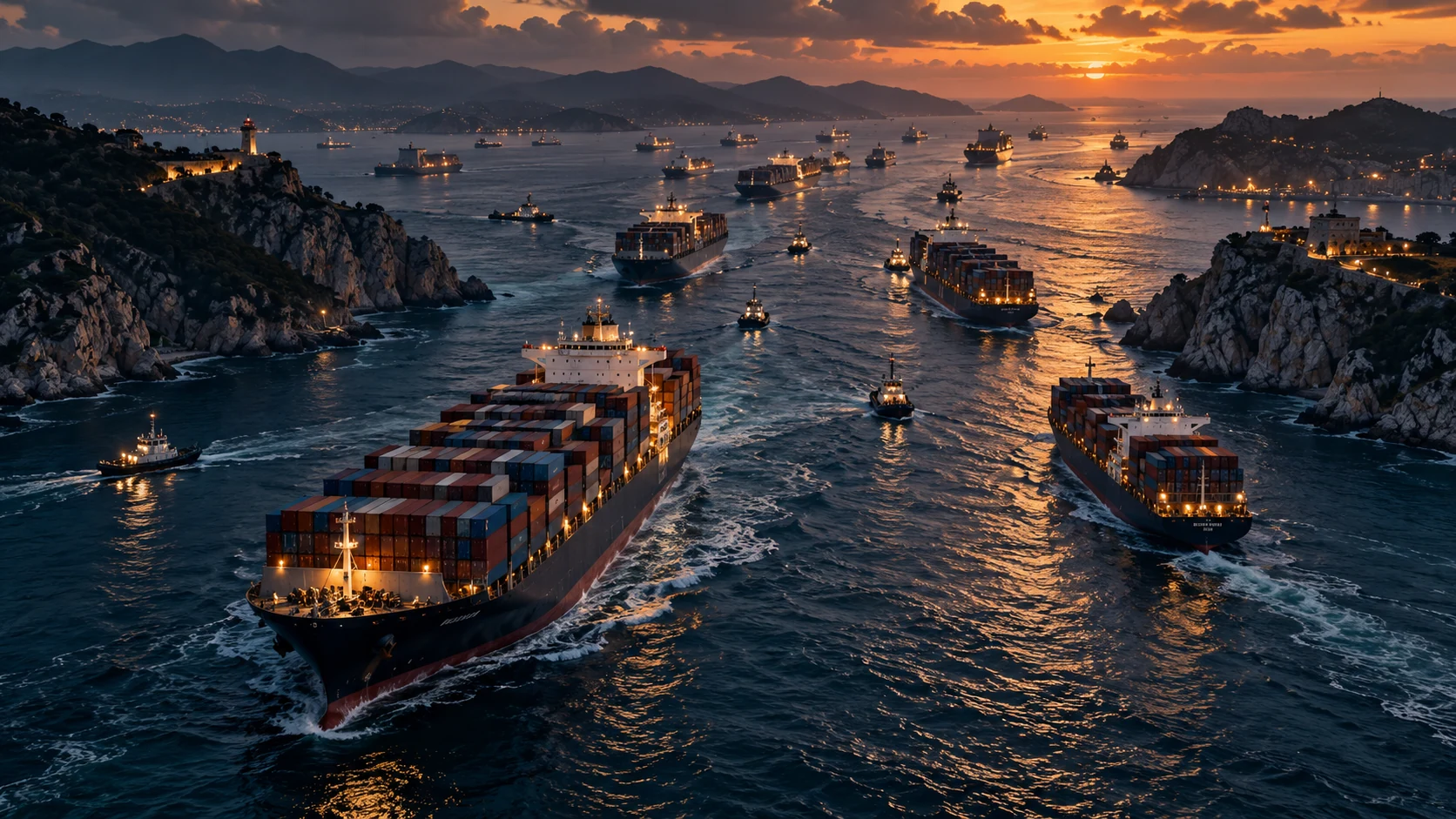
Global trade depends heavily on the sea. Ships transport enormous quantities of oil, gas, food, minerals, manufactured products, vehicles, industrial equipment, and consumer goods between continents. Maritime trade is efficient because a single large vessel can move far more cargo than most land-based alternatives. Yet this vast global system is not evenly distributed across the oceans. In several regions, shipping routes converge into narrow straits, canals, and coastal passages. These locations are known as maritime chokepoints, and their strategic importance comes from the concentration of traffic within a limited geographic space.
A chokepoint matters when ships have few practical alternatives. If an important maritime route passes through a narrow passage, disruption can affect trade far beyond the countries located nearby. Vessels may be forced to wait, change routes, pay higher insurance costs, or travel thousands of additional kilometers. The economic consequences can spread through supply chains as transport becomes slower and more expensive.
Some chokepoints exist naturally, particularly narrow straits connecting larger bodies of water. Others are artificial canals built to shorten major shipping routes. Both can reduce transportation distances dramatically. Their value comes from the time and fuel they save, but that same concentration of efficiency creates vulnerability. The more traffic depends on a particular route, the greater the consequences when access becomes uncertain.
Energy trade illustrates this dependence clearly. Oil and liquefied natural gas are produced in specific regions but consumed around the world. Tankers carrying these products often follow predictable routes between exporters and importers. When a substantial volume of energy passes through a narrow maritime corridor, that corridor becomes important to energy security. Governments and companies monitor political instability, military activity, accidents, piracy, and other risks that could interfere with shipping.
The strategic importance of a chokepoint does not require it to be completely closed. Even the possibility of disruption can influence markets and state behavior. Shipping companies may raise prices to cover additional risk. Insurers may demand higher premiums. Governments may deploy naval forces or organize escorts. Energy buyers may increase inventories or seek alternative suppliers. A relatively small geographic area can therefore affect decisions across global markets.
The physical characteristics of chokepoints also matter. Some passages are narrow enough that shipping lanes are highly concentrated. Others have limitations related to water depth, vessel size, currents, or navigation. Canals may impose additional restrictions because they depend on locks, dredging, maintenance, traffic management, or freshwater availability. A temporary obstruction caused by an accident or technical failure can sometimes have economic effects similar to those caused by political conflict.
Ports are another essential part of maritime geopolitics. Ships do not create commercial value simply by crossing oceans; cargo must be loaded, unloaded, stored, processed, and transported inland. Major ports therefore function as nodes connecting maritime routes with railways, roads, industrial zones, pipelines, and distribution networks. Ports that combine strategic location with efficient infrastructure can become important centers of trade and economic influence.
Control over port access can also have military significance. Naval forces require bases where vessels can refuel, receive maintenance, replenish supplies, and support personnel. A country with access to a network of overseas ports may be able to operate ships farther from its own territory. Port agreements, naval facilities, and logistics partnerships therefore contribute to a state's ability to project power across distant regions.
This connection between commercial infrastructure and military strategy explains why port investments sometimes attract geopolitical attention. A port may serve primarily civilian trade while also possessing characteristics that could support naval operations. Governments may therefore evaluate foreign involvement in strategically located ports not only through economic criteria but also through national security considerations.
Chokepoints can influence alliances as well. Countries dependent on the same maritime corridor have a shared interest in keeping it open. Naval cooperation, information sharing, anti-piracy operations, surveillance, and diplomatic agreements may emerge from this common concern. Major trading powers often care about distant waterways because disruptions can affect their industries and consumers even when the chokepoint lies thousands of kilometers away.
The concept of freedom of navigation is closely connected to this issue. Maritime powers generally benefit from predictable access to international shipping routes. When states disagree over territorial waters, military activity, inspections, blockades, or control of nearby islands, commercial concerns can become entangled with questions of sovereignty and security. A dispute that appears geographically local may therefore attract international attention because of the larger trade routes involved.
Military planners view chokepoints differently from commercial operators but are concerned with many of the same geographic features. Narrow waters restrict movement and make ships easier to detect. Coastal missile systems, aircraft, submarines, mines, and surveillance equipment can threaten vessels passing through confined areas. Defending a chokepoint can therefore be easier in some circumstances than controlling vast areas of open ocean.
At the same time, closing a major shipping route is rarely cost-free for the state attempting it. International trade is interconnected, and countries near chokepoints often depend on commercial traffic themselves. A prolonged disruption can damage regional economies, provoke international opposition, increase military tensions, and create incentives for other states to develop alternative routes. Chokepoint power is therefore real but constrained.
Alternative routes provide one form of resilience. Shipping companies can sometimes navigate around closed passages, although the additional distance may be substantial. Governments may also invest in pipelines, railways, ports, strategic reserves, and diversified suppliers. Such alternatives reduce dependence but usually cannot replace major maritime routes completely or immediately.
The same logic applies to supply-chain planning. Companies that once focused primarily on cost and efficiency increasingly consider geographic concentration as a source of risk. If goods produced in several different countries all travel through the same canal or strait, a supply chain that appears diversified may still depend on a single geographic bottleneck. True resilience requires understanding the entire physical route from producer to consumer.
Climate and environmental changes may gradually alter the geography of maritime trade. New navigable routes could become more commercially significant, while drought or extreme weather can affect existing ports and canals. However, creating an alternative maritime corridor requires more than open water. Reliable navigation, ports, search-and-rescue capability, insurance, infrastructure, political stability, and predictable legal conditions all influence whether a route becomes economically competitive.
The significance of maritime chokepoints ultimately reflects a broader principle of geopolitics: concentrated dependence creates strategic leverage and systemic risk. Globalization allows goods to move across enormous distances, but those movements often pass through a limited number of physical corridors. Efficiency encourages concentration, while security encourages diversification. Governments and companies constantly balance these competing priorities.
Maritime chokepoints will therefore remain important even as technologies and trade patterns change. Their influence comes not simply from the water itself but from the networks that converge around it: shipping, energy, ports, finance, insurance, naval power, industrial supply chains, and diplomacy. A narrow passage can matter to the wider world because the modern global economy depends on connections that are extensive in scale but often surprisingly concentrated in space.
