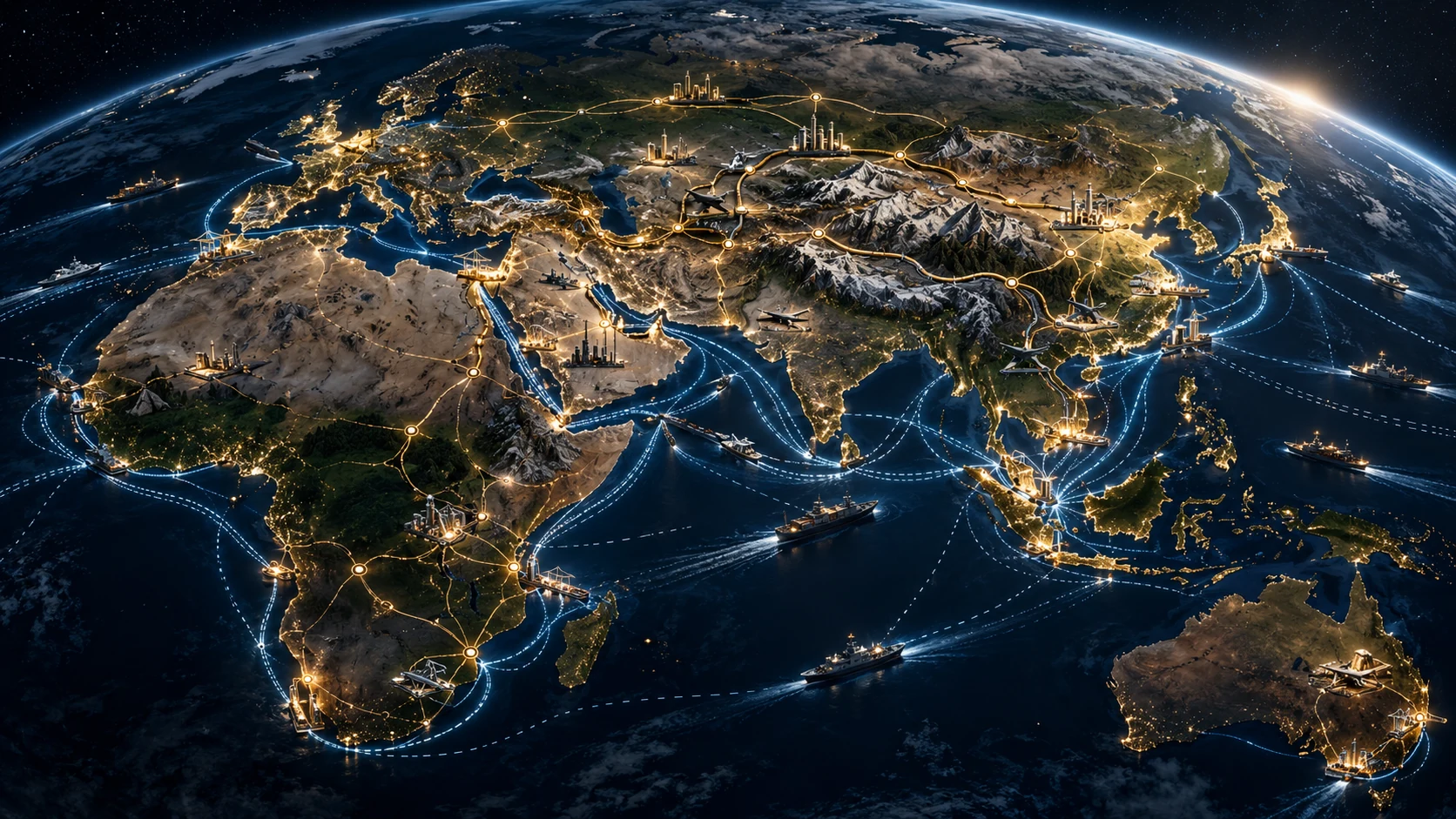
Geopolitics is the study of how geography and other material conditions influence the way states pursue power, security, prosperity, and influence. It begins with a simple observation: countries do not operate in an abstract political space. They occupy particular territories, have specific neighbors, depend on certain trade routes, possess unequal access to resources, and face different military and economic constraints. These conditions do not automatically determine what governments will do, but they shape the range of choices available to them and the costs attached to those choices.
Geography is one of the most durable elements of geopolitical power. A country surrounded by hostile neighbors faces different security problems from an island protected by oceans. A state with reliable access to major seas can participate in maritime trade more easily than a landlocked state dependent on foreign transit routes. Mountain ranges, deserts, rivers, coastlines, fertile plains, and natural harbors can affect defense, transportation, agriculture, communication, and economic development. Geography therefore creates advantages and vulnerabilities that governments must manage over long periods.
Yet geopolitics is much broader than physical geography. International power also depends on economic capacity, industrial production, technology, population, political institutions, military strength, infrastructure, financial influence, and access to critical resources. A country with a large territory but weak institutions may struggle to convert its geographic size into effective power. Another country with limited natural resources may become highly influential through advanced technology, productive industries, strong alliances, efficient institutions, or control over important financial and commercial networks.
This distinction between possessing resources and converting them into power is essential. Oil reserves, mineral deposits, fertile land, or a large population can create opportunities, but they do not automatically produce geopolitical strength. Resources must be extracted, transported, processed, financed, protected, and integrated into productive systems. Population matters when people are healthy, educated, economically active, and supported by institutions capable of organizing complex societies. Technology matters when a country can develop, produce, maintain, and scale it. Military equipment matters when it can be supplied, trained, coordinated, repaired, and used effectively.
Security is another central part of geopolitics. States must consider not only their own capabilities but also the intentions and capabilities of others. A government may strengthen its armed forces because it fears attack, but neighboring states may interpret that military expansion as preparation for aggression. They may respond by increasing their own defenses, forming alliances, or deploying additional forces. The result can be a cycle in which all sides claim to be acting defensively while each becomes more suspicious of the others.
This is one reason alliances have such importance in world politics. Countries rarely depend exclusively on their own resources. Alliances can combine military forces, intelligence, technology, logistics, economic capacity, and geographic access. For smaller states, an alliance with a stronger partner can provide deterrence that would otherwise be too expensive to build independently. For major powers, alliances can extend influence, provide access to strategically located territories, and distribute the costs of maintaining security across several countries.
Trade creates another layer of geopolitical power and vulnerability. Modern economies depend on international flows of energy, food, industrial components, capital, technology, and information. These connections can increase prosperity by allowing countries to specialize and exchange goods efficiently. At the same time, dependence on foreign suppliers can become a strategic concern when essential products come from a small number of countries or pass through vulnerable transport routes.
This creates an important tension at the center of modern geopolitics. Economic interdependence can encourage cooperation because countries benefit from stable commercial relationships. However, the same interdependence can also create instruments of pressure. A government that controls access to an important market, technology, financial system, energy source, transport corridor, or critical component may be able to use that position as leverage. Sanctions, export controls, investment restrictions, tariffs, and supply limitations are examples of economic tools that can serve political and security objectives.
Energy demonstrates this relationship particularly clearly. Industrial economies require reliable supplies of electricity and fuel. Oil and natural gas have therefore influenced alliances, military planning, trade routes, and diplomatic relationships for decades. The transition toward renewable energy changes some of these relationships but does not eliminate geopolitical dependence. Solar panels, batteries, electric vehicles, wind turbines, data centers, and electricity grids depend on minerals, manufacturing capacity, advanced equipment, and large infrastructure networks. Energy security is therefore evolving rather than disappearing.
Technology has become equally important. Semiconductors, artificial intelligence, telecommunications networks, satellites, cloud computing, biotechnology, cybersecurity, and advanced manufacturing contribute not only to economic growth but also to military power and intelligence capabilities. Some technologies are especially geopolitically significant because they are difficult to produce and depend on highly specialized knowledge, equipment, or supply chains. A country controlling a critical technological bottleneck may possess influence far greater than its share of global production would suggest.
Infrastructure connects many of these elements. Ports, railways, roads, pipelines, electrical grids, data centers, undersea cables, satellite networks, and logistics systems determine whether economic and military resources can move efficiently. Infrastructure can therefore create strategic advantages while also producing vulnerabilities. A country may possess abundant energy resources but remain dependent on a small number of pipelines. An economy may participate extensively in global digital commerce while relying on undersea cables that pass through geographically exposed areas.
Finance provides another form of influence. Countries whose currencies, banks, payment systems, and capital markets occupy central positions in the global economy can exercise considerable power without using military force. Access to financing can support development and trade, while restrictions on financial transactions can impose significant costs. However, financial pressure also has limits. If countries expect that a particular system may be used against them, they may gradually seek alternative currencies, payment networks, reserves, suppliers, or trading partners.
Domestic politics also matter. Governments do not respond to geopolitical pressures in identical ways because their institutions, political systems, economic structures, and public priorities differ. Leaders must balance international objectives against domestic constraints such as budgets, elections, social stability, industrial interests, demographic pressures, and public opinion. Two countries facing similar geographic conditions may therefore adopt very different strategies.
Geopolitics should not be understood as the belief that geography dictates destiny. States can adapt to constraints through technology, diplomacy, infrastructure, alliances, and economic development. A landlocked country can improve its access to global markets through reliable relationships with neighboring states and efficient transport networks. A resource-poor country can become prosperous through education, industrial specialization, trade, and technological development. Geographic disadvantages can be reduced, while geographic advantages can be wasted.
The most useful way to think about geopolitical power is therefore as a combination of capabilities, relationships, and constraints. Military force remains important, but it is only one part of the picture. A powerful state needs an economy capable of supporting its commitments, infrastructure capable of moving resources, institutions capable of making and implementing decisions, and relationships that provide access to markets, technology, information, and strategic locations.
Modern geopolitics is increasingly shaped by the interaction of these different forms of power. Military competition overlaps with trade policy. Technology policy influences national security. Energy infrastructure affects diplomacy. Demographic trends affect both economic growth and military recruitment. Financial networks can become instruments of coercion. Commercial supply chains can suddenly become strategic concerns during crises.
Understanding geopolitics therefore requires looking beyond armies and borders. The central question is not simply which country possesses the most weapons or the largest economy. It is how effectively a state can combine geography, economic resources, technology, institutions, alliances, infrastructure, population, and strategic relationships to protect its interests and influence the behavior of others. The international system is shaped by that continuous effort to convert limited resources and imperfect advantages into security, resilience, and power.
