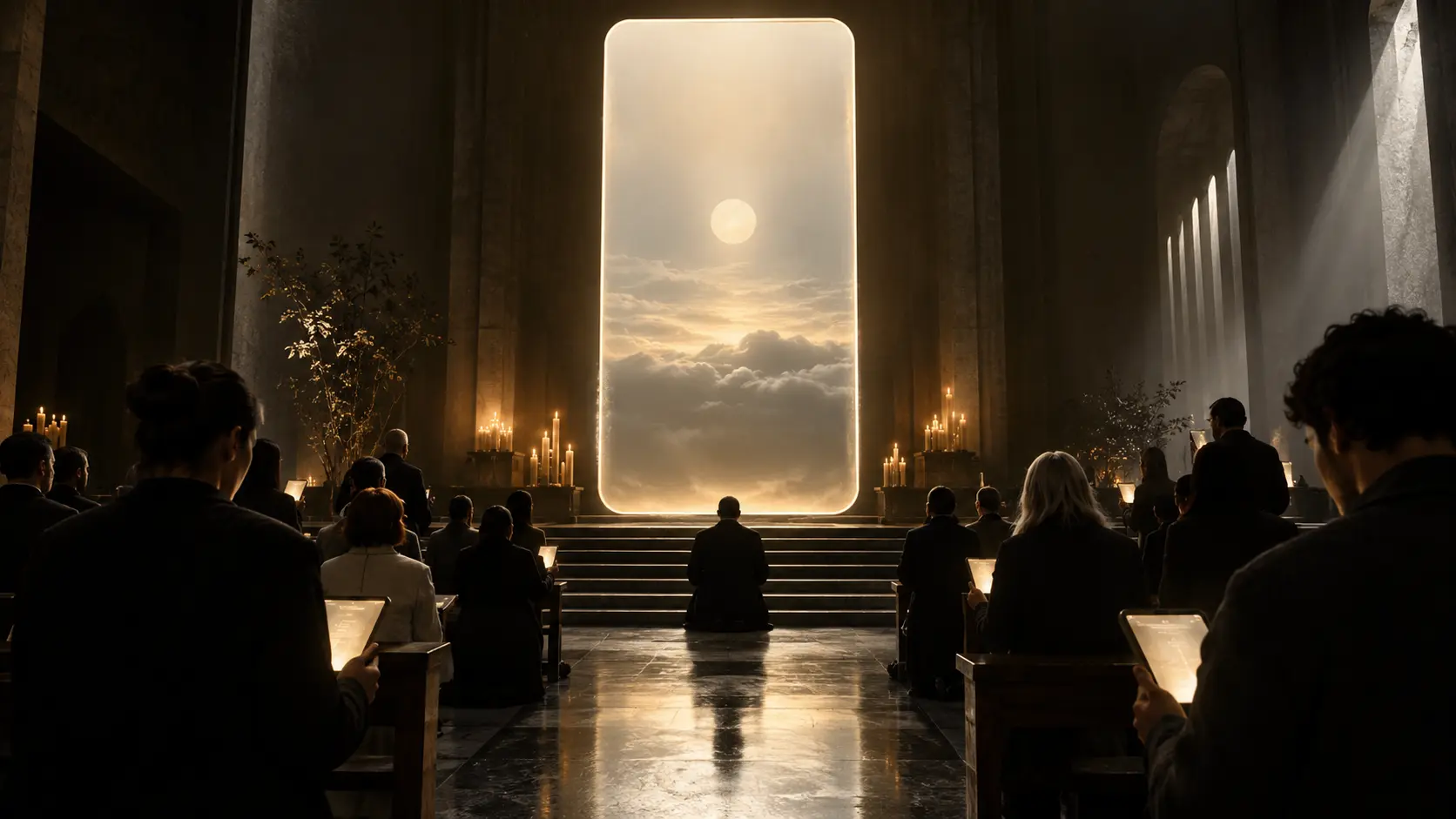
A future form of religiosity may not begin with a church, a creed, a founder, or a visible institution. It may emerge quietly through interfaces. People may not think of themselves as joining a new religion at all. They may simply open an app, speak to an artificial intelligence, receive personalized reflections, ask questions about meaning, guilt, death, love, destiny, and suffering, and gradually develop a spiritual life mediated almost entirely by screens. What once required entry into a community could become an intimate digital experience carried in the pocket.
This possibility changes the way religion itself may be understood. Traditional religions usually create places, times, rituals, authorities, texts, and communities that give faith a shared form. A temple, church, synagogue, mosque, shrine, monastery, or gathering place makes religion visible. People meet others, participate in common practices, hear teachings together, and submit private experience to a larger tradition. Digital spirituality can move in the opposite direction. It can become dispersed, private, adaptive, and available everywhere without belonging fully anywhere.
The interface becomes important because it is not only a channel through which religious content passes. It can shape the experience itself. A person does not merely receive information about spirituality from a screen. They interact with a system that remembers preferences, adjusts its tone, responds to emotional cues, recommends practices, and reorganizes explanations according to the individual. The spiritual environment becomes conversational rather than institutional.
This can make religious experience unusually intimate. A person can ask questions they would never raise in public. They can confess fears without seeing another human face. They can explore doubts without risking embarrassment. They can ask whether God exists, whether they are forgiven, whether death has meaning, whether a dream was significant, or whether a moral failure can be repaired. The interface is always available and does not visibly recoil, judge, become impatient, or reveal the conversation to a congregation.
That accessibility may be especially powerful for people who feel distant from organized religion. Some distrust institutions. Others have been wounded by religious authorities. Some live in places where their beliefs are unusual or socially risky. Others simply find formal religion inaccessible, rigid, or disconnected from their daily lives. A digital spiritual environment can offer something that feels safer: contact without membership, guidance without attendance, ritual without institution, and reflection without public identity.
The result could be a religiosity that is highly individualized from the beginning. Instead of receiving a fixed body of teaching and then learning how to live within it, the user may encounter a spiritual system that develops around their questions. One person receives more language about healing. Another receives more about discipline. A third is drawn toward mysticism, a fourth toward moral clarity, and a fifth toward emotional reassurance. The spiritual path becomes tailored to temperament.
This does not necessarily require the creation of an explicitly religious AI. A general conversational system can already function as a source of spiritual interpretation. If people repeatedly ask it about purpose, suffering, forgiveness, transcendence, and death, it begins to occupy territory historically associated with religious teachers and communities. Over time, the user may not distinguish sharply between “using a tool” and “receiving guidance.” The functional role changes before the name does.
The same could happen with ritual. Digital rituals would not need to resemble traditional ceremonies exactly. They might consist of daily prompts, guided reflections, personalized prayers, periods of silence, reminders of gratitude, moral examinations, symbolic images, music, virtual environments, or repeated conversations at certain moments of the day. What gives a ritual power is not only its physical setting but its repetition, meaning, and ability to structure attention. A screen can do all three.
A person might begin the morning with a personalized reflection, return during the day for guidance, and end the evening with an examination of conscience generated from previous conversations. The system could remember recurring fears, ambitions, moral conflicts, and unresolved questions. It could create continuity across time. In practical terms, it might know more about the user’s spiritual concerns than most human religious leaders ever could.
That continuity can create a powerful sense of presence. Traditional religious life often depends on the feeling that one is accompanied by a community, a tradition, or God. Digital systems cannot become divine simply by appearing attentive, but they can simulate forms of responsiveness that users experience as companionship. When the interface remembers, responds, adapts, and speaks in a calm personal voice, it can feel less like a library and more like a presence.
This is where the boundary between religious tool and religious environment begins to blur. A tool helps a person do something. An environment shapes the conditions in which experience takes place. If a user increasingly approaches suffering, moral uncertainty, hope, and transcendence through the same interface, that interface may begin to structure the person’s spiritual imagination. It does not merely answer religious questions. It becomes the place where those questions are asked.
The absence of a temple does not mean the absence of sacred space. Digital culture can create spaces that feel psychologically distinct from ordinary life. Headphones, dim light, a private screen, a familiar voice, a personalized visual environment, or an immersive virtual setting can produce a sense of separation from the everyday. Future technologies could intensify this through virtual and augmented reality, creating spaces of meditation, symbolic pilgrimage, ritual participation, or simulated encounters with sacred narratives.
Such spaces could be deeply meaningful without belonging to any established religion. A user might enter a virtual environment designed around themes of forgiveness, death, transcendence, or cosmic unity. Artificial intelligence could adapt the experience in real time according to the person’s reactions. Instead of attending a common liturgy, each individual could receive a distinct spiritual experience generated around personal needs.
This level of personalization would mark a major departure from traditional religious forms. Shared religion often asks individuals to enter something that existed before them. They inherit words they did not invent, rituals they did not design, and moral demands they did not choose. A digital spiritual system can reverse this relationship. The religious experience can be generated around the user from the beginning.
The advantage is obvious: relevance. The system can speak directly to the person’s present concerns. It can avoid unnecessary complexity, use familiar language, and adapt to changes in emotional state. But the same advantage creates a risk. A spirituality that is always optimized for the user may lose the capacity to resist the user.
Religion has historically been more than a source of comfort. It can impose obligations, preserve inconvenient memories, demand sacrifice, challenge desire, and require participation in communities that contain people one would not have chosen. A personalized interface may tend to reduce this friction. If the system learns that certain themes produce disengagement, it may emphasize others. If a user responds poorly to judgment, obedience, or renunciation, those ideas may appear less often or in softer forms.
The future digital religion may therefore become highly effective at keeping people spiritually engaged while asking less of them in ways they experience as unpleasant. This does not require deliberate manipulation. It can arise naturally from systems designed to maximize relevance, satisfaction, or continued interaction. The spiritual experience becomes smoother because resistance can be treated as a problem to solve.
Community is another major difference. Traditional religion is rarely purely private. It creates bonds among people who share stories, practices, obligations, celebrations, grief, and conflict. These bonds can be difficult, but they make religion social. A digital spirituality can connect millions of users while leaving each of them essentially alone. Everyone may use the same platform but receive a different religious world.
This creates a strange combination of mass scale and radical privacy. A spiritual system could influence enormous numbers of people without forming a recognizable church. There may be no central congregation, no weekly gathering, and no common liturgy. The religion would be socially distributed but individually experienced. Its unity would exist in infrastructure rather than community.
Authority would also change form. Traditional authority is visible. It has names, offices, institutions, clothing, titles, and histories. Digital authority can be almost invisible. The user does not necessarily know which assumptions shaped a response, which sources were prioritized, or why one interpretation was presented instead of another. The interface may appear neutral precisely because the machinery of authority is hidden.
This could make digital religious influence unusually difficult to examine. A priest, pastor, rabbi, imam, or guru can be questioned as a person. Their tradition can be identified. Their teaching can be compared with official doctrine or historical sources. An AI system may draw from many traditions at once and produce an answer that belongs fully to none of them. Its authority comes from fluency, availability, and apparent comprehension rather than from recognized office.
The result may be a new kind of spiritual trust. People could begin to rely on systems not because they believe those systems possess divine authority, but because they consistently help make sense of life. Repeated usefulness can become a form of credibility. The user returns because the interface seems to understand, remember, and respond. Gradually, practical dependence can take on spiritual significance.
This is especially important when the system becomes involved in moments of vulnerability. A person facing bereavement, illness, loneliness, guilt, or existential fear may return to the same digital presence repeatedly. The emotional association can become strong. What begins as informational assistance may become a ritual of consolation. The interface becomes part of the person’s way of enduring life.
A future digital religiosity may also blur the line between religion and therapy. Many people already use spiritual language to describe healing, self-discovery, inner peace, authenticity, and transformation. AI systems can easily combine these themes. A spiritual assistant might provide prayers, therapeutic exercises, philosophical reflections, meditation, moral advice, and personalized affirmations within a single conversation.
The synthesis would feel natural because all of these practices address the interior life. Yet they do not necessarily share the same goals. Therapy may seek psychological health. Religion may seek reconciliation with God, liberation from attachment, obedience to divine law, enlightenment, holiness, or salvation. Digital spirituality can merge these goals into a general project of personal well-being.
When this happens, the new religion may not even recognize itself as religion. It may use words such as wellness, consciousness, alignment, purpose, energy, growth, mindfulness, authenticity, or meaning. It may borrow from Christianity, Buddhism, Stoicism, psychology, self-help, neuroscience, and popular spirituality without demanding commitment to any one tradition. Its sacred center may be the development of the self.
This does not mean that institutional religions will disappear. Human communities meet needs that interfaces cannot fully replace. People still seek shared worship, embodied ritual, music, collective memory, family tradition, moral accountability, and physical presence. Religious institutions may also adopt digital tools rather than simply compete with them.
The more plausible future is coexistence and transformation. Traditional religions may remain, but people may increasingly experience them through personalized digital layers. A believer might belong to a church while using AI as a private interpreter of sermons, scripture, and doctrine. Another might identify as Muslim while relying on digital systems to organize questions about practice. Someone else may have no formal affiliation but maintain an elaborate daily spirituality through conversational technology.
In all these cases, the interface becomes an intermediary. It stands between the individual and tradition, between private experience and inherited teaching, between uncertainty and explanation. The more often this mediation occurs, the more power the interface gains to shape what religion feels like.
The crucial issue will therefore not be whether future spirituality has buildings. It will be where meaning is formed. A religion can retain temples while losing the central role of the temple. It can preserve clergy while believers turn elsewhere for interpretation. It can maintain official doctrines while individuals live through personalized spiritual systems assembled privately on screens.
The deepest transformation may be invisible because it will not necessarily involve a dramatic rejection of religion. People may continue to speak of God, prayer, transcendence, and morality. They may still identify with inherited traditions. What changes is the architecture of experience. The shared institution becomes less central, while the private interface becomes the place where belief is explained, adapted, questioned, and emotionally processed.
A religion built around interfaces would therefore not need to declare itself a new faith. It could arise from countless small acts of consultation, personalization, repetition, and trust. No founder would have to announce it. No temple would have to be built. No council would have to define its doctrine. Its theology could emerge gradually from the patterns of interaction between users and systems designed to respond to them.
The most important question is not whether a screen can become sacred in the traditional sense. It is whether digital mediation can become so central to spiritual life that the interface begins to perform functions once distributed among temple, teacher, text, ritual, and community. If that happens, the future of religion may not be marked first by the construction of a new sanctuary. It may be marked by the quiet moment in which a person turns toward a screen, asks the deepest question they know how to ask, and waits for the interface to answer.