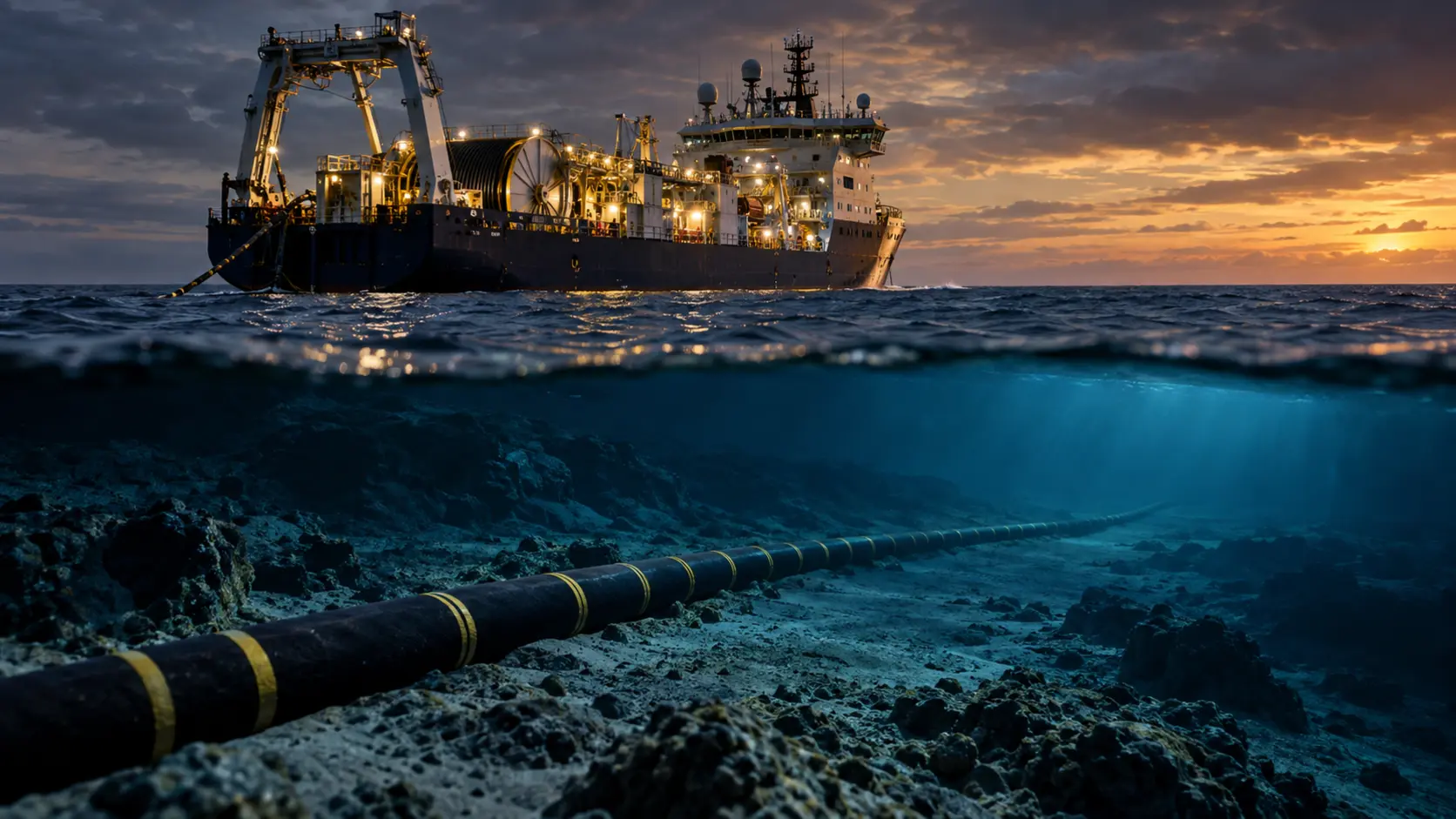
Undersea internet cables carry most of the data that moves between continents. Although the internet often seems wireless and almost abstract, its global operation depends heavily on physical infrastructure lying across the ocean floor. These cables connect countries, data centers, telecommunications networks, cloud platforms, financial systems, and millions of users. Without them, international digital communication would be slower, more expensive, and far less reliable.
An undersea internet cable is essentially a long fiber-optic connection designed to operate beneath the ocean for many years. Inside the cable are extremely thin strands of glass that carry data as pulses of light. Fiber optics can transmit enormous amounts of information at very high speed, which makes them well suited to the demands of modern internet traffic. Around the optical fibers are layers of protective materials that help shield the cable from pressure, water, corrosion, and physical damage.
The cables are not equally thick along their entire length. In deep ocean areas, where the risk of human interference is relatively low, the protective structure can be comparatively light. Near coastlines, however, cables are often reinforced because they are more exposed to anchors, fishing equipment, seabed activity, and other hazards. In some shallow areas, they may also be buried beneath the seabed for extra protection.
These cables begin and end at landing stations located near the coast. A landing station connects the submarine cable to terrestrial telecommunications networks. From there, data travels through national fiber networks, internet exchange points, data centers, and local service providers until it reaches businesses and individual users. A cable landing point can therefore become an important part of a country's digital infrastructure.
The routes followed by undersea internet cables are carefully planned. Engineers consider seabed geography, water depth, geological activity, shipping routes, fishing zones, existing infrastructure, and political conditions. The shortest route is not always the safest or most practical. Cables may be directed around underwater mountains, areas with frequent earthquakes, or regions where anchoring activity creates a higher risk of damage.
Before installation, survey ships study the proposed route in detail. Once the path has been selected, specialized cable-laying vessels carry thousands of kilometers of cable and gradually lower it onto the seabed. Near shore, the cable may be buried using equipment that creates a narrow trench. In deeper water, it is usually placed directly on the ocean floor.
Because light signals weaken as they travel long distances through optical fiber, undersea cables use repeaters or optical amplifiers positioned at intervals along the route. These devices strengthen the signal so it can continue across thousands of kilometers. They receive electrical power through conductive components built into the cable system, allowing data to travel between continents without needing intermediate surface stations.
The capacity of modern submarine cables is enormous. A single system can carry huge volumes of internet traffic, including video streams, cloud computing data, financial transactions, corporate communications, software services, voice calls, and ordinary web browsing. Traffic is usually divided among multiple fiber pairs and different wavelengths of light, allowing many streams of data to travel through the same physical cable at the same time.
This infrastructure is especially important to the digital economy. Companies that operate internationally need fast and reliable connections between offices, customers, cloud platforms, and data centers. Banks and financial markets depend on rapid data exchange. Streaming services move large video files across borders, while technology companies synchronize information between computing facilities in different regions. International e-commerce, online gaming, video calls, and remote work all depend, directly or indirectly, on these physical connections.
Undersea internet cables are also essential to cloud computing. Large cloud providers operate data centers in many parts of the world, and those facilities must exchange enormous quantities of information. For this reason, major technology companies have become increasingly involved in financing and building submarine cable systems rather than relying only on traditional telecommunications operators.
Many people assume that satellites carry most international internet traffic, but this is not the case. Satellites are extremely useful, particularly for remote areas, ships, aircraft, disaster zones, and places where terrestrial infrastructure is difficult to build. However, submarine fiber-optic cables generally offer much greater capacity and lower latency for large-scale intercontinental communication.
Latency is the delay between sending and receiving data. Signals traveling through submarine fiber can usually move between continents with relatively low delay compared with many satellite systems, especially those using satellites in high orbits. Low Earth orbit satellite networks can reduce this delay considerably, but fiber remains highly efficient for moving enormous volumes of data between major population and economic centers.
Satellites and submarine cables therefore serve different but complementary roles. Satellites can provide flexible coverage and reach places where cables cannot easily go. Undersea cables, in contrast, provide the high-capacity backbone needed for the continuous movement of global internet traffic. The modern communications system depends on both, but for intercontinental data volume, fiber-optic cables remain central.
Despite their importance, submarine cables are vulnerable to physical damage. Fishing activity and ship anchors are among the most common causes of faults in shallow waters. Earthquakes, underwater landslides, volcanic activity, and strong currents can also damage cables. In rare cases, deliberate interference may be a concern, especially because some routes carry strategically important communications.
When a cable is damaged, network operators first identify the approximate location of the fault. A specialized repair ship then travels to the area, recovers the damaged section from the seabed, and replaces or repairs it. This can be difficult, particularly in deep water or poor weather. Repairs may take time because ships must reach the site, locate the cable, work safely, and test the restored connection.
A single cable break does not normally disconnect an entire continent from the internet. Major networks are designed with redundancy, meaning traffic can often be redirected through other submarine cables or land routes. Routing systems automatically adjust when a path becomes unavailable. However, the effect of a failure depends on how many alternative connections exist.
Regions with many independent cables and diverse routes are generally more resilient. If one system fails, traffic can be shifted elsewhere with limited disruption. Areas served by only a small number of cables are more vulnerable. In such cases, a single break can cause slower connections, congestion, higher latency, or temporary loss of international connectivity.
Multiple simultaneous failures can be much more serious. Natural disasters can damage several cables in the same area, especially if they follow similar routes. This is one reason route diversity is so important. Building additional cables along different paths reduces the risk that a single event will affect all available connections.
The concentration of landing points can also create vulnerabilities. If several cables come ashore in the same limited area, damage to coastal infrastructure or local power systems may affect multiple connections at once. Governments and network operators therefore pay increasing attention to the resilience and security of cable landing stations as well as the cables themselves.
Undersea cables also have geopolitical importance. The routes they follow, the companies that own them, the countries where they land, and the equipment used in their construction can all have strategic consequences. Because these systems carry commercial, government, and personal communications, states increasingly regard them as critical infrastructure.
Ownership of submarine cable systems is often shared among telecommunications companies, technology firms, and investment groups. Some cables are built by large consortia, while others are financed by a smaller number of companies. The growth of cloud computing and global digital services has made technology companies more directly involved in this infrastructure because they benefit from controlling capacity between their data centers and major markets.
Security concerns extend beyond physical damage. Operators must also protect landing stations, network equipment, and management systems from intrusion or sabotage. The data traveling through fiber-optic cables is often encrypted by the services using the network, but the infrastructure itself still needs strong physical and digital protection.
Undersea internet cables also illustrate how misleading the language of the "cloud" can sometimes be. Cloud services may feel intangible, but they depend on servers, power systems, data centers, fiber networks, and cables stretching across oceans. A video call between people on different continents may pass through several terrestrial networks before entering a submarine cable and traveling thousands of kilometers beneath the sea.
Even simple activities can rely on this infrastructure. When a user opens a website hosted in another region, their request may travel from a home router to an internet provider, across a national backbone, through a cable landing station, and into an undersea fiber-optic system. The response follows a similar path back. This entire journey can happen in a fraction of a second.
The continued growth of internet traffic is driving the construction of new submarine cable systems with greater capacity and more direct routes. New cables can reduce congestion, improve redundancy, connect emerging digital markets, and shorten the distance between major data centers. They also help support rising demand from video streaming, artificial intelligence, cloud services, online commerce, and other data-intensive applications.
Yet the basic principle remains remarkably physical. Global digital communication depends on glass fibers, protective layers, landing stations, ships, amplifiers, and carefully planned ocean routes. The internet may appear to exist everywhere at once, but its international reach is grounded in infrastructure that must be built, maintained, protected, and repaired.
Undersea internet cables are therefore one of the least visible but most important parts of the global communications system. They connect continents at enormous speed, support the digital economy, and provide the backbone for much of international internet traffic. Their existence is a reminder that the online world depends on very real physical structures, many of them resting quietly on the ocean floor.