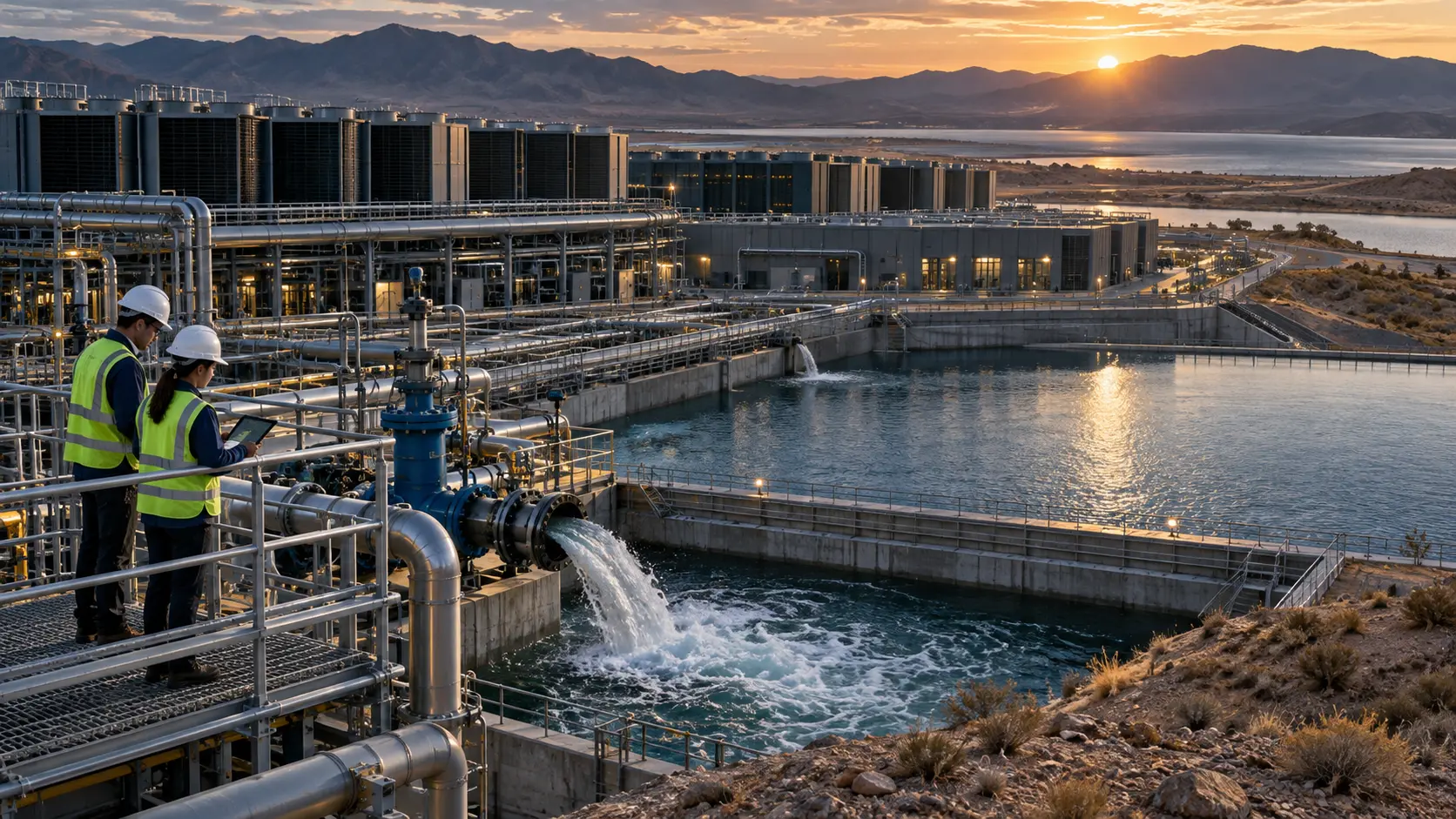
Data centers are often described as part of the digital economy, but their operation depends on very physical resources. Electricity powers servers, processors, storage systems, and networks, while cooling systems remove the heat produced by all that equipment. In many facilities, water plays an important role in this cooling process. Water is also essential to semiconductor manufacturing, where extremely pure water is used repeatedly to clean wafers and support the production of advanced chips. As computing and artificial intelligence expand, data center water consumption has become an increasingly important environmental issue.
The main reason data centers need cooling is simple: computers generate heat. Every processor, memory module, storage device, and network switch converts part of the electricity it consumes into thermal energy. A single server may not seem especially demanding, but a large data center can contain thousands of machines operating continuously. AI facilities can be even more challenging because high-performance accelerators are often packed densely into racks and can consume far more power than conventional computing equipment.
If this heat is not removed, equipment can overheat, slow down, or fail. Data centers therefore use carefully designed cooling systems to keep servers within safe temperature ranges. Some rely mostly on air cooling, while others use water directly or indirectly. The exact design depends on climate, equipment density, electricity prices, water availability, and the engineering choices made when the facility is built.
One common approach uses chilled water. In these systems, water circulates through cooling equipment and absorbs heat from the data center environment. The heated water then moves to another part of the system where the heat is released. In some facilities, chillers use refrigeration equipment to cool the water before it returns to the servers.
Other data centers use evaporative cooling. Instead of relying entirely on mechanical refrigeration, these systems take advantage of the fact that water absorbs heat when it evaporates. Air passing through wet surfaces or cooling towers can be cooled before being used to regulate the temperature inside the facility. This method can reduce electricity use under suitable conditions, but it can increase water consumption because some of the water is intentionally evaporated.
Cooling towers are an important example. Warm water from the cooling system is circulated through a tower where part of it evaporates into the atmosphere. That evaporation removes heat from the remaining water, which can then be reused. Because some water is lost during this process, fresh water must be added regularly. Additional water may also be discharged to prevent minerals and impurities from becoming too concentrated.
Not every data center uses large amounts of water on site. Some facilities rely heavily on air cooling, closed-loop liquid systems, or other designs that minimize direct water use. In cooler climates, outside air can sometimes provide part of the cooling without extensive mechanical refrigeration. This means that data center water consumption varies widely from one facility to another.
Liquid cooling is becoming more important as computing hardware grows more powerful. Instead of cooling an entire room with air, liquid can remove heat directly from processors or other high-temperature components. Because liquids can carry heat more efficiently than air, these systems can support denser computing equipment.
Direct-to-chip cooling, for example, circulates liquid through plates attached to processors. Other designs immerse electronic equipment in specially engineered fluids. These approaches can reduce some of the inefficiencies associated with moving large volumes of cold air through server rooms, although their total water impact depends on how the heat is ultimately rejected outside the building.
This distinction matters because water use can occur both directly and indirectly. A data center may consume little water inside the facility but still depend on electricity generated by power plants that use water for cooling. Conversely, a data center using evaporative cooling may consume more water directly while reducing its electricity requirements. Evaluating environmental impact therefore requires looking at the complete system rather than only at what happens inside the building.
It is also important to distinguish between water withdrawal and water consumption. Water withdrawal refers to water taken from a river, lake, reservoir, groundwater source, or municipal system. Some of that water may later be returned to the environment. Water consumption refers to the portion that is not returned to the same local water system, often because it evaporates, becomes part of a product, or is otherwise removed from immediate reuse.
This difference can substantially change how water use is interpreted. A facility may withdraw a large amount of water but return most of it after use. Another facility may withdraw less but consume a larger share through evaporation. Both figures can matter, especially in regions where water availability is limited.
Geography is therefore critical. The environmental effect of using a given amount of water depends heavily on where and when that water is taken. A facility operating in a cool, water-rich region may place relatively little pressure on local supplies. The same level of consumption in a drought-prone or arid area can create much greater concern.
Seasonal conditions also matter. Water may be plentiful during part of the year and scarce during another. A data center that consumes significant amounts during a dry season can compete indirectly with households, agriculture, industry, or ecosystems for limited supplies. This is why annual totals alone do not always capture the true local impact.
The source of the water makes a difference as well. Some facilities rely on drinking-quality municipal water, while others can use reclaimed wastewater, industrial water, or other non-potable sources. Using recycled water can reduce pressure on freshwater supplies, although it may require additional treatment systems and infrastructure.
Data centers are only one part of the digital water footprint. Semiconductor manufacturing also depends heavily on water, and for very different reasons. Chip factories need extraordinarily clean production environments because microscopic contaminants can damage circuits. During manufacturing, silicon wafers go through many chemical, deposition, etching, and cleaning steps.
Water is used repeatedly to rinse these wafers and remove particles, chemical residues, and unwanted materials. Ordinary tap water is not clean enough for advanced semiconductor manufacturing. Manufacturers therefore produce ultrapure water, which has been treated to remove extremely small concentrations of minerals, organic substances, microbes, and other contaminants.
Producing ultrapure water requires several purification stages. Depending on the facility, treatment can involve filtration, reverse osmosis, ion removal, ultraviolet processing, and other techniques. The result is water with a level of purity far beyond what is needed for ordinary drinking purposes.
Advanced semiconductor production can require large quantities of this water because wafers must be cleaned many times as layers are built and patterned. The more complex the chip, the more manufacturing stages may be required. As demand grows for processors used in artificial intelligence, cloud computing, vehicles, and communications, semiconductor water requirements can become part of the broader environmental impact of digital technology.
Chip factories also need water for cooling and other industrial processes. Some water can be treated and reused, but complete recycling is difficult because different production steps introduce chemicals and contaminants that must be removed. Semiconductor companies therefore invest heavily in water treatment, recycling, and recovery systems, particularly in regions where supplies are constrained.
The connection between data centers and chip factories is important because the environmental cost of computing does not begin when a server is turned on. Manufacturing the processors, memory, storage devices, and networking equipment inside a data center already requires energy, water, materials, and industrial infrastructure. The operational phase adds further demand through electricity and cooling.
Artificial intelligence is intensifying attention to these issues. Training and operating large AI models can require large clusters of high-performance processors. These systems consume substantial electricity and produce large amounts of heat, which can increase cooling requirements. As more AI capacity is installed, data centers may need to expand power and cooling systems accordingly.
Inference, or the everyday use of AI models, can also contribute significantly. A model may be trained only occasionally but then serve millions of users continuously. This means the long-term water footprint of AI may depend not only on large training runs but also on the ongoing operation of data centers handling requests day after day.
There is no single universal amount of water used by an AI query or a data center. Consumption depends on the model, hardware, cooling design, climate, electricity source, workload, and time of year. Simple estimates can therefore be misleading if they are presented as if every system operates under the same conditions.
Efficiency improvements can reduce water demand. More energy-efficient processors produce less heat for the same amount of useful work. Better software can reduce unnecessary computation. Advanced cooling systems can reuse water more effectively or operate with less evaporation. Data centers can also shift some workloads to locations or times where environmental conditions are more favorable.
Water reuse is another important strategy. Some operators use treated wastewater instead of potable water, while others capture and recycle water inside closed-loop systems. Semiconductor fabs can also reclaim part of their process water for less sensitive applications after treatment. The feasibility of these approaches depends on local infrastructure, regulations, and economics.
Data center operators increasingly have to consider both energy and water together. A cooling system that uses less water may consume more electricity, while a system that reduces electricity use may rely more heavily on evaporation. The best design therefore depends on local conditions rather than a single universal solution.
This trade-off becomes especially important when electricity itself has a water footprint. Certain power generation technologies use water for cooling, meaning that reducing on-site water use while significantly increasing electricity demand may simply shift water consumption elsewhere. A complete environmental assessment should therefore account for both direct and indirect effects.
Location decisions can help reduce these pressures. Companies can favor regions with abundant water, cooler climates, strong electrical grids, and access to reclaimed water systems. However, other considerations such as latency, land prices, tax policy, network connectivity, and proximity to users also influence where data centers are built.
Local communities may have different priorities. A large data center can bring investment, tax revenue, and jobs, but it can also increase demand for electricity and water. In regions already experiencing water stress, residents and policymakers may question whether industrial digital infrastructure should receive access to limited supplies.
Transparency is therefore becoming increasingly important. Companies can report water withdrawal, consumption, reuse, and local water stress rather than publishing only broad global totals. More detailed information makes it easier to understand whether water use is concentrated in vulnerable areas and whether efficiency measures are producing meaningful improvements.
The environmental impact of digital infrastructure is easy to overlook because the user experience is so intangible. Opening a website, streaming a video, storing a file, or asking an AI system a question requires only a few taps on a screen. Yet behind those actions are processors producing heat, cooling systems removing it, electrical grids supplying power, and factories manufacturing the chips that make the computation possible.
Data center water consumption is therefore part of a much larger material system. Water helps control heat in many computing facilities, supports electricity generation in some regions, and is essential to the production of semiconductors. Its importance varies by technology and location, but it cannot be separated from the growth of digital infrastructure.
As cloud computing and artificial intelligence expand, the challenge is not simply to use less water everywhere. It is to use water more intelligently, especially in places where supplies are scarce. Better cooling designs, recycled water, more efficient hardware, improved reporting, and careful site selection can all reduce pressure on local resources.
The digital economy may feel weightless, but its foundations are physical. Servers need electricity, processors generate heat, cooling systems need resources, and chips require water long before they reach a data center. Recognizing these connections makes it easier to understand that the environmental cost of computing is shaped not only by software, but by the industrial systems that keep the digital world running.