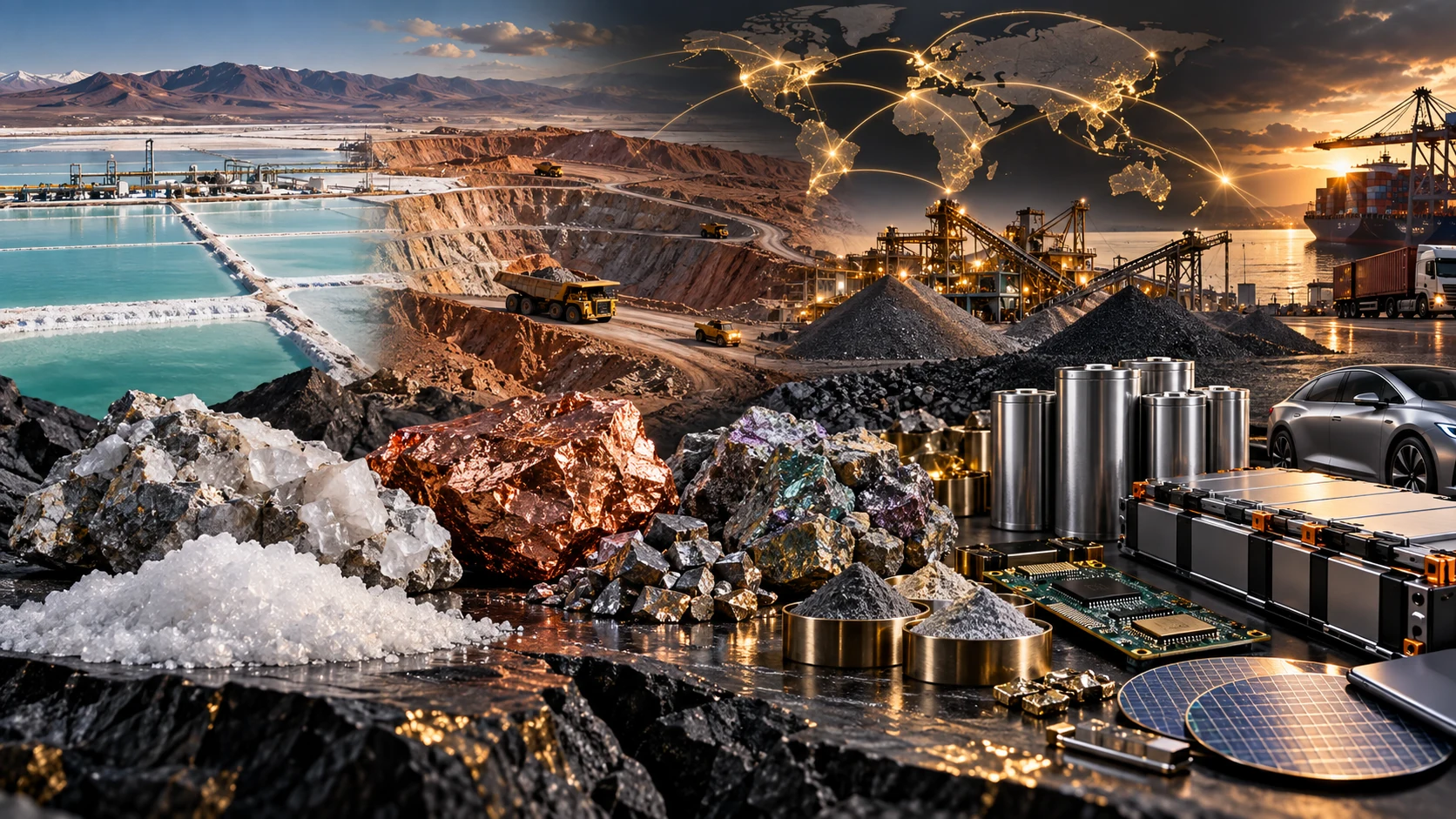
The digital economy may appear weightless, but it depends on enormous quantities of physical materials. Smartphones, electric vehicles, wind turbines, satellites, data centers, telecommunications networks, batteries, advanced weapons, and electricity grids all require minerals extracted from the earth. As economies become more technologically sophisticated, access to certain raw materials has become a strategic concern once again.
Critical minerals are resources considered economically important and vulnerable to supply disruption. The exact list varies by country because different economies have different industrial priorities. Commonly discussed examples include lithium, cobalt, nickel, graphite, copper, rare earth elements, and several specialized metals used in electronics, aerospace systems, energy technologies, and advanced manufacturing.
What makes a mineral strategically important is not simply scarcity. Some minerals are relatively abundant in geological terms but difficult to mine economically, concentrated in a few producing countries, or dependent on specialized processing. Others are available from many sources but require years of investment before new mines can begin production.
Demand matters as much as supply. A material that once had limited strategic significance can become important when new technologies rapidly increase consumption. Lithium is an obvious example because rechargeable batteries have transformed its economic importance. Similar shifts can occur whenever technological change increases demand faster than mining and processing capacity can respond.
Mineral production begins with geology, but geology alone does not determine power. A country may possess extensive reserves and still have little influence over the final supply chain. Mines require capital, skilled labor, infrastructure, environmental permits, energy, water, transport, and political stability. Extracted ore must then be processed and refined before manufacturers can use it.
Processing is often more strategically significant than mining. Raw ore may contain only a small percentage of the desired material and must undergo complex chemical or metallurgical treatment. Countries that dominate refining and processing can therefore occupy critical positions even when much of the original mining occurs elsewhere.
Manufacturing adds another layer. Refined minerals become valuable strategic inputs only when transformed into components such as battery cells, magnets, electrical equipment, semiconductors, or aerospace parts. Industrial knowledge, engineering capability, patents, manufacturing equipment, and quality control determine how effectively materials are converted into advanced products.
This creates a chain of dependencies. A country may mine a resource domestically, export it for refining, import the processed material, and then depend on foreign manufacturers for the final component. Measuring security only by the location of mineral reserves therefore provides an incomplete picture.
Rare earth elements illustrate this complexity particularly well. Despite their name, many rare earths are not exceptionally rare in the Earth's crust. The challenge lies in economically viable deposits and the difficult process of separating and refining them. Their strategic importance comes from their use in specialized magnets, electronics, defense systems, and other advanced applications.
Batteries create another important supply chain. Producing modern battery cells requires combinations of raw materials, chemical processing, specialized manufacturing equipment, technical knowledge, and large-scale factories. A country seeking greater battery security therefore needs more than access to lithium or nickel. It must consider every stage from mining to final assembly.
Copper demonstrates how the energy transition can increase demand for materials that are already widely used. Electrification requires transmission lines, motors, transformers, charging systems, buildings, renewable generation, and industrial equipment. Expanding electricity infrastructure therefore increases pressure on mineral supply even when the minerals themselves are not considered exotic.
Data centers and artificial intelligence also have a material footprint. Advanced computing requires semiconductors, servers, cooling systems, power infrastructure, backup generation, and large quantities of electricity. Expanding digital infrastructure therefore increases demand for copper and other industrial materials alongside highly specialized electronic components.
Defense technologies intensify the strategic importance of certain minerals because military systems often require materials with unusual properties. Jet engines, missiles, radar systems, satellites, sensors, communications equipment, and precision weapons may rely on metals or rare earth components that are difficult to substitute without reducing performance.
Substitution can reduce vulnerability, but it is rarely simple. Engineers may redesign products to use less of a scarce material or replace it with an alternative. However, substitutes may be more expensive, less efficient, heavier, or less durable. Developing new materials can also require years of research and industrial testing.
Recycling offers another potential source of supply. Batteries, electronics, and industrial equipment contain valuable materials that can sometimes be recovered. Recycling reduces the need for new mining and can create domestic sources of strategic inputs. However, recycling cannot immediately satisfy rapidly growing demand when relatively little old equipment is available to be processed.
Mining itself is highly capital intensive and slow. Discovering a promising deposit does not mean production can begin quickly. Exploration, feasibility studies, financing, environmental review, infrastructure construction, and community negotiations can take many years. This delay means supply cannot always respond rapidly when demand rises.
Environmental and social concerns complicate expansion further. Mining can affect water resources, ecosystems, local communities, and land use. Governments therefore face a difficult balance between securing materials for new technologies and maintaining environmental standards. Attempts to accelerate production can create political conflict if communities believe they are bearing costs without receiving benefits.
Resource nationalism may emerge when governments seek greater control over strategically valuable deposits. States may increase taxes, require local processing, restrict exports, demand domestic ownership, or renegotiate contracts. These policies can help countries capture more value from their resources, but they may also discourage investment if companies see the regulatory environment as unpredictable.
Export restrictions can create international tension because downstream manufacturers depend on reliable material supplies. A government controlling a major share of production or processing may use restrictions to support domestic industry or gain bargaining leverage. Even when such measures are not explicitly political, they can have geopolitical consequences because of the concentration of supply.
Importing countries respond by trying to diversify. They may finance mines abroad, negotiate resource partnerships, support domestic processing, create strategic stockpiles, subsidize recycling, or encourage companies to source from multiple regions. These strategies may cost more than relying on the cheapest supplier, but governments increasingly treat some redundancy as a form of insurance.
Stockpiling can reduce short-term vulnerability. Governments or companies can store materials that are difficult to replace quickly. However, strategic reserves are only useful for products that can be stored economically and whose demand is relatively predictable. They provide time during a disruption but do not solve long-term shortages.
Foreign investment also becomes part of mineral geopolitics. Governments may scrutinize acquisitions of mines, processing companies, and advanced materials firms because ownership can influence supply security. Infrastructure financing around mines can be strategically significant as well, particularly when new railways, ports, or power plants connect resource-rich regions to global markets.
The geographic distribution of minerals can alter relationships between states. Countries that were previously peripheral to major industrial supply chains may become more strategically important when they possess resources needed for batteries, renewable energy, or advanced electronics. This can create opportunities for investment and development, but resource wealth alone does not guarantee broader prosperity.
The history of commodity-dependent economies shows why. Heavy dependence on mineral exports can expose government revenue to price fluctuations and discourage diversification. If most processing and manufacturing occur abroad, the producing country may capture only a fraction of the final product's value. Converting geological resources into long-term economic strength requires institutions, infrastructure, education, and industrial capability.
The geopolitical competition surrounding critical minerals is therefore not simply a new version of competition over oil. Mineral markets differ greatly from energy markets. Minerals are not consumed in exactly the same way as fuel. Once incorporated into equipment, many can remain in use for years and may later be recycled. Their supply chains also involve a wider variety of specialized processing stages.
Nevertheless, the strategic principle is similar. Concentrated dependence creates vulnerability. If a small number of companies or countries dominate a material that is essential to major industries, disruptions can affect economies far beyond the original source.
The technology age has therefore made natural resources more, not less, relevant. Digital systems, clean energy, advanced defense, and modern manufacturing are all grounded in physical supply chains. Yet possessing minerals is only one part of geopolitical power. Extraction, refining, technology, manufacturing, infrastructure, finance, and access to markets determine whether geological wealth becomes strategic influence.
The countries best positioned in this competition are not necessarily those with the largest reserves. They are those able to build resilient networks across the full supply chain while maintaining enough alternatives to withstand disruption. Critical minerals matter because they reveal a fundamental reality of modern technology: even the most advanced economy still depends on materials that must be mined, processed, transported, and transformed in the physical world.
