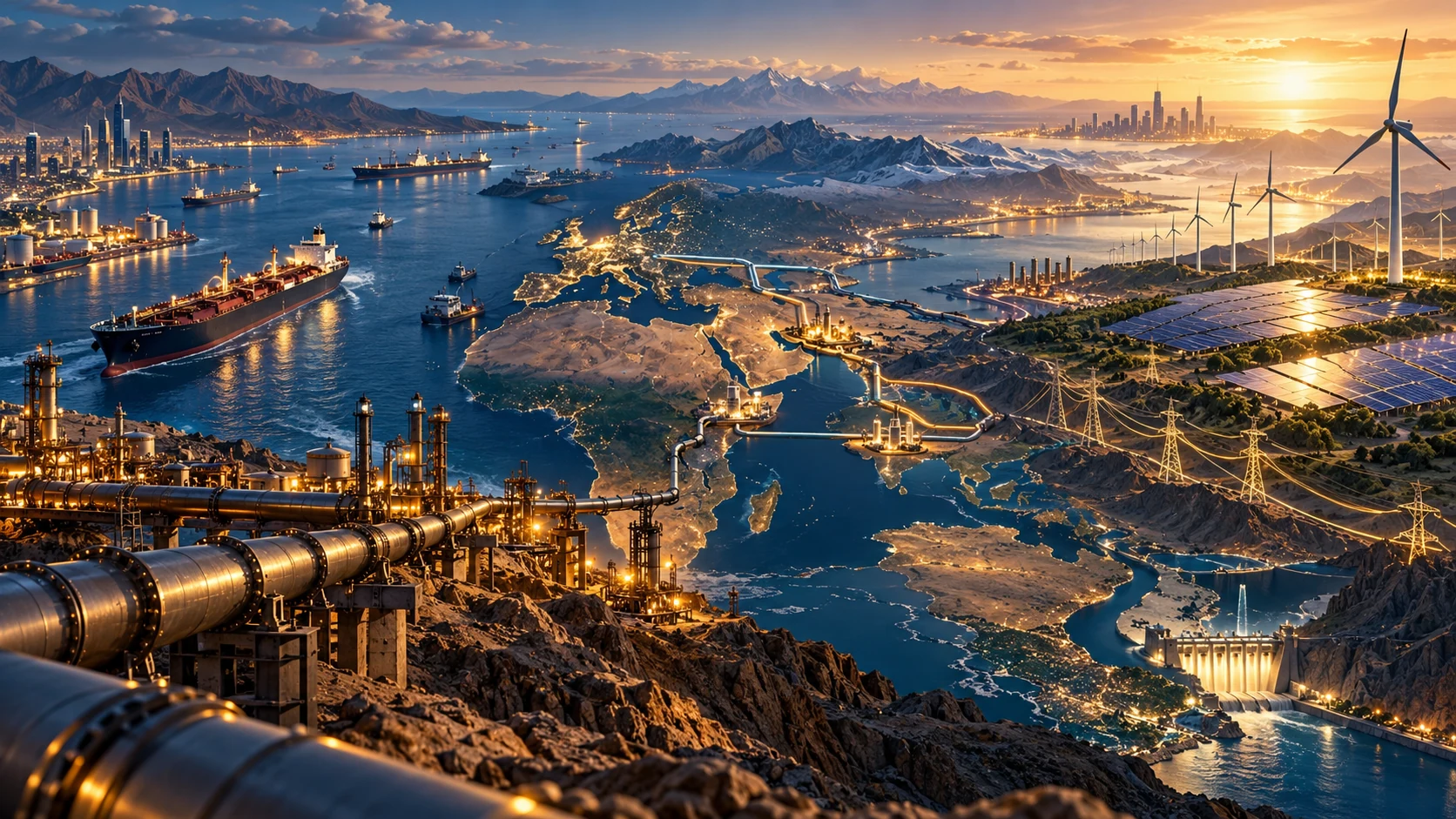
Energy is one of the foundations of modern power. Economies need it to operate factories, transport goods, heat and cool buildings, run data centers, power communications systems, produce food, and support military operations. Because energy resources and infrastructure are distributed unevenly across the world, countries depend on one another for fuel, technology, transportation, and investment. This creates relationships that are economic in normal circumstances but can become strategic during crises.
Oil has historically occupied a central position in energy geopolitics because it is essential to transportation and can be traded across long distances. Countries with large reserves can earn substantial export revenue, while major importers must secure stable supplies. Tankers, pipelines, refineries, ports, storage facilities, and insurance networks connect producers with consumers, making the oil system both global and physically concentrated.
The geopolitics of oil is not simply about who possesses reserves. Production depends on extraction technology, infrastructure, investment, political stability, and access to markets. A country may hold large underground resources but lack the capital or technical capacity to develop them efficiently. Another state may have relatively modest reserves while exercising influence through refining, trading, finance, shipping, or advanced energy technology.
Natural gas has different strategic characteristics. Although it can be transported as liquefied natural gas by ship, large quantities still move through pipelines. Pipelines create particularly strong relationships between specific producers and consumers because they connect fixed geographic locations. Building alternative routes requires large investments and can take years.
This can create dependence in both directions. Importers rely on suppliers for energy, but exporters also rely on buyers for revenue. The bargaining balance depends on how easily each side can find alternatives. A supplier with many potential customers has more flexibility than one connected to a single market. Likewise, an importer with diversified sources is less vulnerable than one dependent on a single pipeline.
Liquefied natural gas has made gas markets more flexible by allowing supplies to move between regions by sea. Even so, LNG depends on expensive infrastructure, including liquefaction plants, specialized ships, import terminals, storage, and regasification facilities. The existence of gas reserves alone therefore does not guarantee the ability to respond quickly to supply disruptions.
Electricity introduces an entirely different form of dependence because it must generally be produced and consumed at nearly the same time. Electricity grids require constant balancing between supply and demand. Neighboring countries can improve efficiency and reliability by connecting their grids, but interconnected systems can also create cross-border vulnerabilities.
Unlike oil, electricity cannot normally be transported economically across oceans in its final form. This makes generation capacity, transmission lines, regional interconnectors, and grid management strategically significant. Electricity security depends on a country's ability to maintain generation, transmission, distribution, and fuel supply simultaneously.
The growth of renewable energy is transforming these relationships. Solar and wind power reduce the need for continuous imports of fossil fuels once the infrastructure has been installed. Countries with strong renewable resources may therefore gain greater energy independence. However, the transition does not eliminate dependency. It changes what countries depend on.
Solar panels, wind turbines, batteries, electric vehicles, power electronics, transmission equipment, and energy storage systems all require industrial supply chains. Many depend on minerals such as lithium, nickel, copper, cobalt, graphite, and rare earth elements. They also depend on specialized manufacturing, chemical processing, engineering, software, and electrical equipment.
This means the geopolitical center of gravity can shift from fuel flows toward technology and materials. A country that imports oil may reduce that dependence by electrifying transport, yet become more dependent on imported batteries, minerals, or electrical components. Energy security increasingly requires looking at the entire industrial system rather than simply measuring domestic fuel production.
Processing capacity is especially important. Mining a mineral is only the first stage of a much longer supply chain. Raw materials often require refining, purification, chemical conversion, and manufacturing before they can be used in batteries or other technologies. A country with extensive mineral deposits may therefore remain dependent on another country for processing.
Manufacturing concentration creates similar risks. If a large share of global production of solar cells, battery components, turbines, or grid equipment comes from a small number of locations, disruptions can have international effects. Governments increasingly treat industrial capacity as part of energy security because equipment shortages can delay the expansion or repair of energy systems.
The transition also increases the importance of electricity grids. A system dominated by fossil fuels often stores large amounts of energy physically in coal piles, oil tanks, or gas storage facilities. Renewable systems depend more heavily on transmission, flexible demand, storage, backup generation, and sophisticated grid management because wind and solar production vary with weather conditions.
Grid infrastructure is therefore becoming a strategic asset. High-voltage transmission lines allow electricity to move between regions, helping balance areas with different weather conditions and demand patterns. Yet long transmission networks also require physical protection and cybersecurity. The more economies electrify transportation, heating, and industry, the more disruptive major power failures can become.
Energy storage provides another source of resilience. Batteries can help manage short-term fluctuations in renewable generation, while other technologies may provide longer-duration storage. Storage reduces dependence on immediate supply but creates its own material and technological requirements. The strategic question becomes not only how much energy a country can produce, but how reliably it can deliver energy when and where needed.
Nuclear power remains part of this landscape. Nuclear plants can provide large quantities of low-carbon electricity with relatively small amounts of fuel. However, nuclear energy depends on specialized engineering, fuel-cycle services, regulatory capacity, long construction periods, and complex safety systems. Countries without a developed nuclear industry may rely heavily on foreign suppliers for reactors, maintenance, components, or enriched fuel.
Energy infrastructure also has military significance. Refineries, pipelines, power plants, terminals, and transmission networks are critical to civilian economies and defense systems. During conflict, attacks on energy infrastructure can reduce industrial production, disrupt communications, and weaken public services. Protecting energy systems is therefore part of national security planning.
Cybersecurity has become increasingly important in this context. Modern energy networks use digital control systems to manage generation, pipelines, substations, and grid operations. These systems improve efficiency but also create new points of vulnerability. A cyberattack can potentially disrupt physical infrastructure without requiring conventional military action.
Strategic reserves provide one method of managing short-term disruptions. Governments can store oil, gas, or other critical materials to create time for markets and policy to adjust during crises. Reserves cannot replace functioning supply chains indefinitely, but they can reduce the immediate impact of temporary shortages.
Diversification is another key principle. Countries become less vulnerable when they can obtain energy from multiple suppliers, routes, and technologies. A diversified system may include domestic production, imported fuel, renewable energy, nuclear power, storage, and interconnected grids. Redundancy can appear economically inefficient because it requires additional capacity, but it may improve resilience.
Energy exporters also face transition risks. Countries whose government revenue depends heavily on fossil fuel exports may experience fiscal pressure if global demand changes over time. Successful adaptation may require economic diversification, investment in new industries, and changes in public finance. The energy transition therefore creates geopolitical consequences not only for consumers but also for producers.
At the same time, fossil fuels are unlikely to disappear suddenly. Transportation, petrochemicals, aviation, shipping, industrial heat, and existing infrastructure continue to support significant demand. Energy transitions historically take time because they require replacing enormous amounts of equipment and infrastructure. For this reason, old and new energy systems are likely to coexist for long periods.
This overlap can create additional complexity. Governments may need to secure oil and gas supplies while simultaneously investing in electricity networks, renewables, batteries, and new industrial capacity. A country can therefore face several kinds of energy dependence at once.
Climate policy adds another strategic dimension. Governments differ in their economic structures, domestic energy resources, technological capabilities, and willingness to absorb transition costs. Policies that benefit one country may create difficulties for another. Carbon tariffs, clean-energy subsidies, and domestic manufacturing incentives can therefore become sources of international competition as well as tools of environmental policy.
The central lesson of energy geopolitics is that energy independence is rarely absolute. Countries may reduce one dependency only to discover another in equipment, minerals, grids, finance, or technology. The relevant question is not whether an economy can eliminate all external connections, but whether those connections are sufficiently diversified and resilient.
The energy transition is changing the map of global power without removing the importance of energy itself. Oil and gas remain strategically significant, while electricity systems, critical minerals, industrial production, batteries, and grid technologies are becoming more important. Energy security is therefore expanding from a question of fuel supply into a broader question of infrastructure, technology, manufacturing capacity, and strategic resilience.
