Artificial intelligence is becoming an increasingly important tool in scientific research because it can analyze enormous amounts of data, detect patterns that are difficult for people to see, and help researchers explore possibilities more quickly. In fields such as medicine, biology, materials science, and engineering, AI can assist with tasks ranging from predicting molecular structures to designing experiments. Its greatest value is not that it replaces the scientific method, but that it can accelerate parts of discovery that are computationally intensive, repetitive, or difficult to search manually.
Scientific research often involves searching through an enormous space of possible explanations, molecules, materials, designs, or experimental conditions. A researcher developing a drug may need to consider millions of chemical compounds. A materials scientist may investigate countless combinations of elements and structures. An engineer may need to compare thousands of possible designs before identifying the most promising ones. AI can help narrow these spaces by estimating which possibilities deserve further investigation.
Machine learning is particularly useful when researchers have large datasets containing examples of inputs and outcomes. A model can be trained to recognize relationships within those examples and then make predictions about new cases. In medicine, for instance, AI can analyze medical images, molecular data, patient records, or biological measurements to identify patterns associated with disease. In materials science, it can learn relationships between a material's chemical structure and properties such as strength, conductivity, or heat resistance.
The ability to detect patterns does not mean that the system automatically understands why those patterns exist. A model may discover that certain molecular features are associated with a desired biological effect without providing a complete explanation of the underlying mechanism. This makes AI useful for identifying promising directions, but scientific interpretation is still necessary. Researchers must determine whether a pattern represents a meaningful relationship, a coincidence, or a bias in the data.
Drug discovery is one of the most widely discussed applications of AI in scientific research. Developing a new medicine involves many stages, including identifying a biological target, finding molecules that interact with it, testing those molecules, evaluating safety, and conducting clinical trials. Traditional drug development can take years because researchers must explore an enormous number of possible compounds and eliminate unsuitable candidates.
AI can accelerate some of these early stages by predicting how molecules may behave. Models can estimate whether a compound is likely to bind to a biological target, whether it may have toxic effects, or whether certain chemical modifications could improve its properties. Generative models can also propose new molecular structures rather than only evaluating existing ones. Researchers can then prioritize the most promising candidates for laboratory testing.
This approach changes the search process. Instead of synthesizing and testing every possible compound, scientists can use computational models to reduce the number of candidates that require expensive physical experiments. The benefit can be substantial when even a modest improvement in selection avoids large amounts of unsuccessful laboratory work.
Biology presents similar opportunities because living systems generate enormous quantities of complex data. Genetic sequencing, protein analysis, microscopy, and other technologies can produce datasets too large for manual interpretation. AI can help identify relationships between genes, proteins, cells, and diseases that might otherwise remain hidden.
One important area is protein research. Proteins perform many of the essential functions of living organisms, and their three-dimensional structures strongly influence how they behave. Predicting those structures from amino acid sequences was historically difficult. Advances in machine learning have significantly improved computational protein structure prediction, giving researchers new tools for understanding biological mechanisms and guiding experiments.
AI can also support the design of proteins with desired characteristics. Instead of merely analyzing structures that already exist in nature, generative models can suggest new sequences that may fold into useful shapes or perform particular functions. Potential applications include medicines, industrial enzymes, and biological materials. These designs still require experimental confirmation because a computational prediction cannot establish that a protein will behave as expected in a living or laboratory environment.
Materials science provides another example of AI-assisted exploration. Researchers may seek materials that are lighter, stronger, more durable, more conductive, or better suited to energy storage. The number of possible chemical compositions and crystal structures is immense, making exhaustive testing impossible.
Machine learning models can estimate material properties before a sample is physically produced. Researchers can use these predictions to select candidates for batteries, semiconductors, catalysts, construction materials, or other applications. Generative approaches can go further by proposing entirely new compositions designed around specific requirements.
The same principle applies to engineering. AI can help optimize shapes, structures, circuits, manufacturing processes, and control systems. A model can evaluate numerous design alternatives and identify combinations that satisfy competing requirements such as cost, weight, strength, efficiency, and safety. Engineers can then examine the most promising designs rather than beginning with an unrestricted search.
This type of computational exploration is especially valuable when the design space is too large for traditional trial and error. In aerospace engineering, for example, many geometric variations can be simulated before a physical prototype is built. In electronics, AI may help identify more efficient circuit layouts. In manufacturing, models can predict how changes in process settings affect product quality.
AI can also assist at an earlier stage of science by helping researchers generate hypotheses. Scientific literature grows so quickly that it can be difficult for individuals to remain familiar with every relevant publication. Language models and other AI systems can analyze large collections of papers, identify relationships among findings, and suggest connections that researchers may wish to investigate.
A system might notice, for example, that a biological pathway studied in one disease shares features with a mechanism described in another field. It could suggest that a drug developed for one purpose might be worth investigating for another. Such suggestions are not discoveries by themselves. They are hypotheses that need to be evaluated against evidence.
This distinction is fundamental. A scientific hypothesis becomes valuable only when it can be tested. AI can propose thousands of plausible ideas, but quantity alone does not produce knowledge. Researchers must still determine which ideas are meaningful, design appropriate experiments, and assess whether the results support or contradict the original proposal.
AI is also useful for analyzing experimental results. Modern instruments can produce vast datasets containing images, chemical measurements, genetic information, or signals collected over time. Machine learning can classify these observations, identify unusual patterns, and measure features automatically. This can reduce the amount of manual analysis required and make experiments easier to scale.
In microscopy, for example, models can detect and classify cells or structures across thousands of images. In astronomy, AI can help identify unusual objects within massive observational datasets. In particle physics, machine learning can assist in distinguishing potentially interesting events from enormous quantities of background data. These systems act as powerful filters that help researchers focus attention where it is most useful.
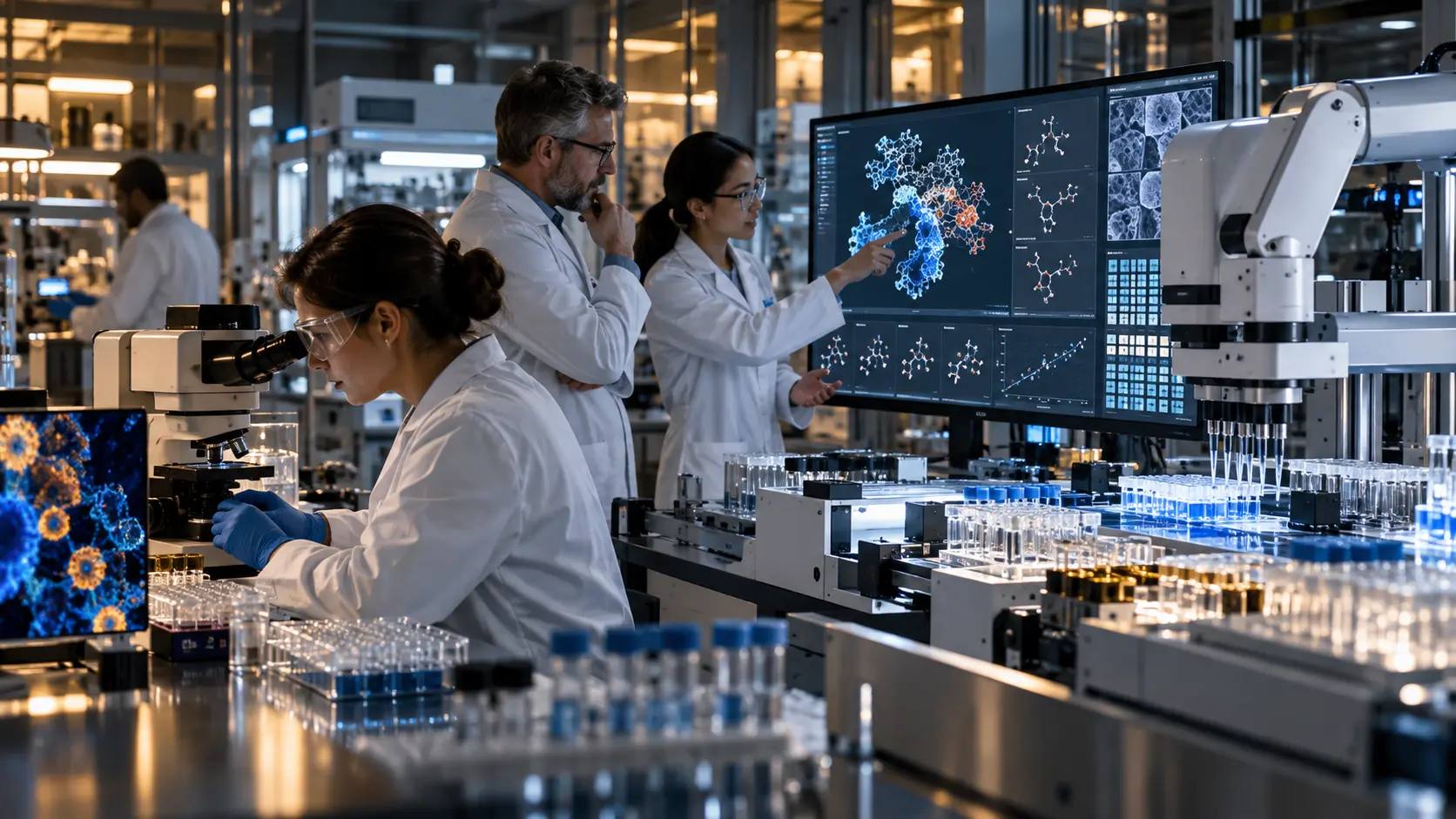
An increasingly important development is the combination of AI with automated laboratories. In a conventional laboratory, human researchers decide which experiment to perform, prepare the materials, operate equipment, analyze results, and choose the next experiment. An automated system can connect several of these stages.
In a so-called self-driving laboratory, an AI system may select experimental conditions, send instructions to robotic equipment, receive measurements, analyze the results, and use them to decide what experiment should happen next. This creates a closed loop in which computation and physical experimentation continuously inform one another.
For example, a system searching for a better battery material might begin with several candidate compositions. Robotic equipment could prepare and test samples, while the AI analyzes performance and predicts which combinations should be tested next. Each experiment provides new data, allowing the model to refine its predictions. The process can continue until the system identifies candidates that meet the desired criteria.
This approach can make experimentation more efficient because the system does not need to test possibilities randomly. It can choose experiments that are expected to provide the most useful information or that have the highest probability of improving performance. Researchers sometimes describe this as active learning, where the model helps determine which new data would be most valuable to collect.
Automated laboratories could also operate for longer periods than a human team working manually. Robotic equipment can perform repetitive procedures continuously, which can increase the number of experiments completed in a given period. Standardization may also improve because machines can repeat certain physical actions more consistently.
However, laboratory automation introduces its own limitations. Real experiments are messy. Equipment can fail, samples can become contaminated, sensors can drift, and unexpected physical effects can influence results. An AI system may interpret faulty measurements as meaningful evidence unless appropriate quality controls are present. Automation therefore increases the importance of monitoring, calibration, and error detection.
Data quality is one of the largest challenges for AI in scientific research. Machine learning models learn from the information they receive, so biased, incomplete, or poorly measured data can produce misleading predictions. A large dataset is not necessarily a good dataset. Researchers must understand how the data was collected, what it represents, and where systematic errors may exist.
This is especially important in medicine. A model trained primarily on data from one population may perform less reliably on another. Differences in age, ancestry, healthcare access, equipment, or clinical practice can influence results. An AI system that performs well in one hospital or research dataset may not work equally well elsewhere.
Reproducibility is another concern. Scientific results should ideally be repeatable by independent researchers using comparable methods. AI can complicate this requirement when models depend on proprietary software, undocumented datasets, changing algorithms, or enormous computing resources that other laboratories cannot access.
Researchers therefore need to document not only their scientific findings but also the computational systems that contributed to them. Model versions, training procedures, data sources, evaluation criteria, and relevant software settings may all affect the result. Without this information, it can be difficult to determine whether an AI-assisted discovery can be independently verified.
Interpretability presents a related problem. Some machine learning systems can make accurate predictions without providing a simple explanation for how they reached them. This may be acceptable when the model is used to prioritize low-risk experiments, but it becomes more problematic when researchers need to understand causal mechanisms.
Science is not only about prediction. A model may correctly predict that a material will behave in a particular way without explaining the physical reason. Scientific understanding usually requires deeper accounts of cause and mechanism. AI-generated predictions can therefore be starting points for explanation rather than substitutes for it.
Causation is especially important because statistical relationships can be misleading. Two variables may appear strongly associated even when neither causes the other. Hidden factors can create correlations that disappear under different conditions. AI systems trained primarily to detect patterns may reproduce these relationships without recognizing the underlying causal structure.
Experimentation remains essential because controlled experiments can distinguish among competing explanations. By changing one factor and observing the result, researchers can test whether a suspected relationship is causal. AI can help choose which experiments to run, but physical evidence remains the foundation of empirical science.
Generative AI introduces additional opportunities and risks. Language models can help summarize papers, draft code, organize research notes, explain methods, and suggest experimental ideas. These capabilities can reduce administrative work and allow researchers to spend more time on scientific interpretation.
At the same time, generative models can hallucinate. They may invent citations, misrepresent findings, or produce plausible but incorrect technical explanations. A fluent scientific answer is not necessarily an accurate one. Researchers therefore need to verify AI-generated claims against original publications, databases, experimental records, and other reliable sources.
The risk increases when AI systems are allowed to operate autonomously across multiple stages of research. An agent might search literature, generate a hypothesis, design an experiment, analyze the results, and prepare a report. Such automation could accelerate discovery, but mistakes can propagate from one stage to the next. A false assumption introduced early in the workflow may influence every later decision.
For this reason, automated scientific systems need checkpoints where assumptions, data quality, methods, and conclusions can be reviewed. Some stages may be safe to automate extensively, while others should require human approval. The appropriate level of autonomy depends on the cost of error and the nature of the research.
Human judgment remains particularly important in deciding which questions are worth asking. AI can optimize within a defined objective, but scientific importance is not always easy to express mathematically. Researchers make judgments about which problems matter, which explanations are meaningful, what evidence is sufficient, and how discoveries fit within a broader scientific context.
Creativity in science also involves more than generating large numbers of possibilities. Important advances often come from reframing a problem, recognizing that an accepted assumption may be wrong, or connecting ideas from apparently unrelated fields. AI may assist with these processes, but evaluating whether a novel idea is scientifically valuable still requires substantial judgment.
Ethical considerations further limit complete automation. Research involving human participants, animals, dangerous materials, or potentially harmful technologies requires oversight that extends beyond technical optimization. An AI system cannot simply maximize experimental progress without regard to ethical, legal, or social constraints.
The economics of research may also change as AI becomes more capable. Automated analysis and experimentation can reduce the cost of exploring some scientific questions, allowing smaller teams to perform work that once required much larger organizations. At the same time, the most advanced AI systems and automated laboratories can require expensive computing infrastructure and specialized equipment, potentially concentrating certain forms of research in well-funded institutions.
Access to scientific data will also influence who benefits. AI models improve when they can learn from large, high-quality datasets, but important research data may be private, proprietary, fragmented, or difficult to standardize. Institutions with extensive data resources may gain significant advantages, particularly in medicine, biotechnology, and industrial research.
Collaboration between humans and AI is therefore likely to become a defining feature of future research. Scientists can contribute domain knowledge, experimental intuition, ethical judgment, and an understanding of which questions matter. AI can contribute rapid computation, pattern recognition, large-scale search, and the ability to evaluate enormous numbers of alternatives.
The strongest systems may combine these abilities rather than attempting to remove human researchers entirely. An AI system can propose candidates, but scientists can judge whether the proposals make sense. Automated equipment can perform experiments, but researchers can investigate unusual results. Machine learning can identify patterns, but scientific reasoning is needed to determine whether those patterns reveal something fundamental about the world.
AI in scientific research is ultimately a technology for expanding the range and speed of exploration. It can help researchers search chemical spaces, interpret biological data, optimize engineering designs, generate hypotheses, and coordinate automated experiments. These capabilities could shorten some discovery cycles and make previously impractical investigations possible.
Yet scientific progress cannot be reduced to generating plausible predictions or maximizing experimental throughput. Reliable knowledge requires evidence, reproducibility, critical evaluation, and a willingness to reject attractive ideas when experiments do not support them. Artificial intelligence can make the process of discovery faster and more powerful, but the credibility of science will continue to depend on rigorous validation and informed human judgment.