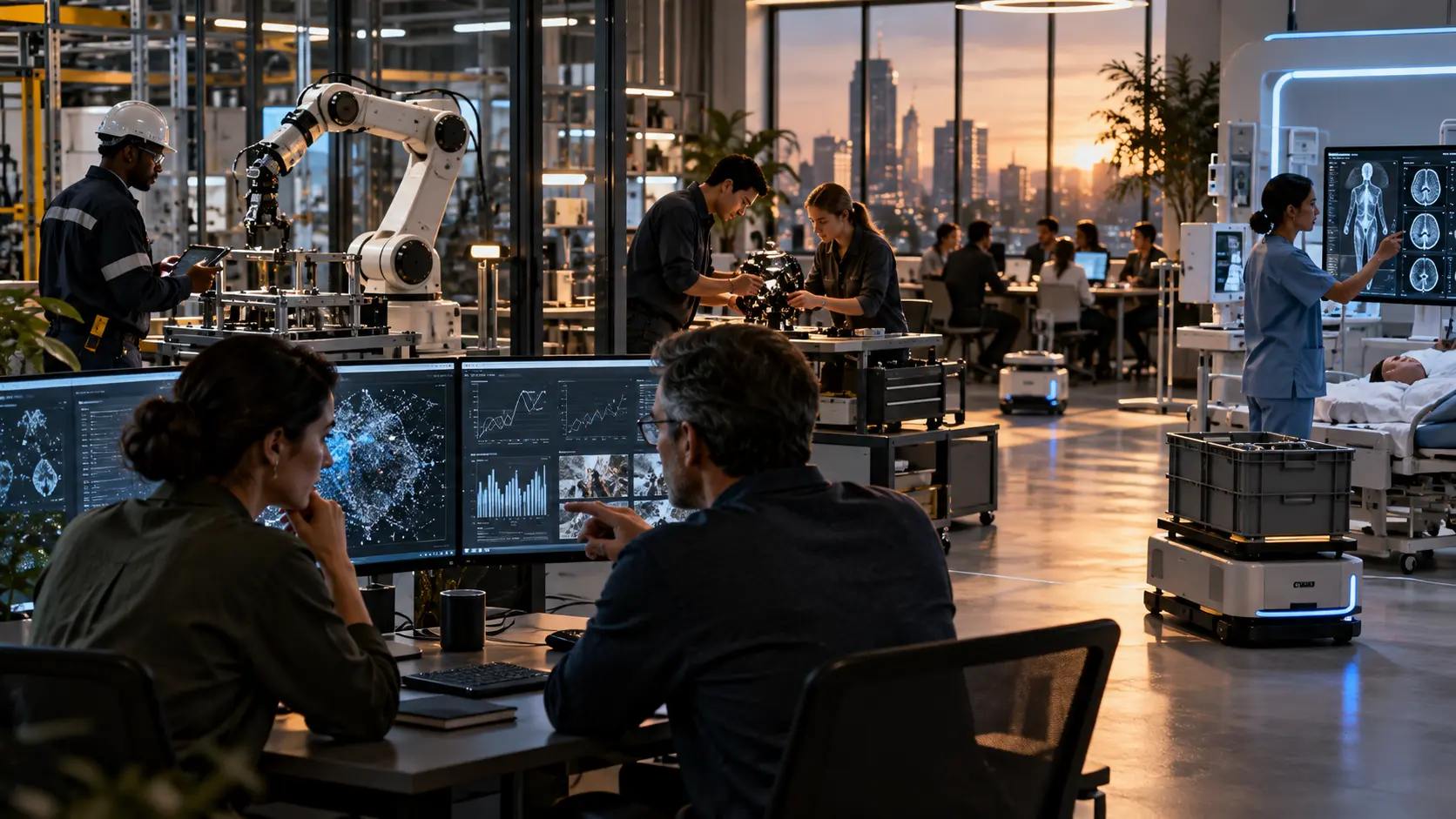
The question of whether artificial intelligence will replace human jobs is more complicated than a simple choice between employment and unemployment. AI is already changing how many kinds of work are performed, but technological change usually affects specific tasks before it eliminates entire occupations. In many cases, workers will not disappear from a profession; instead, the content of their jobs will change as some responsibilities become automated and others become more important.
A job is usually made up of many different tasks. A lawyer may research cases, review documents, speak with clients, negotiate agreements, appear in court, and make strategic judgments. A nurse may record information, monitor patients, communicate with families, administer treatment, coordinate with physicians, and respond to unexpected changes. AI may become highly capable at some parts of these jobs while remaining much less suited to others. This is why it is often more accurate to ask which tasks AI can automate than which occupations it can completely replace.
Generative AI has expanded the range of tasks that machines can perform because it can work with language, images, code, and other forms of information that were once difficult to automate. Earlier waves of automation were often associated with physical machinery or software following rigid rules. Modern AI systems can draft documents, summarize large amounts of text, generate computer code, classify information, answer questions, and assist with analysis. As these systems improve and become connected to business software and autonomous agents, they may take responsibility for increasingly complex sequences of work.
Some occupations are more exposed to AI than others because their tasks are easier to perform digitally. Jobs that involve processing structured information, producing standardized text, handling routine customer inquiries, reviewing documents, or following predictable procedures may be particularly affected. Administrative work, basic content production, some forms of customer support, entry-level analysis, and portions of software development are examples of areas where AI can already perform meaningful parts of the workload.
Exposure to automation, however, does not automatically mean that an occupation will disappear. A profession can be heavily affected by AI while continuing to employ large numbers of people. If technology allows each worker to perform certain tasks faster, organizations may respond by reducing staff, expanding output, lowering prices, creating new services, or assigning employees to more valuable responsibilities. The final effect depends not only on what AI can technically do but also on business demand, regulation, costs, organizational choices, and the willingness of customers to accept automated services.
Jobs that depend heavily on physical activity in unpredictable environments are often harder to automate with software-based AI alone. Electricians, plumbers, construction workers, caregivers, mechanics, and many other workers must interact with physical objects and adapt continuously to real-world conditions. Robotics may eventually automate more of these activities, but manipulating the physical world is often more difficult than generating information on a computer screen. The cost and reliability of robotic systems also matter when employers decide whether automation is economically practical.
Human interaction creates another important barrier to full replacement. Many occupations depend on trust, empathy, persuasion, leadership, negotiation, responsibility, or social understanding. AI can assist in these areas, but people may still prefer or require human involvement when decisions are sensitive or consequences are significant. A patient may benefit from AI-assisted medical analysis while still wanting a physician to explain treatment options. A company may use AI to analyze candidates while continuing to rely on managers to make hiring decisions. The presence of AI can therefore change the work without removing the human role.
In many professions, the most likely effect is complementarity, meaning that AI increases the capabilities of workers rather than replacing them completely. A programmer can use AI to generate routine code and spend more time on architecture, debugging, and product decisions. A financial analyst can automate data preparation and focus more heavily on interpreting results. A teacher can use AI to help prepare materials while concentrating on instruction, feedback, and student support. When technology complements workers in this way, productivity can rise without eliminating the occupation itself.
Higher productivity can have several possible effects on employment. If workers can produce more in less time, an employer may need fewer people to generate the same amount of output. But lower production costs can also increase demand, allowing businesses to sell more or offer services that were previously too expensive. New technology can also create entirely new categories of work. The history of automation contains examples of occupations that declined, occupations that expanded, and industries that emerged only after new technologies became available.
AI may also change the skill requirements within existing professions. Routine responsibilities can become less valuable when they are easy to automate, while judgment, problem solving, communication, domain expertise, and the ability to supervise AI systems may become more important. Workers who understand both their profession and the capabilities of AI may gain an advantage because they can decide when automation is useful, identify mistakes, and integrate machine-generated work into a broader process.
This shift could create difficulties for entry-level workers. Junior employees have traditionally learned professions by performing simpler tasks before taking on more complex responsibilities. If AI automates many of those introductory activities, organizations may need new ways to train people and develop expertise. A law firm, accounting firm, or software company cannot depend indefinitely on experienced professionals without preparing younger workers to replace them. The structure of career development may therefore need to change even when the profession itself remains strong.
Wages may also be affected unevenly. If AI makes a particular skill easier to supply, the economic value of that skill may decline. Workers whose responsibilities consist mainly of tasks that can be automated cheaply could face weaker bargaining power or slower wage growth. At the same time, people who possess scarce expertise, manage complex systems, make high-stakes decisions, or use AI especially effectively may become more productive and command higher compensation.
These effects could widen differences between workers. AI may benefit employees who already have strong technical, managerial, or professional skills, while creating greater pressure on workers performing standardized cognitive tasks. However, the outcome is not predetermined. If AI tools become easy to use, they may also help less experienced workers perform tasks that previously required specialized knowledge. In that case, some forms of expertise could become more widely accessible rather than more concentrated.
The distribution of economic gains will depend heavily on who owns the technology and how organizations use it. Productivity improvements can produce higher profits, lower prices, better services, higher wages, shorter working hours, or some combination of these outcomes. There is no automatic rule determining how those gains will be shared. Labor markets, competition, public policy, bargaining power, education systems, and corporate decisions all influence whether the benefits of AI are broadly distributed or concentrated among a smaller number of firms and individuals.
Different industries will experience these changes at different speeds. Technology companies may adopt advanced AI rapidly because their work is already highly digital. Finance, consulting, marketing, media, law, and administrative services may also see substantial changes because many of their tasks involve information processing. Healthcare, education, manufacturing, transportation, and construction may adopt AI in more uneven ways because regulation, physical infrastructure, safety requirements, and human relationships play larger roles.
There is also a major difference between what is technically possible and what organizations are willing to automate. An AI system may be capable of producing a legal document, medical recommendation, or financial analysis, but businesses may still require human review because mistakes carry legal or financial consequences. Reliability becomes especially important when tasks affect health, safety, rights, or large amounts of money. In these settings, AI may function primarily as a decision-support system rather than an independent replacement for professionals.
The quality of AI itself also limits automation. These systems can make factual errors, misunderstand unusual situations, produce confident but incorrect outputs, and struggle when tasks require information outside their available context. Human workers often possess practical knowledge that is difficult to capture in formal instructions, including an understanding of organizational culture, customer expectations, interpersonal relationships, and unusual exceptions. Such knowledge can make complete automation considerably harder than a demonstration of a single successful AI task might suggest.
Over time, however, improved reliability and the growth of autonomous AI agents could allow systems to manage broader workflows. An agent may be able to receive an objective, gather information, use software tools, make intermediate decisions, check results, and continue working with limited supervision. This could increase the number of activities that organizations can automate. It would also make questions of accountability, security, permissions, and human oversight increasingly important.
Workers are likely to respond to these changes by adapting their skills, but adaptation is not always easy or automatic. Retraining requires time, money, and access to opportunities, and not every worker can move smoothly into a new occupation. A person displaced from one industry may live in a region where expanding jobs are scarce or may lack the qualifications required for them. Even when technological change eventually produces economic growth, the transition can impose substantial costs on particular workers and communities.
Governments and institutions therefore have an important role in shaping the labor-market effects of AI. Education systems may need to emphasize adaptable skills and continuous learning rather than preparing people for a single fixed set of tasks. Employers may need to redesign training programs and create clearer paths for workers whose responsibilities are changing. Public policy may also address unemployment support, labor protections, competition, and access to new economic opportunities.
The most realistic future is unlikely to involve either the complete disappearance of human employment or a world in which AI has little effect on jobs. Instead, work will probably be reorganized unevenly. Some roles will shrink, some will disappear, many will change, and new ones will emerge. In numerous occupations, people who use AI effectively may replace some of the demand for people who do not, even when AI does not replace the profession itself.
The question “will AI replace jobs?” therefore has no single answer. AI can replace certain tasks, reduce demand for some kinds of labor, and transform the structure of entire professions, but it can also increase productivity, create new services, and expand what individual workers are able to accomplish. The long-term impact will depend not only on the capabilities of artificial intelligence but also on how businesses, workers, governments, and society choose to use it. The future of work will be shaped as much by these human decisions as by the technology itself.