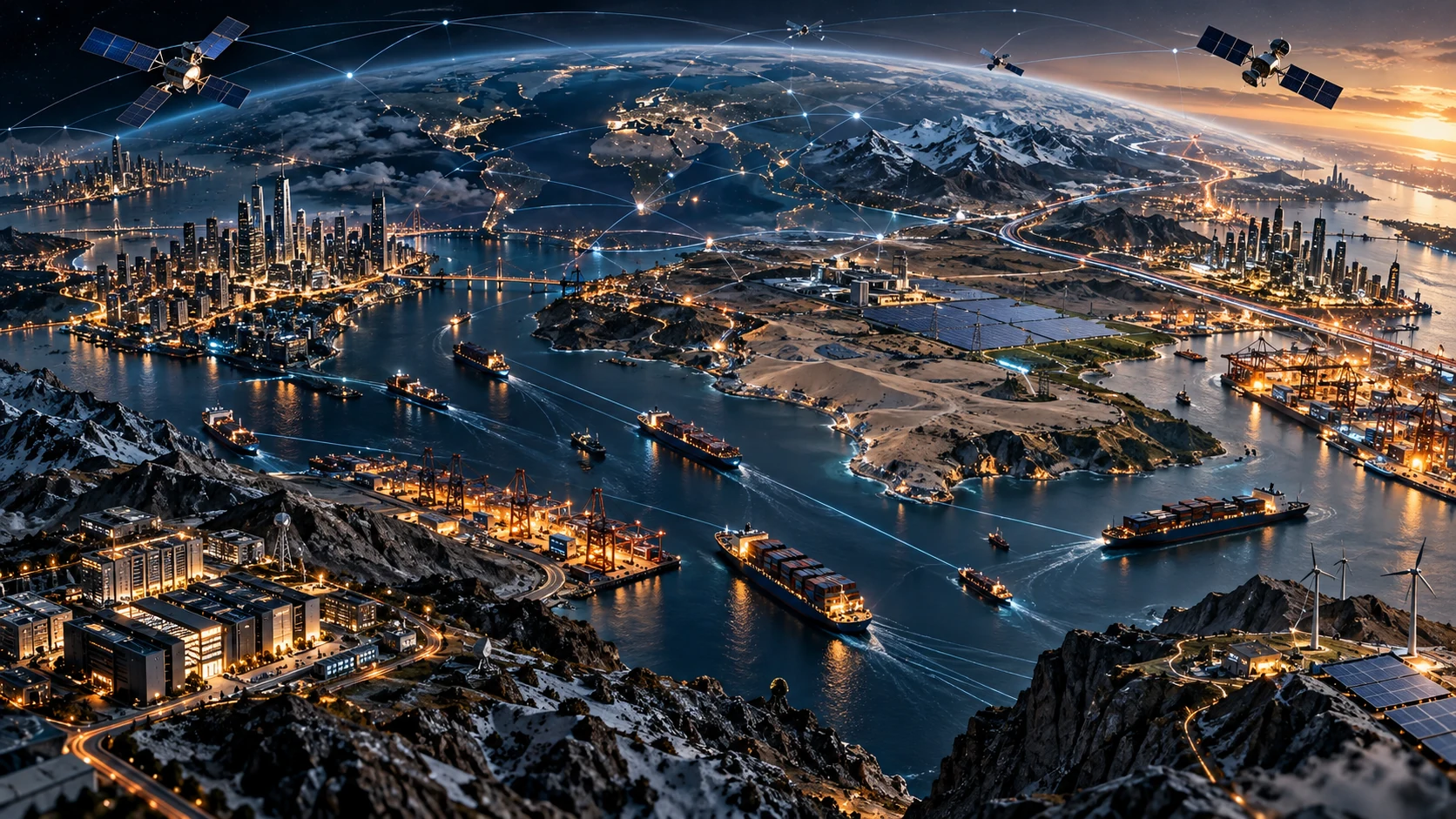
The future of world order is likely to be shaped by a tension that cannot easily be resolved. Governments increasingly want to reduce strategic dependence on foreign countries, especially in areas such as technology, energy, finance, critical minerals, semiconductors, food, and defense. At the same time, modern economies remain deeply dependent on international trade, global supply chains, foreign markets, cross-border investment, and specialized technologies produced in multiple countries. The result is not a simple retreat from globalization but a more political and selective form of interdependence.
For several decades, economic integration encouraged governments and companies to organize production primarily around efficiency. Manufacturing moved across borders, supply chains became longer, and firms specialized in increasingly narrow stages of production. This created enormous economic benefits, but it also created dependencies that became more visible during major crises.
A country may discover that an essential product depends on components manufactured in only a few factories. A technology sector may rely on specialized machinery produced abroad. Energy systems may depend on pipelines, shipping routes, or imported minerals. Financial institutions may rely on foreign currencies or payment networks. These dependencies become geopolitical concerns when relations between states deteriorate.
Governments are therefore paying more attention to resilience. Instead of asking only which supplier is cheapest, policymakers increasingly ask whether supply can continue during war, sanctions, political disputes, natural disasters, or cyberattacks. This does not mean cost has become irrelevant. It means security is becoming part of economic decision-making.
Supply chains are likely to remain global, but they may become more diversified. Companies may spread production across several countries rather than concentrating it in one location. Governments may encourage firms to source critical products from politically trusted partners.
This process is sometimes described through ideas such as reshoring, nearshoring, or friend-shoring. The terminology varies, but the strategic logic is similar: reducing exposure to suppliers that could become unreliable during geopolitical conflict.
Complete economic self-sufficiency remains unrealistic for most countries. Advanced products depend on too many specialized inputs for every state to reproduce the entire supply chain domestically. Attempting to do so would be enormously expensive and could reduce innovation.
The more likely outcome is selective protection. Governments will identify a limited number of sectors as strategically important and support domestic or allied capacity in those areas. Semiconductors, telecommunications, defense technology, energy infrastructure, pharmaceuticals, critical minerals, and artificial intelligence are likely to receive particular attention.
This approach will blur the traditional boundary between economic policy and national security. Subsidies, export controls, investment restrictions, procurement rules, and industrial policy will increasingly be justified through strategic arguments.
Technology competition will be central. Leadership in AI, semiconductors, computing, biotechnology, telecommunications, cybersecurity, and space systems can strengthen both economic and military power. Governments will therefore invest heavily in research and attempt to protect technologies considered sensitive.
Export controls will remain an important instrument. Countries possessing advanced technologies can restrict access to slow the development of rivals. However, these controls may also encourage targeted states to invest in domestic alternatives.
The long-term effectiveness of technological restrictions will depend on how difficult the targeted capabilities are to reproduce. Some technologies can be substituted relatively quickly. Others depend on decades of accumulated knowledge, specialized equipment, research networks, and skilled labor.
Artificial intelligence will intensify this competition because AI capability depends on infrastructure as well as software. Advanced models require chips, electricity, data centers, cloud systems, and skilled researchers. States with strong computing ecosystems may gain advantages across both civilian and military sectors.
The global semiconductor industry will remain particularly important because of its concentration. Governments are already treating chip manufacturing and semiconductor equipment as strategic capabilities. Yet full national independence will remain difficult because the supply chain is spread across many countries.
Energy geopolitics will also evolve rather than disappear. Oil and gas will continue to matter, especially during a long transition in which fossil fuels remain part of the global economy. At the same time, electricity grids, batteries, renewable technologies, nuclear power, and critical minerals will become more strategically significant.
The transition will create new dependencies. A country that reduces oil imports may become more dependent on imported battery materials, electrical equipment, or solar components. Energy security will therefore increasingly mean control over systems rather than individual fuels.
Critical minerals will receive growing attention because they connect natural resources to technology. Lithium, copper, nickel, graphite, rare earth elements, and other materials are essential to batteries, electronics, electricity networks, and defense systems.
However, mineral geopolitics will be shaped by more than mining. Processing, refining, manufacturing, transport, and technology determine where the real bottlenecks exist. Countries with large reserves may not automatically gain the greatest strategic influence.
Cyber competition will provide states with another means of applying pressure below the threshold of conventional war. Cyber operations can steal information, disrupt infrastructure, interfere with government systems, or damage economic activity.
Because cyberattacks can be difficult to attribute quickly, they allow states and non-state actors to operate in ambiguous territory. This makes cyberspace likely to remain a persistent arena of geopolitical competition.
Information operations may evolve alongside cyber capabilities. Artificial intelligence can increase the scale and sophistication of manipulated media, automated propaganda, and influence campaigns. Governments will therefore treat information resilience as part of national security.
Military competition will remain significant, but it will increasingly depend on civilian technology. Satellites, semiconductors, AI, cloud computing, autonomous systems, advanced sensors, and secure communications all contribute to battlefield effectiveness.
This integration between civilian and military technology will make commercial industries more strategically important. Governments will pay greater attention to foreign investment, intellectual property, research partnerships, and technology transfer.
Traditional military alliances will continue to matter, especially for deterrence. At the same time, strategic partnerships may become more specialized. Countries may cooperate through different groups for defense, technology, critical minerals, maritime security, infrastructure, or intelligence.
This will produce a more networked international order. Instead of belonging to one rigid bloc for every issue, many states will participate in overlapping arrangements.
Middle powers may gain greater influence in such a system. Countries with significant economies, strategic locations, industrial capacity, natural resources, or diplomatic reach can become important partners for several major powers simultaneously.
These states may resist pressure to choose a single side. They can seek security cooperation with one country while maintaining strong trade relationships with another. This strategic flexibility is likely to become more common in a multipolar environment.
Developing economies may also gain bargaining power because major powers will compete for access to markets, minerals, infrastructure projects, diplomatic support, and strategic geography. However, these opportunities can create pressure as well. Governments may face difficult choices when competing powers demand incompatible commitments.
International institutions will continue to operate but may face greater strain. Global organizations work most effectively when major powers agree on basic rules. As rivalry grows, consensus becomes harder to achieve.
This does not mean multilateralism will disappear. States will still need cooperation on climate change, public health, aviation, shipping, nuclear risk, finance, and many other transnational issues.
Instead, global governance may become more fragmented. Universal institutions may coexist with regional organizations, informal coalitions, technology partnerships, and issue-specific groups.
Financial systems could also become more politically contested. Access to major currencies, payment systems, and capital markets provides powerful sanctions leverage. Governments concerned about vulnerability may seek alternative arrangements.
Yet replacing established financial systems is difficult because their strength comes from liquidity, institutional trust, market depth, and network effects. Alternatives may grow without completely displacing existing structures.
Sanctions will remain an important tool because they allow governments to impose costs without direct military action. Their frequent use, however, will encourage states to reduce exposure to foreign financial pressure.
This will contribute to gradual diversification rather than complete separation. Countries may hold more varied reserves, use multiple payment channels, and expand trade with partners outside traditional networks.
Demographic trends will quietly shape these developments. Aging populations in many countries will affect labor markets, defense budgets, healthcare spending, and economic growth. Other regions will experience rapid population expansion.
The geopolitical effects will depend on whether states can convert demographic change into productive capacity. Education, migration, employment, and institutional quality will matter more than raw population numbers.
Climate change will add another layer of pressure. Water availability, agricultural productivity, extreme weather, migration, infrastructure, and energy systems can all be affected. These stresses may intensify existing political problems rather than create entirely new ones.
The Arctic may also become more strategically relevant as environmental change affects navigation and resource access. However, harsh conditions, infrastructure requirements, and high costs will continue to limit rapid transformation.
Food security will remain part of geopolitics because agriculture depends on climate, fertilizer, energy, water, transport, and trade. Countries that rely heavily on imports can become vulnerable during major disruptions, while large exporters may gain temporary leverage.
Infrastructure itself will increasingly be treated strategically. Ports, railways, pipelines, undersea cables, data centers, electricity networks, and satellite systems connect national economies to the wider world. Governments will pay closer attention to who owns and operates these assets.
The central challenge will be finding a workable balance between efficiency and resilience. Highly optimized systems are often cheaper, but they can become fragile when too much depends on a small number of suppliers or routes.
Building redundancy costs money. Maintaining spare capacity, alternative suppliers, and strategic reserves may appear inefficient during normal periods. Their value becomes clear during crises.
This means economic policy will increasingly involve choices about how much efficiency governments and companies are willing to sacrifice for security. Different countries will answer this question differently depending on their geography, institutions, alliances, and threat perceptions.
The future world order is therefore unlikely to be defined by complete globalization or complete fragmentation. Both forces will operate simultaneously.
Strategic sectors will become more protected, while ordinary commerce will continue across borders. Technology ecosystems may partially separate, while companies remain connected through international markets. Alliances may strengthen in security affairs while members maintain extensive trade with countries outside those alliances.
Competition and interdependence will therefore coexist rather than replace one another. Major powers will seek greater autonomy while continuing to rely on global systems that no single country can fully reproduce.
This creates a world that is more complex than a return to traditional great-power rivalry. Economic networks, technology, finance, cyber capabilities, and global supply chains give states new tools for competition while also making complete confrontation more costly.
The international system may become increasingly multipolar, but power will remain uneven across different domains. One state may dominate a particular technology, another may control key resources, and another may possess superior military or financial capabilities.
This uneven distribution will encourage flexible partnerships and constant bargaining. Countries will cooperate where their interests overlap and compete where they do not.
The most successful states will probably not be those that eliminate dependence entirely. That goal is unrealistic in a highly specialized global economy. More important will be the ability to identify dangerous dependencies, diversify critical relationships, maintain domestic capabilities where necessary, and preserve access to international markets and innovation.
World order is therefore moving toward managed interdependence. Governments will continue to trade, invest, share technology, and cooperate, but they will do so with greater awareness of vulnerability.
The central geopolitical question of the coming decades will not be whether globalization survives. It will be how states redesign globalization so that they can benefit from international connections without becoming strategically exposed to them. The future is likely to be defined by that difficult balance between openness and security, competition and cooperation, national resilience and global dependence.
