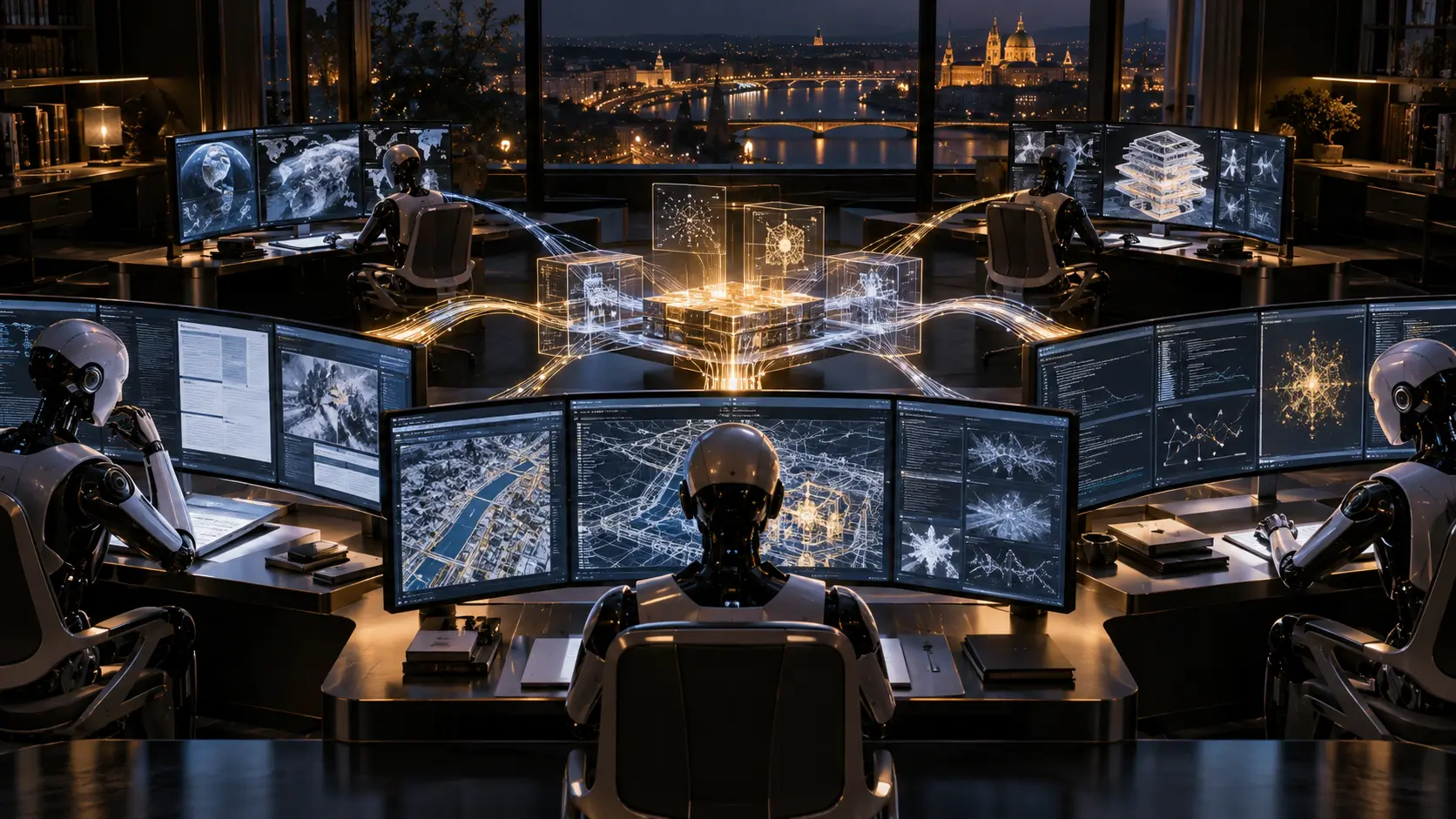
Multi-agent AI systems are artificial intelligence architectures in which several agents work together rather than relying on a single system to handle an entire task. Each agent may have its own role, tools, instructions, memory, or area of expertise, while a coordination mechanism determines how their work is combined. This approach is designed to make complex problems easier to manage by dividing them into smaller parts and assigning those parts to agents that are better suited to handle them.
The basic idea resembles teamwork. Instead of asking one AI agent to research a topic, analyze data, write a report, verify the facts, and manage the final workflow by itself, a multi-agent system might assign those responsibilities separately. One agent could gather information, another could evaluate the evidence, a third could produce a draft, and a fourth could review the result for errors. The agents may exchange information directly or communicate through a central controller that manages the overall process.
This structure can be useful because complex tasks often require different capabilities. A single AI model may be broadly capable, but it can still benefit from specialized instructions, dedicated tools, or separate decision-making roles. An agent responsible for data analysis might have access to statistical software, while another responsible for document production might focus on clarity and organization. A security-focused agent might inspect proposed actions before they are executed. By separating responsibilities, the system can create clearer boundaries between different kinds of work.
Task distribution is one of the central features of multi-agent AI systems. A large objective must first be divided into smaller tasks. This can be done by a human, by a central planning agent, or through predefined workflow rules. The system then assigns each task according to the capabilities of the available agents. In a software project, for example, one agent might inspect requirements, another might write code, another might create tests, and another might review the implementation for defects.
The quality of this division matters. If a complex problem is divided poorly, agents may duplicate work, overlook important dependencies, or produce outputs that do not fit together. Effective orchestration therefore requires an understanding of which tasks can be performed independently and which depend on information from earlier stages. Some workflows are naturally parallel, while others must proceed in sequence.
Specialization can improve performance because an agent can be optimized for a particular role. Its system instructions can emphasize specific goals, its tools can be restricted to those it needs, and its evaluation criteria can be tailored to the task. A research agent might be instructed to prioritize reliable sources and identify uncertainty, while a planning agent might focus on dependencies, deadlines, and resource constraints. Specialization does not necessarily require different underlying models; several agents can use the same model while behaving differently because of distinct instructions and tools.
Communication between agents is another essential part of the architecture. An agent must be able to pass useful information to the next agent without introducing confusion or losing important context. Communication may occur through structured messages, shared databases, memory systems, task queues, or natural-language exchanges. The format matters because unstructured communication can create ambiguity, while overly rigid formats may prevent agents from expressing useful details.
Structured communication is often valuable in business settings. Instead of allowing agents to exchange long free-form messages, a system might require them to pass specific fields such as task status, evidence, confidence level, recommended action, and unresolved issues. This makes the workflow easier to inspect and reduces the chance that important information will be lost in conversational text.
Some multi-agent systems use a central coordinator. This coordinator receives the main objective, assigns tasks, monitors progress, and determines when the overall job is complete. It may also resolve conflicts between agents and decide whether a failed task should be retried or assigned elsewhere. This design creates a clear control point, which can make supervision and auditing easier.
Other architectures are more decentralized. Agents may communicate directly and decide collectively how work should proceed. This can make the system more flexible, especially when no single agent has enough information to manage the entire task. However, decentralized systems are harder to control because coordination emerges from interactions among agents rather than from a single authority.
A common design pattern involves a planner and several workers. The planner breaks down the objective, sends tasks to worker agents, collects their results, and decides what should happen next. Another pattern uses a supervisor that evaluates agent outputs and requests revisions when quality is insufficient. Some systems also include critic agents whose role is not to perform the main task but to challenge assumptions, identify errors, or verify compliance with rules.
These arrangements can be particularly helpful for workflows that involve multiple forms of expertise. Consider a company preparing a market entry analysis. One agent might examine competitors, another could analyze financial projections, another could research regulatory requirements, and another could synthesize the results. A final reviewer could check whether the conclusions are supported by the evidence. The system as a whole can cover more ground than a single undifferentiated agent.
Parallelism is another advantage. If several tasks are independent, multiple agents can work on them at the same time. This can shorten the time required for large workflows. A research system could investigate several sources or hypotheses simultaneously, while a software system could test different components in parallel. The benefit depends on whether the tasks can truly be separated without creating conflicts or duplicated effort.
Multi-agent systems can also improve robustness by introducing redundancy. Two agents may independently analyze the same problem and compare results. If both reach the same conclusion, confidence may increase. If they disagree, the system can escalate the issue to another agent or a human reviewer. This does not guarantee correctness, but it can help expose uncertainty that a single agent might miss.
However, using more agents does not automatically make a system more reliable. Multiple agents can repeat the same error, reinforce one another's false assumptions, or create the appearance of agreement without independent evidence. If all agents rely on the same flawed source or similar model behavior, consensus may be misleading. Redundancy is most useful when the agents have genuinely different perspectives, tools, evidence, or methods.
Conflicting objectives create another difficulty. One agent may be instructed to maximize speed, while another emphasizes accuracy. A cost-control agent may reject an action that a performance-focused agent recommends. These differences can be useful because they force trade-offs to be considered, but the system needs rules for resolving disagreement. Without clear priorities, agents can become trapped in repeated debate or produce inconsistent actions.
Communication failures can also propagate through the system. If one agent sends incomplete or incorrect information, later agents may treat it as reliable and build on it. A small misunderstanding can therefore spread across several stages of the workflow. This problem is similar to error accumulation in a single long agent process, but multi-agent architectures add more communication boundaries where mistakes can occur.
Context loss is another concern. Each agent may only receive a portion of the overall problem, which can improve focus but reduce awareness of broader goals. An agent might optimize its local task in a way that harms the final result. For example, a writing agent could simplify a technical explanation so aggressively that it removes details needed by a compliance reviewer. Good coordination requires agents to understand enough of the larger objective to avoid damaging dependencies.
System-level control is therefore one of the most important challenges. A multi-agent system must coordinate not only what each agent does but also what the entire group is allowed to do. Permissions, tool access, spending limits, data access, and approval requirements may need to be enforced centrally. Otherwise, several individually limited agents could collectively produce actions that exceed the intended boundaries.
Human oversight remains especially important when agents can take consequential actions. A system may be allowed to research options and prepare recommendations automatically while requiring human approval before making purchases, modifying production systems, sending sensitive communications, or making legal or financial commitments. This creates a separation between analysis and authority.
Monitoring is also necessary because multi-agent behavior can be difficult to understand after the fact. Organizations may need logs showing which agent made each decision, what information it used, what messages were exchanged, which tools were called, and where errors occurred. Without this level of visibility, debugging a failed workflow can become extremely difficult.
Cost is another practical consideration. Every additional agent may require model inference, memory, tool access, and communication overhead. A task that could be handled reliably by a single agent may become unnecessarily expensive if divided among many specialized components. Multi-agent systems are most useful when the benefits of specialization, parallel work, or independent review justify the added complexity.
Latency can increase as well. If agents must repeatedly consult one another, wait for approvals, or pass information through several stages, the workflow may become slower even if some steps run in parallel. Designers need to balance collaboration with efficiency. More communication is not always better.
Traditional software engineering principles remain important in these systems. Clear interfaces, predictable data formats, error handling, permission boundaries, and testing can reduce many coordination problems. The fact that the individual components use AI does not eliminate the need for disciplined system design. In many cases, the most reliable multi-agent architecture combines flexible AI reasoning with conventional software controls.
Evaluation must also occur at the system level. Testing each agent independently is not enough because failures can emerge from interactions between otherwise capable components. A research agent may produce accurate information, and a writing agent may produce clear prose, yet the overall workflow may still fail if the transfer between them is incomplete. Organizations therefore need to test full workflows, including unusual cases and failures.
Multi-agent AI systems can be useful in software engineering, research, operations, customer service, cybersecurity, logistics, financial analysis, and other areas where work naturally divides into specialized tasks. Their greatest value often appears in processes that involve several kinds of reasoning and tool use rather than a single repetitive action. They can also support long-running workflows where different agents take responsibility at different stages.
The architecture can extend beyond purely cooperative systems. Some designs use competitive or adversarial roles. One agent proposes a solution while another tries to find weaknesses. A third may judge between them. This can improve quality when disagreement encourages stronger evidence and more careful reasoning, although it can also increase cost and complexity.
There is also growing interest in systems where agents dynamically form teams. Instead of using a fixed set of roles, a coordinator may decide which specialists are needed for a particular task. A simple request might involve only one or two agents, while a complicated project could activate many. This flexibility can make resource use more efficient, but it requires good planning and reliable estimates of task difficulty.
The main advantage of multi-agent AI systems is not that several AIs are automatically smarter than one. Their value comes from organization. By dividing responsibilities, applying specialization, enabling parallel work, and introducing review mechanisms, a multi-agent architecture can make difficult workflows easier to manage. The same structure, however, also creates new failure points.
For businesses and developers, the decision to use multiple agents should depend on the nature of the task. A simple, well-defined process may be better handled by one agent or even traditional automation. A complex workflow with multiple domains, independent subtasks, and important quality checks may benefit from a coordinated group of agents. The architecture should serve the problem rather than add complexity for its own sake.
Multi-agent AI systems represent a shift from thinking about artificial intelligence as a single assistant toward treating it as a network of cooperating components. This can make AI more capable of managing complex work, but it also turns coordination, supervision, and system design into central technical problems. As these architectures become more common, their success will depend not only on how capable individual agents are, but on how reliably the entire system can communicate, resolve conflicts, control actions, and remain aligned with the goals set by human users.