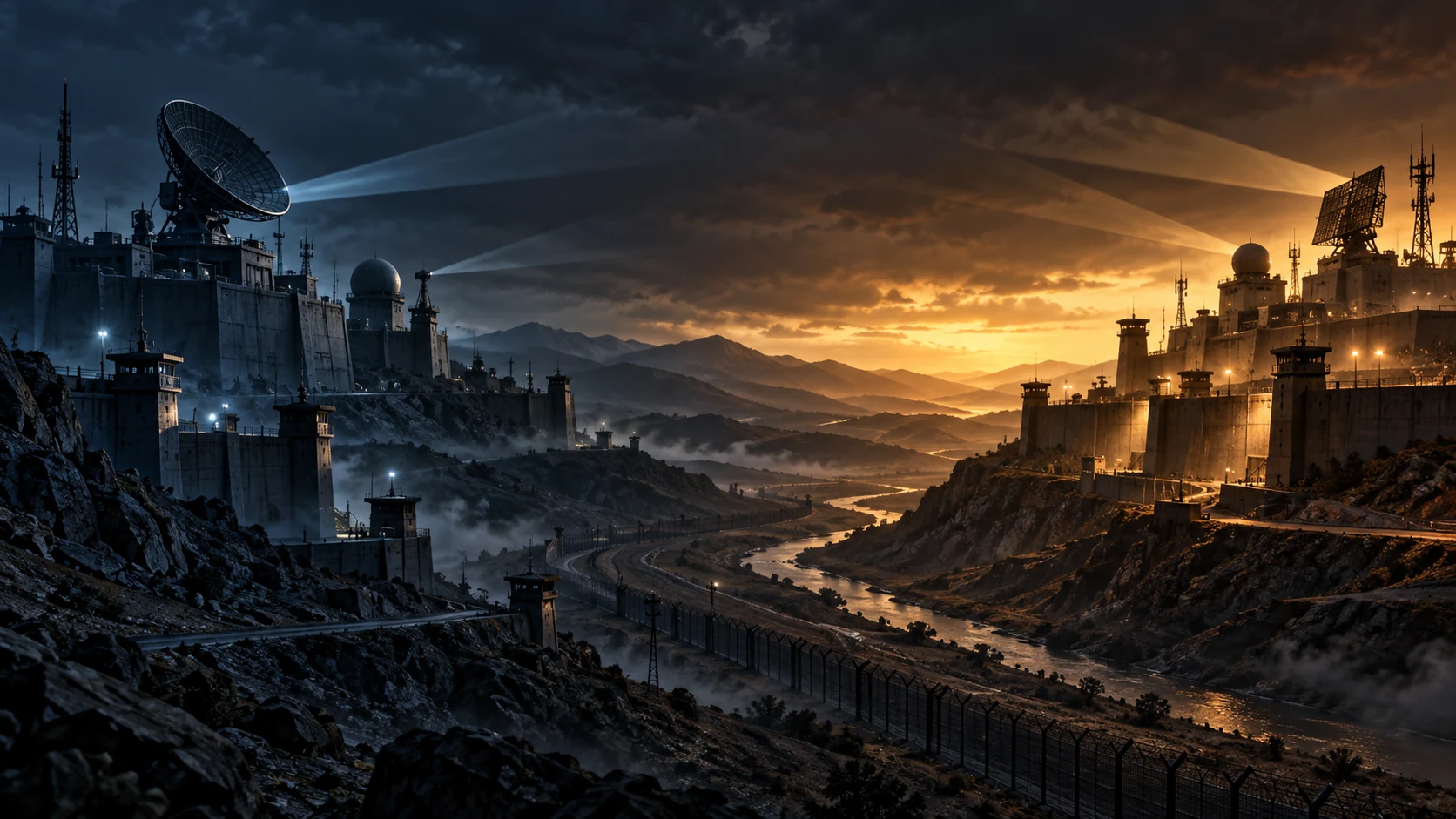
The security dilemma describes one of the most persistent problems in international politics: actions taken by one country to make itself safer can unintentionally make other countries feel less safe. Those countries may respond by strengthening their own military capabilities, which then creates additional insecurity for the original state. The result can be an escalating cycle of suspicion and armament even when none of the governments involved initially intends to start a war.
The problem exists because the international system has no central authority capable of guaranteeing every state's security. Governments cannot rely completely on promises from other countries because political leaders, alliances, military capabilities, and strategic intentions can change. States therefore try to protect themselves by maintaining armed forces, strengthening borders, building alliances, developing new weapons, or positioning military assets in strategically important locations.
From the perspective of the government taking these measures, the logic may be defensive. Leaders may believe they are responding to genuine vulnerabilities or preparing against possible future threats. Neighboring states, however, cannot observe intentions with certainty. They can see new missiles, military bases, troop deployments, defense agreements, or weapons purchases, but they cannot know with confidence how those capabilities might be used later.
This distinction between capabilities and intentions is fundamental. Intentions can change quickly; military capabilities usually take much longer to build. A government that appears peaceful today may become hostile after an election, political crisis, revolution, or change in leadership. For this reason, states often plan not only for what their neighbors say they intend to do but also for what those neighbors could do under less favorable circumstances.
Imagine that one country fears a future attack and increases the number of troops near its border. Its leaders may view the deployment as a purely defensive precaution. The neighboring country sees the same forces and worries that they could be used offensively with little warning. It deploys additional troops of its own. The first country then interprets this response as evidence that its original fear was justified and expands its military position further. Neither side needs to desire war for the cycle to continue.
Weapons technology can intensify this problem when it is difficult to distinguish offensive from defensive capabilities. A missile system intended to deter attack may also be capable of striking enemy territory. An air-defense network may appear defensive but could support offensive operations by reducing the risks faced by attacking forces. Military infrastructure built for protection can sometimes be repurposed for power projection.
The dilemma becomes especially dangerous when military strategy rewards acting first. If leaders believe that waiting during a crisis could leave their forces vulnerable to a devastating initial attack, they may feel pressure to mobilize quickly or even strike preemptively. The fear that an opponent might move first can therefore create incentives for escalation even when both sides would prefer to avoid conflict.
This problem is closely related to the concept of the offense-defense balance. When defensive military technologies and strategies are relatively strong, states may be able to protect themselves without posing severe threats to their neighbors. Fortifications, defensive terrain, or clearly limited weapons can sometimes make intentions easier to interpret. When offensive capabilities appear dominant, however, military preparations may seem more threatening because rapid attack becomes easier.
Geography influences the security dilemma as well. States separated by large oceans or difficult terrain may feel less immediate military pressure than countries sharing open land borders. Strategic depth can give governments more time to respond to an attack. Small states located between larger powers may have less room for error because foreign forces can reach important political or economic centers quickly.
Alliances can reduce insecurity while simultaneously creating new dilemmas. A state threatened by a stronger neighbor may join an alliance to discourage aggression. The alliance increases the weaker state's sense of security because an attack could trigger support from other members. The rival state, however, may see the alliance's expansion or military presence as a threat to its own position and respond with additional deployments or counter-alliances.
Arms races are one possible consequence. When two states repeatedly react to each other's military improvements, defense spending can grow even without a change in underlying political objectives. One side buys more aircraft, leading the other to strengthen air defenses. One deploys new missiles, prompting the other to develop countermeasures. Each step may appear rational when considered individually, but the combined result can leave both countries spending more while feeling less secure.
Nuclear weapons create an especially severe version of the dilemma. Nuclear deterrence depends partly on convincing an adversary that aggression would produce unacceptable retaliation. States therefore seek reliable forces that can survive a first strike. Measures designed to protect those forces, however, can be interpreted as preparations for nuclear conflict. Missile defense, hardened facilities, mobile launchers, submarines, and early-warning systems can all affect how rivals assess the strategic balance.
At the same time, nuclear deterrence can also discourage direct war because leaders understand the extraordinary risks of escalation. The security dilemma does not mean that military competition inevitably leads to conflict. It describes a mechanism through which uncertainty and fear can make cooperation more difficult.
Diplomacy can reduce the dilemma by increasing information and predictability. Military hotlines, advance notice of exercises, arms-control agreements, inspections, data exchanges, and observation mechanisms can help governments understand what others are doing. These arrangements cannot eliminate mistrust, but they can reduce the chance that routine military activity will be mistaken for preparation for attack.
Transparency is helpful but has limits. States rarely want to reveal all their military capabilities because secrecy can itself contribute to deterrence. Governments may also worry that information provided in good faith could later be used against them. Effective confidence-building measures therefore try to create enough transparency to reduce miscalculation without requiring states to expose every vulnerability.
Arms control follows a similar logic. Agreements can limit particularly destabilizing weapons, restrict deployments, or establish verification procedures. Their value often lies not only in reducing the number of weapons but also in making behavior more predictable. When both sides know that certain capabilities are constrained and can verify compliance, uncertainty decreases.
Political communication also matters. Leaders can signal that military actions are limited in purpose, although such statements are most credible when behavior supports them. A country claiming purely defensive intentions while conducting threatening exercises or refusing basic transparency may struggle to reassure its neighbors. Words matter, but observable policies often matter more.
Economic relationships can sometimes moderate the security dilemma by increasing the costs of conflict. Countries that trade heavily with each other may have stronger incentives to preserve stability. Yet economic interdependence does not automatically remove strategic rivalry. Governments may worry that dependence itself creates vulnerability, especially when essential goods, energy, technology, or financial systems are involved.
Historical experience can deepen mistrust. States that have previously fought wars or experienced occupation may interpret military developments through memories of earlier conflicts. Domestic politics can reinforce these perceptions as leaders use historical narratives to justify defense policies. Once public opinion views another state as a serious threat, compromise can become politically difficult even when both sides might benefit from reduced tension.
The security dilemma is therefore not simply a story about aggressive states threatening peaceful ones. It is most useful precisely when intentions are uncertain and several actors are concerned about their own security. A government may behave cautiously from its own perspective while appearing dangerous from another. Understanding this difference does not require accepting every security claim as sincere, but it helps explain why international tensions can grow without a deliberate plan for confrontation.
The broader lesson is that security is relational. A country's safety depends partly on its own military strength, but also on how other governments interpret that strength and respond to it. Building additional capability can deter attack, yet beyond a certain point it may provoke countermeasures that reduce the advantage originally sought. Managing this tension requires deterrence, communication, diplomacy, and sometimes restraint.
The security dilemma remains central to world politics because uncertainty cannot be eliminated. Governments must prepare for risks without knowing exactly what others will do in the future. The challenge is to build enough strength to discourage aggression while avoiding unnecessary signals that convince rivals they must prepare for conflict themselves. International security often depends not only on possessing power, but on managing how that power is perceived.
