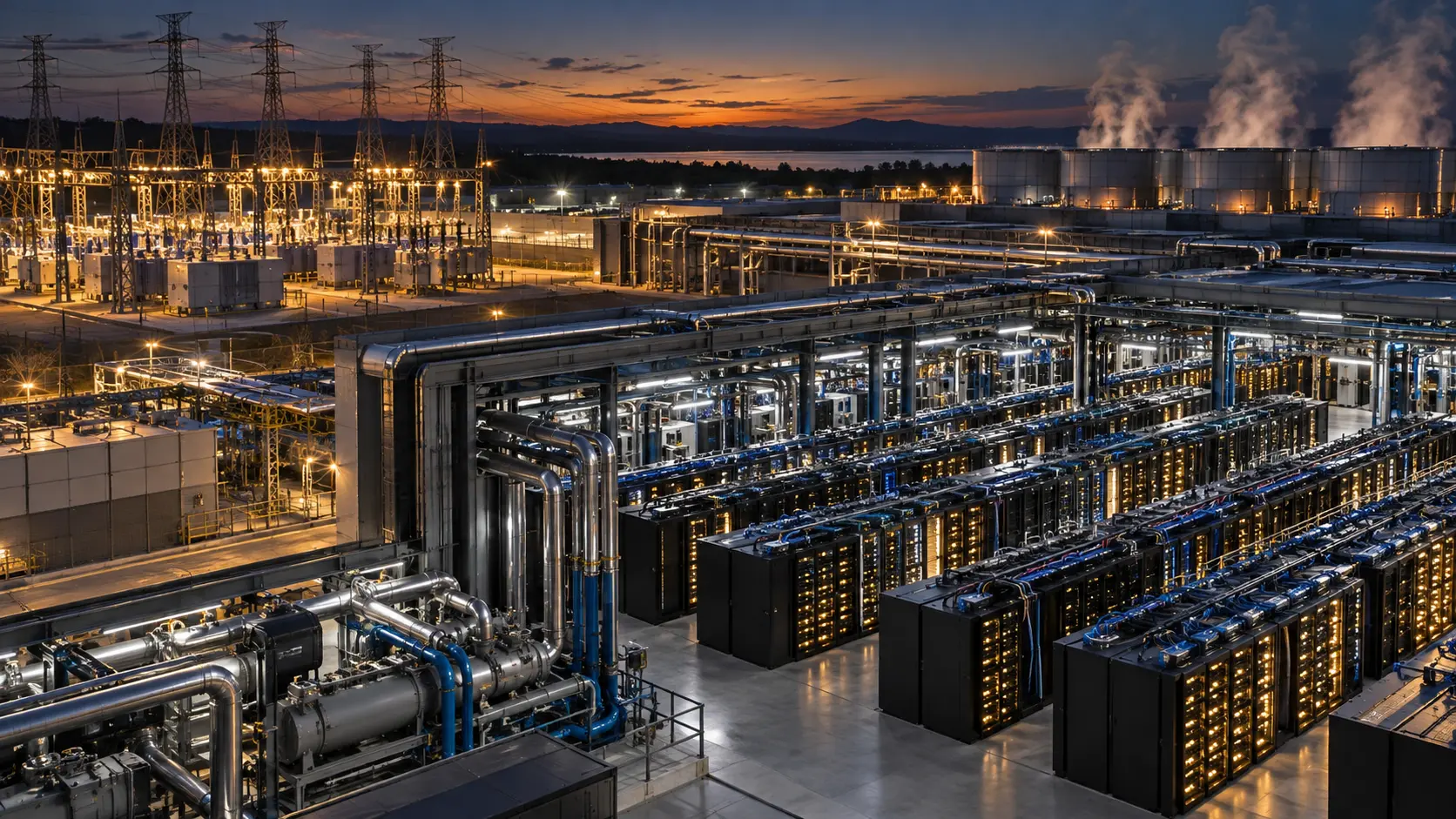
Artificial intelligence can feel like a purely digital technology, but modern AI depends on a large physical infrastructure of chips, servers, data centers, electrical systems, and cooling equipment. Training and operating advanced models requires enormous amounts of computation, and computation consumes energy. As AI systems become larger, more widely used, and more capable of processing text, images, audio, and video, the physical resources required to support them also grow. This is why AI data center energy consumption has become an important issue for technology companies, utilities, governments, and investors.
At the center of this infrastructure are specialized computing chips. Traditional computer processors, known as CPUs, are designed to handle many different kinds of tasks. AI workloads often benefit more from chips optimized for performing large numbers of mathematical operations in parallel. Graphics processing units, or GPUs, became especially important because they can process many calculations simultaneously. Other specialized accelerators have also been developed specifically for machine learning.
Training a modern AI model involves adjusting a very large number of numerical parameters. To do this, the system processes enormous quantities of data and repeatedly performs mathematical operations that compare predictions with expected results. Each training step requires computation, and a large model may go through vast numbers of these operations before training is complete. The process can involve thousands of high-performance chips working together for extended periods.
These chips are usually organized into large computing clusters. A cluster connects many servers so they can share the workload. Training an advanced model on one machine would often be impractical because the task is too large and would take too long. By distributing the work across many processors, companies can train models more quickly, but the total amount of electricity used across the entire system can still be substantial.
The chips themselves are only one part of the energy demand. Servers require memory, storage, networking equipment, and power conversion systems. High-speed networking is especially important because thousands of processors may need to exchange data constantly during training. If communication between machines becomes too slow, expensive computing hardware can sit idle while waiting for information. This is why AI data centers rely on specialized networking technologies as well as powerful processors.
Electricity is also needed to remove heat. Nearly all the electrical energy used by computing equipment eventually becomes heat, and dense AI clusters can generate large amounts of it in a relatively small space. If that heat is not removed efficiently, hardware can overheat, slow down, or become damaged. Cooling is therefore essential to reliable AI operation.
Traditional data centers often use air conditioning and powerful fans to cool servers. High-density AI hardware can require more advanced solutions. Some facilities use liquid cooling, where coolant absorbs heat directly from components or from closely connected equipment. Liquid can transfer heat more efficiently than air, making it increasingly attractive for powerful AI systems.
Cooling systems themselves consume electricity, which means that the energy required by AI infrastructure is greater than the amount used directly by processors. Data centers also need pumps, backup power systems, lighting, monitoring equipment, and other supporting infrastructure. Engineers often measure the overall efficiency of a facility by comparing total data center energy use with the electricity consumed directly by computing equipment.
AI energy use can be divided broadly into training and inference. Training is the process of building or updating a model by exposing it to data and adjusting its parameters. Inference happens when a trained model is used to generate an answer, classify information, create an image, or perform another task. Training can require an intense burst of computing power, while inference can become the larger long-term energy cost if millions of users interact with the model every day.
This distinction is important because a model may be trained only occasionally but used continuously. A popular AI service might answer enormous numbers of requests, each requiring computation. A single request may consume relatively little energy compared with the training of the entire model, but the combined effect of large-scale usage can become significant.
Different AI tasks also require different amounts of computation. Generating a short text response is usually less demanding than producing a high-resolution image or several seconds of video. Video generation is particularly computationally intensive because the system must create and coordinate many frames while maintaining consistency over time. More complex reasoning, longer context windows, and repeated tool use can also increase computing requirements.
Model size is another major factor. Larger models generally contain more parameters and often require more memory and more calculations for both training and inference. However, size is not the only factor that determines energy use. The efficiency of the model architecture, the type of hardware, the precision of calculations, and the quality of software optimization can make large differences.
Developers use several techniques to reduce computing demand. One is to perform calculations using lower numerical precision when full precision is unnecessary. This can reduce memory use and increase processing speed. Another is model quantization, which represents model parameters with fewer bits. Smaller or specialized models can also be used for tasks that do not require the capabilities of the largest available system.
Software optimization matters because inefficient code can waste expensive hardware capacity. Better scheduling, faster communication between processors, improved memory management, and optimized mathematical libraries can all reduce the amount of computing needed to achieve the same result. In large-scale AI systems, even modest efficiency improvements can produce meaningful savings.
The location of a data center also affects energy use and operating costs. Electricity prices vary significantly by region, and cooling requirements depend partly on local climate. Areas with abundant, relatively inexpensive power can be attractive for large computing facilities. Access to transmission infrastructure is equally important because a data center may require more electricity than the local grid can easily supply.
This has made power availability a strategic issue for AI companies. Obtaining enough chips is no longer the only challenge. Companies may also need to secure access to suitable land, electrical substations, transmission capacity, water or alternative cooling resources, and long-term energy contracts. In some regions, the time required to connect a new facility to the electrical grid can become a major constraint on expansion.
The cost of electricity directly affects the economics of AI. High-performance accelerators are expensive, but their value depends on how intensively they can be used. If a company owns a large cluster, it must pay not only for the hardware but also for electricity, cooling, maintenance, networking, and facility operations. These ongoing expenses help explain why access to advanced AI models can be costly.
Computing demand also influences business strategy. Companies may decide which workloads deserve the most powerful models and which can be handled by smaller systems. They may route simple questions to efficient models while reserving larger models for difficult tasks. This kind of workload management can lower costs without necessarily reducing the quality of service for users.
Another important factor is utilization. A data center that contains expensive AI hardware but leaves much of it idle is economically inefficient. Companies therefore try to schedule workloads so that processors remain busy. This can include running training jobs, serving user requests, performing model evaluations, and completing background tasks at different times.
The rapid expansion of AI has increased competition for specialized chips and computing capacity. Leading-edge processors require advanced semiconductor manufacturing, and only a limited number of companies and facilities can produce the most sophisticated chips at scale. This makes semiconductor supply chains an important part of the AI industry.
Access to computing infrastructure can therefore shape technological competition. Organizations with large amounts of capital can purchase or rent more high-performance computing capacity, train larger models, run more experiments, and serve more users. Smaller companies and research institutions may rely on cloud services or shared computing resources because building a private AI data center is prohibitively expensive.
Cloud computing has made access to AI hardware more flexible. Instead of constructing their own facilities, organizations can rent computing capacity from large cloud providers. This lowers the initial investment required to experiment with AI, but it does not eliminate the underlying infrastructure costs. Those costs are reflected in the prices charged for cloud services and AI model access.
Governments have also become more interested in computing capacity because advanced AI has implications for economic competitiveness, scientific research, and national security. Countries with strong semiconductor industries, reliable energy systems, and extensive data center infrastructure may have advantages in developing and deploying advanced AI. For this reason, computing power is increasingly treated as a strategic resource.
The environmental impact of AI data centers depends heavily on how electricity is generated. A facility powered primarily by fossil fuels can produce substantially more greenhouse gas emissions than one supplied by low-carbon energy sources. Companies can reduce emissions by improving efficiency, purchasing renewable energy, locating data centers near cleaner power sources, or supporting the development of additional low-carbon generation.
The relationship between renewable energy and data centers is not always simple, however. AI facilities may operate continuously, while wind and solar generation vary with weather and time of day. Reliable operation may require energy storage, flexible demand, grid connections, or other power sources that can provide electricity when renewable generation is low. Matching round-the-clock computing demand with low-carbon electricity is therefore an infrastructure challenge as well as a purchasing decision.
Water use can also become an issue. Some cooling systems rely on water to remove heat efficiently, and large data centers can consume significant amounts depending on their design and location. In areas where water is scarce, this can create competition with residential, agricultural, or industrial demand. Alternative cooling technologies can reduce water use, although they may involve different costs or energy trade-offs.
It is important not to treat all AI systems as equally energy intensive. A small model running on a personal device uses far less infrastructure than a large cloud-based model serving millions of people. The energy required for a particular AI task depends on model design, hardware, usage volume, response length, and many other variables. Broad claims about the energy cost of “AI” can therefore be misleading unless they specify what kind of system and workload are being discussed.
The industry is also becoming more efficient over time. New generations of chips can perform more AI calculations per unit of energy. Models can be compressed, optimized, or specialized. Data centers can improve cooling and power management. These advances can reduce the energy required for a particular task, although efficiency improvements may be partly offset if overall AI usage grows even faster.
This is a familiar pattern in computing. When technology becomes cheaper and more efficient, people often use more of it. If generating an AI response requires less energy but the number of responses increases dramatically, total electricity consumption can still rise. The future energy footprint of AI will therefore depend on both efficiency and demand.
The growing infrastructure requirements of AI also affect where innovation can happen. Training a frontier-scale model requires resources that few organizations can afford, creating a gap between institutions with access to massive computing clusters and those without it. At the same time, improvements in smaller models and cloud access can make useful AI capabilities available much more widely.
AI data center energy consumption is ultimately a consequence of turning mathematical intelligence into physical computation. Every generated sentence, image, or video depends on hardware performing calculations inside real buildings connected to electrical grids. As AI becomes more capable and more widely used, the demands on chips, electricity, cooling, networking, and data center construction are likely to remain central to the technology's development.
The future of artificial intelligence will therefore depend not only on better algorithms but also on the physical systems that make those algorithms possible. Advances in chip efficiency, energy generation, cooling, software optimization, and data center design may be just as important as improvements in model architecture. The competition to build more capable AI is increasingly also a competition for reliable, affordable computing power and the energy needed to sustain it.