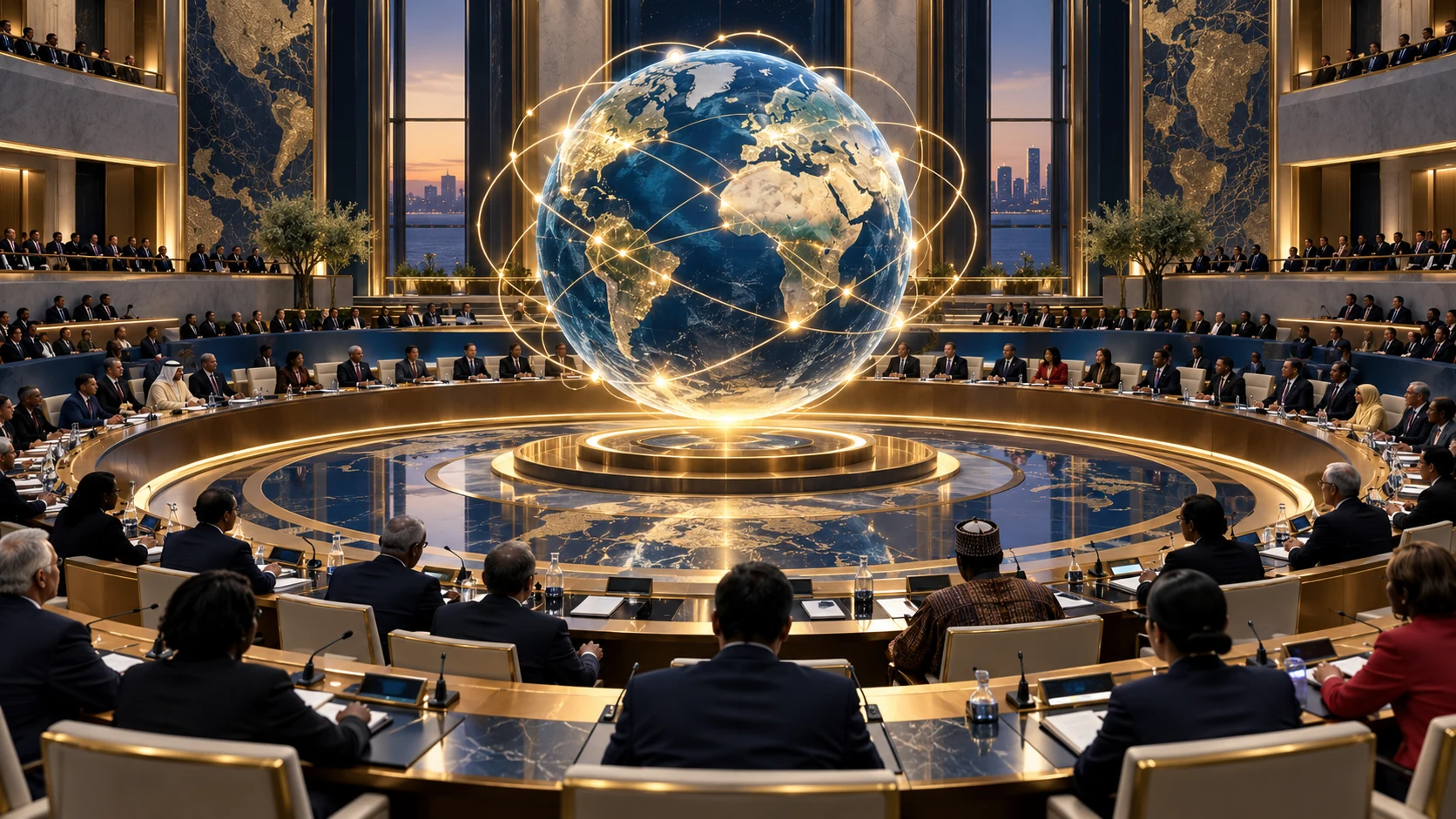
International institutions exist because states repeatedly face problems they cannot solve efficiently on their own. Trade, war, public health, migration, finance, aviation, shipping, climate change, nuclear proliferation, and many other issues cross national borders. Even powerful countries often need information, coordination, common rules, and predictable procedures to manage these problems. Institutions provide frameworks that make cooperation easier, although they do not eliminate conflict or replace state sovereignty.
The United Nations is the most visible example. Created after the Second World War, the UN provides a forum where governments can negotiate, debate international crises, coordinate humanitarian action, support development programs, and establish shared norms. Its importance does not come from functioning as a world government. The UN has no independent authority comparable to that of a national state and depends heavily on member governments for funding, enforcement, troops, and political support.
This distinction is essential for understanding both the value and the limits of international institutions. They can organize cooperation, but they generally cannot force major powers to act against what those governments consider vital national interests. Institutions operate within the international distribution of power rather than above it.
One of their most important functions is reducing uncertainty. Governments frequently need information about what other states are doing, what rules apply, and how commitments will be interpreted. International organizations can collect data, monitor agreements, publish reports, and provide standardized procedures. This makes state behavior more predictable.
Predictability has economic value. International trade works more efficiently when companies know which rules govern tariffs, customs procedures, aviation, shipping, payments, and technical standards. Without common frameworks, every international transaction would require more complicated negotiation and carry greater political risk.
Institutions also reduce the cost of repeated negotiation. If states had to create a new diplomatic process every time a dispute emerged, international cooperation would be slow and inefficient. Permanent organizations provide established meeting places, specialized staff, legal procedures, and technical expertise.
The UN General Assembly illustrates the value of a permanent political forum. Every member state has representation and can participate in debate. General Assembly resolutions are often not legally binding, but they can express broad international opinion, establish political norms, and provide legitimacy for collective initiatives.
The UN Security Council has a different role. It carries primary responsibility for international peace and security within the UN system and can authorize certain binding measures. Its structure reflects the power distribution that existed when the UN was established, particularly through the permanent membership and veto powers of five states.
The veto demonstrates the compromise at the center of the UN system. Great powers were given special influence partly because an organization attempting to impose decisions directly against them might simply be ignored or abandoned. The result is an institution capable of collective action in some situations but often constrained when major powers disagree sharply.
Critics frequently interpret this as institutional failure. In one sense, it is a real limitation: the Security Council may become paralyzed during severe conflicts involving the interests of permanent members. Yet this limitation also reflects the deeper reality that international institutions cannot easily overcome fundamental power rivalry.
Multilateralism extends beyond the UN. It describes cooperation among several states through shared rules, institutions, or diplomatic processes. The World Trade Organization, international financial institutions, regional organizations, development banks, arms-control regimes, and specialized technical bodies all represent different forms of multilateral cooperation.
Many international institutions perform highly technical functions that receive little public attention. International aviation depends on shared standards for navigation and safety. Maritime commerce requires common rules and procedures. Postal services, telecommunications, meteorology, and public health all involve cross-border coordination that would be much more difficult without specialized organizations.
Standardization is especially important. When countries agree on technical rules, companies can operate across borders more easily. Common standards reduce compatibility problems and transaction costs. Although these issues appear administrative, they can have enormous economic consequences.
Institutions also help governments negotiate collective-action problems. Climate change provides a clear example. Individual states may have limited incentives to bear large costs if they believe others will not do the same. International agreements create forums for negotiating contributions, monitoring progress, and building political pressure for participation.
Public health presents a similar challenge. Infectious diseases can cross borders rapidly, which means surveillance, information sharing, research, and coordinated responses have international value. No country can guarantee complete health security by acting only within its own territory.
Peacekeeping is another distinctive institutional function. UN peacekeeping missions can monitor ceasefires, support political agreements, protect civilians under specific mandates, and help stabilize post-conflict environments. Their effectiveness varies greatly depending on the mission, available resources, local political conditions, and cooperation from the parties involved.
International institutions can also provide legitimacy. Governments sometimes prefer to act with broad multilateral support because collective authorization can make policies appear less unilateral. This legitimacy can help maintain coalitions and reduce diplomatic resistance.
Legitimacy, however, is contested. Different governments disagree about whether particular institutions are representative, fair, or dominated by certain powers. Voting structures, funding systems, leadership positions, and historical privileges can all become sources of political disagreement.
Representation has become increasingly important as the global distribution of economic and demographic power changes. Institutions designed decades ago may not fully reflect contemporary realities. Rising powers often demand greater influence, while established powers may resist reforms that reduce their privileges.
This creates tension between effectiveness and representation. Institutions with many members may be more legitimate but harder to coordinate. Smaller groups may make decisions more quickly but exclude important countries. There is no perfect institutional design that solves both problems simultaneously.
Regional institutions offer one alternative. Countries in the same geographic area often share economic, political, and security concerns. Regional organizations can address trade, infrastructure, conflict resolution, migration, and regulatory coordination among states with closer connections.
Informal groups also play a major role. Governments sometimes prefer flexible forums without permanent bureaucracies or legally binding rules. These arrangements can adapt quickly to new problems, although they may lack the institutional continuity of formal organizations.
International law interacts with institutions in complex ways. Treaties create obligations that states agree to accept, and institutions may help interpret or monitor those commitments. Yet enforcement ultimately depends heavily on state cooperation. International legal systems are therefore different from domestic systems backed by centralized police and courts.
The absence of a world government does not mean international rules are meaningless. States often comply because predictability benefits them, because they value their reputation, because agreements are reciprocal, or because violations may provoke political or economic costs. Powerful states sometimes violate rules, but they also frequently rely on the same rules in areas where cooperation benefits them.
Institutions can also shape expectations over time. Repeated cooperation may normalize certain behaviors and make alternatives appear more costly or illegitimate. This is one way international norms develop. Rules against particular weapons, protections for diplomats, and common expectations about sovereignty have all been reinforced through institutional practice.
Great-power competition places these mechanisms under pressure. When major states believe an institution is being used against their strategic interests, they may block decisions, create alternative organizations, reduce funding, or ignore unfavorable rulings. Institutional fragmentation can therefore reflect broader geopolitical fragmentation.
At the same time, rivalry can increase the need for institutions. Competing powers still require communication channels, crisis-management mechanisms, arms-control discussions, and basic economic coordination. During periods of tension, institutions may be most valuable precisely because trust between states is low.
International institutions should therefore not be judged by whether they eliminate international conflict. No realistic organization can remove the underlying differences in power, interests, geography, ideology, and security that drive state competition. Their more realistic function is to make some forms of cooperation easier and some forms of conflict more manageable.
They can provide information where uncertainty would otherwise dominate, rules where repeated negotiation would be costly, and forums where governments can communicate even during serious disputes. They can coordinate humanitarian action, establish technical standards, monitor agreements, and give smaller states opportunities to participate in international decision-making.
Their effectiveness depends on political support. Institutions function best when influential states believe continued cooperation serves their interests. When that support disappears, institutional authority weakens.
This does not make international institutions irrelevant. It means their power is conditional. They are tools through which states organize cooperation, not substitutes for politics itself. Their importance lies in helping governments manage a world in which countries remain sovereign but increasingly depend on one another.
The persistence of international institutions reflects this practical need. States may disagree intensely about security, trade, territory, or ideology, yet they still require common procedures for aviation, finance, public health, communications, development, humanitarian relief, and diplomacy. Institutions matter because interdependence creates problems that unilateral power alone cannot solve efficiently, even in an international system where competition remains unavoidable.
